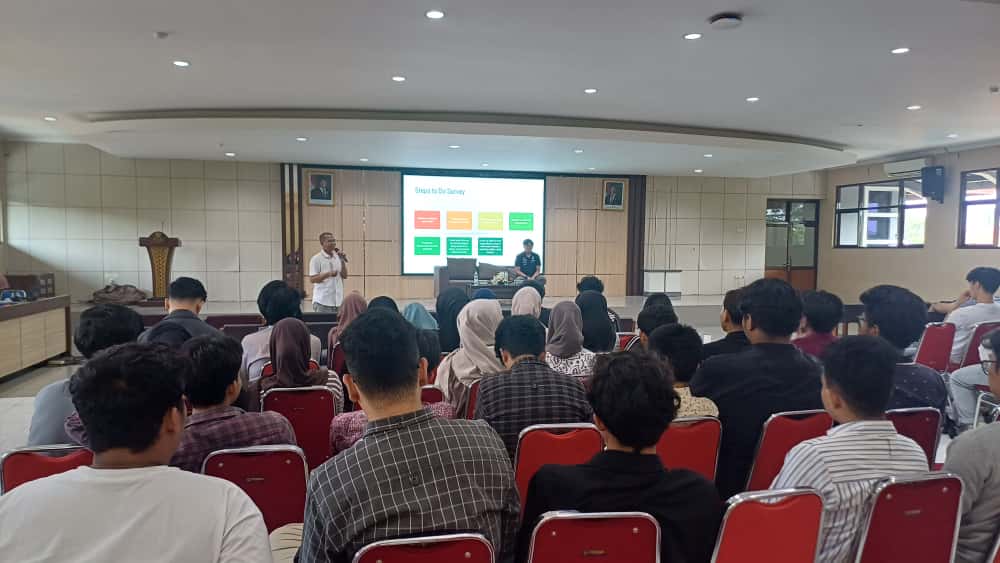
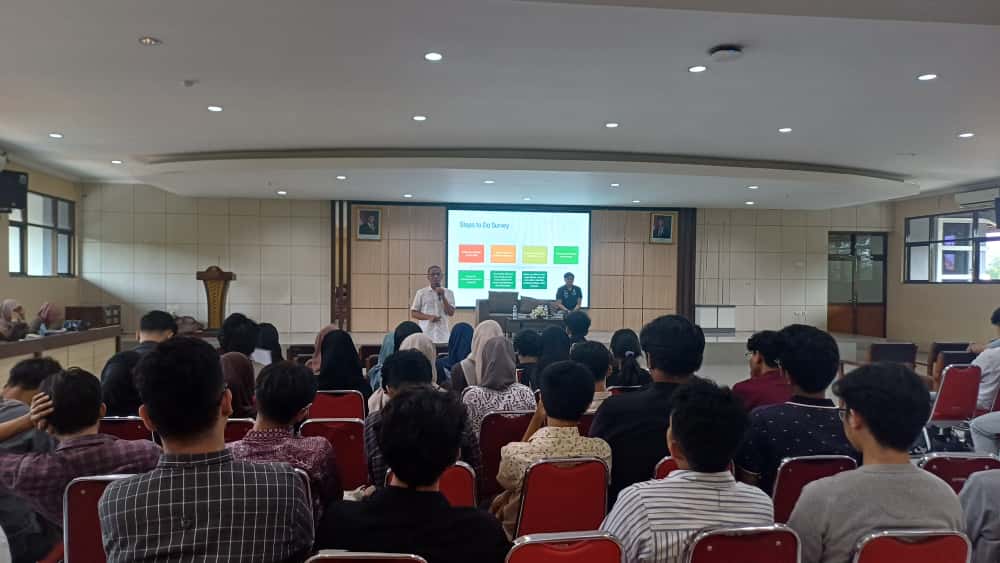
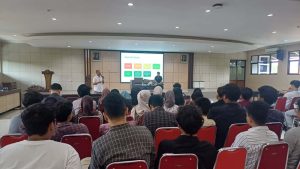
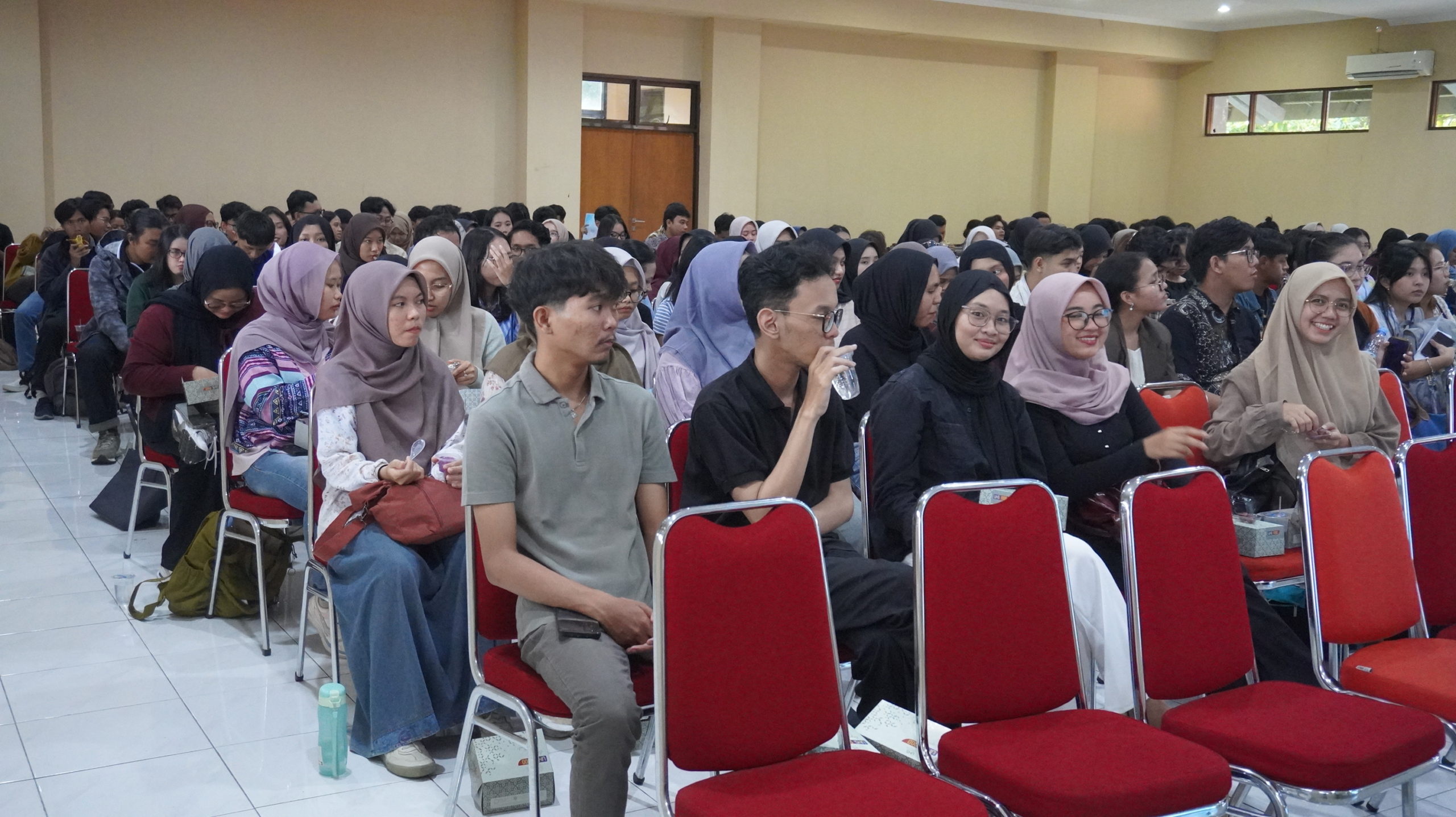
More than 100 students from the Digital Business Study Program, Faculty of Economics and Business (FEB), Universitas Sebelas Maret (UNS), took part in a public lecture entitled “Quantitative Research: Survey and Questionnaire Design” held at the Soedarah Soepono Hall, FEB UNS, on Wednesday, 15 October 2025. The event was officially opened by Tastaftiyan Risfandy, S.E., M.Sc., Ph.D., Vice Dean for Academic and Student Affairs, and featured Zamroni Salim, Ph.D., Head of the Macroeconomics and Finance Research Center, National Research and Innovation Agency (BRIN), as the keynote speaker.
 In his material presentation, Dr. Zamroni provided a comprehensive overview of quantitative research methodology, covering survey techniques, questionnaire development, and field observation. He explained that surveys are essential tools for gathering both quantitative and qualitative data that are specific and relevant to research objectives. He further emphasized that well-designed questionnaires are crucial to ensure research validity and reliability.
“Questionnaires must be constructed with clear research objectives, precise wording, and strong data protection measures,” he stated. He highlighted the importance of confidentiality and privacy principles in line with modern research ethics.
The lecture also outlined different types of survey questions, including open-ended, closed-ended, and Likert scale questions. Dr. Zamroni discussed how to select appropriate question types and avoid common mistakes such as double-barreled questions and ambiguous phrasing.
Additionally, students were introduced to the importance of pilot testing research instruments before large-scale implementation. The pre-test phase ensures that respondents can clearly understand the questions and helps improve both the structure and flow of the questionnaire.
This activity is expected to enhance the data-driven research skills of Digital Business students, a key competency in the digital economy era. By mastering survey techniques and questionnaire design, students can produce research that is not only relevant to academic development but also impactful for society.
Aligned with the Sustainable Development Goals (SDGs), particularly Goal 4 (Quality Education) and Goal 9 (Innovation and Infrastructure), this public lecture represents FEB UNS’s concrete step in supporting the development of ethical, evidence-based research and innovation that contributes to sustainable development.
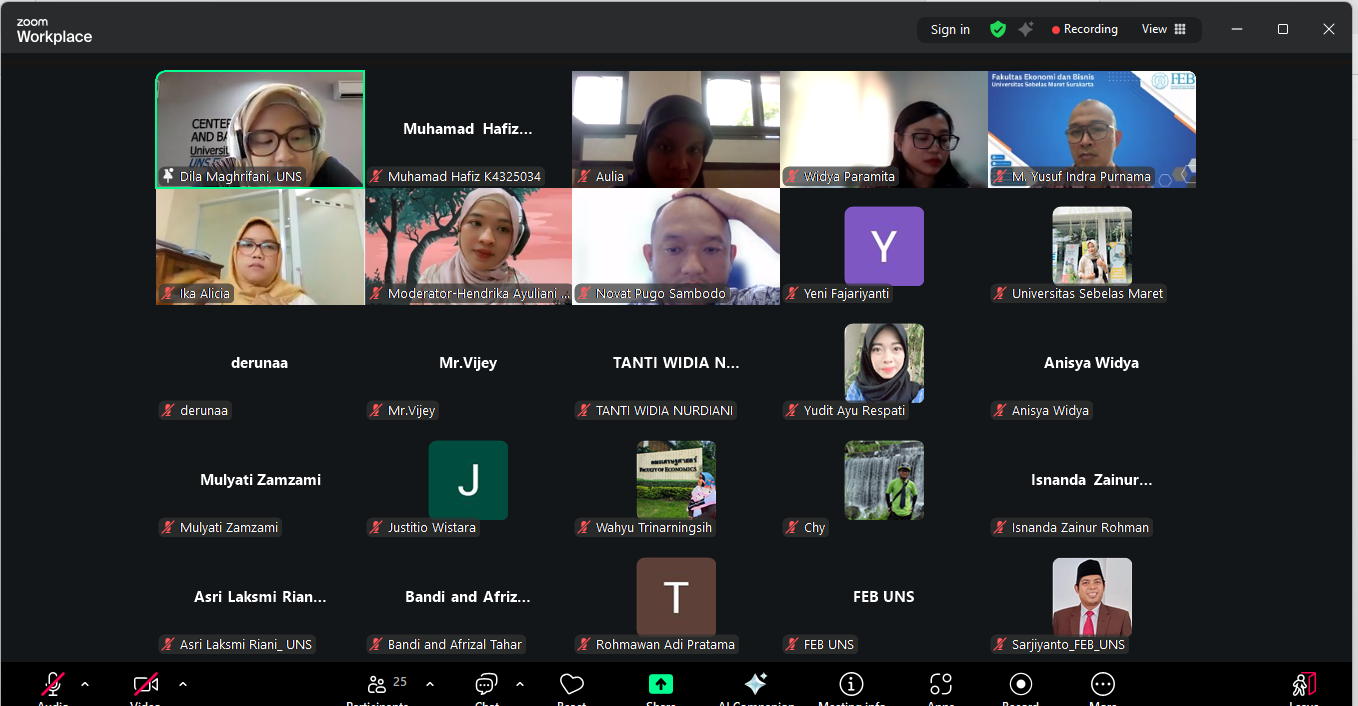
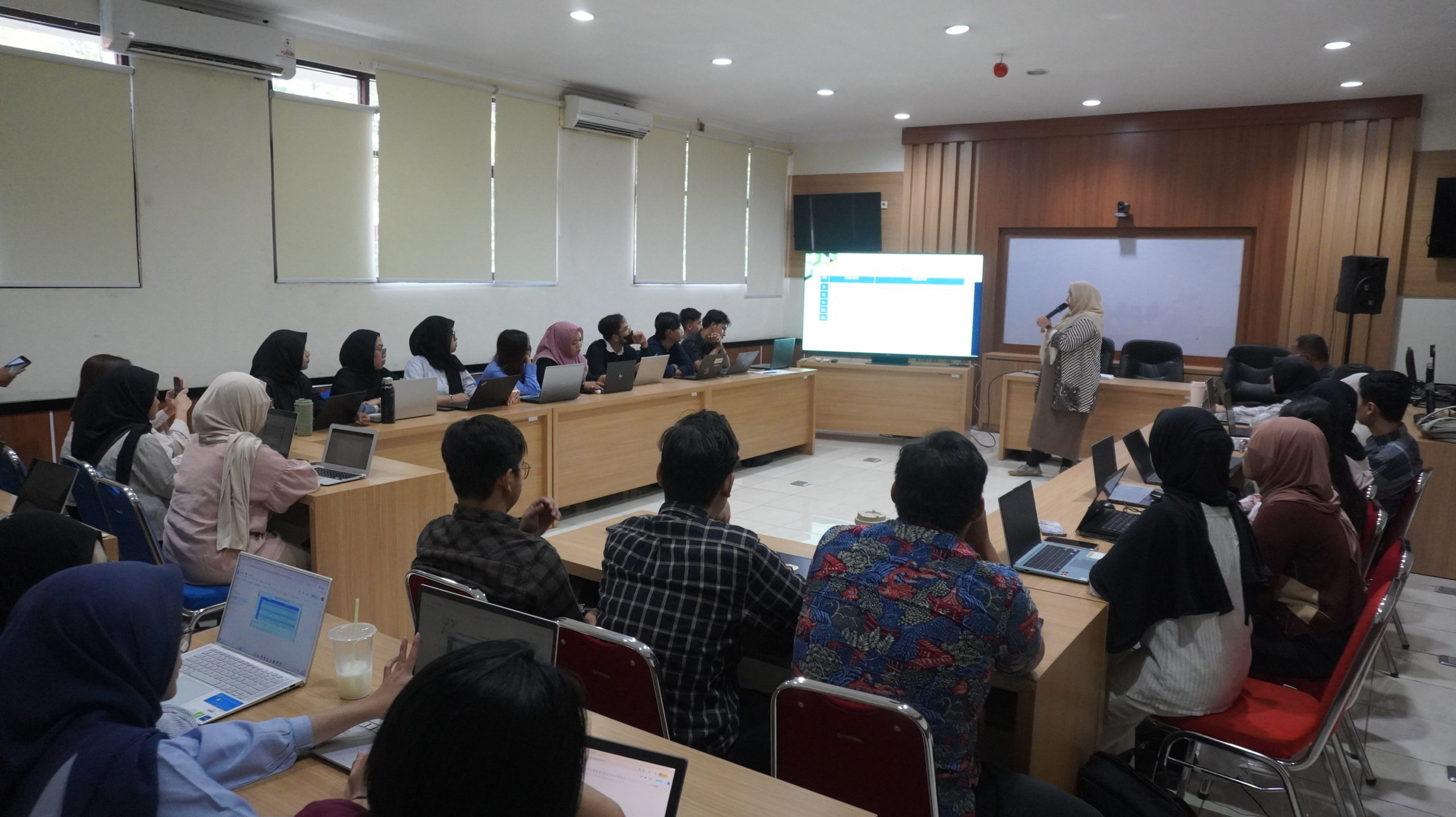
 The program began with two days of intensive training on 13–14 October, followed by a competency certification assessment by the National Professional Certification Agency (BNSP) on the third day, 15 October 2025.


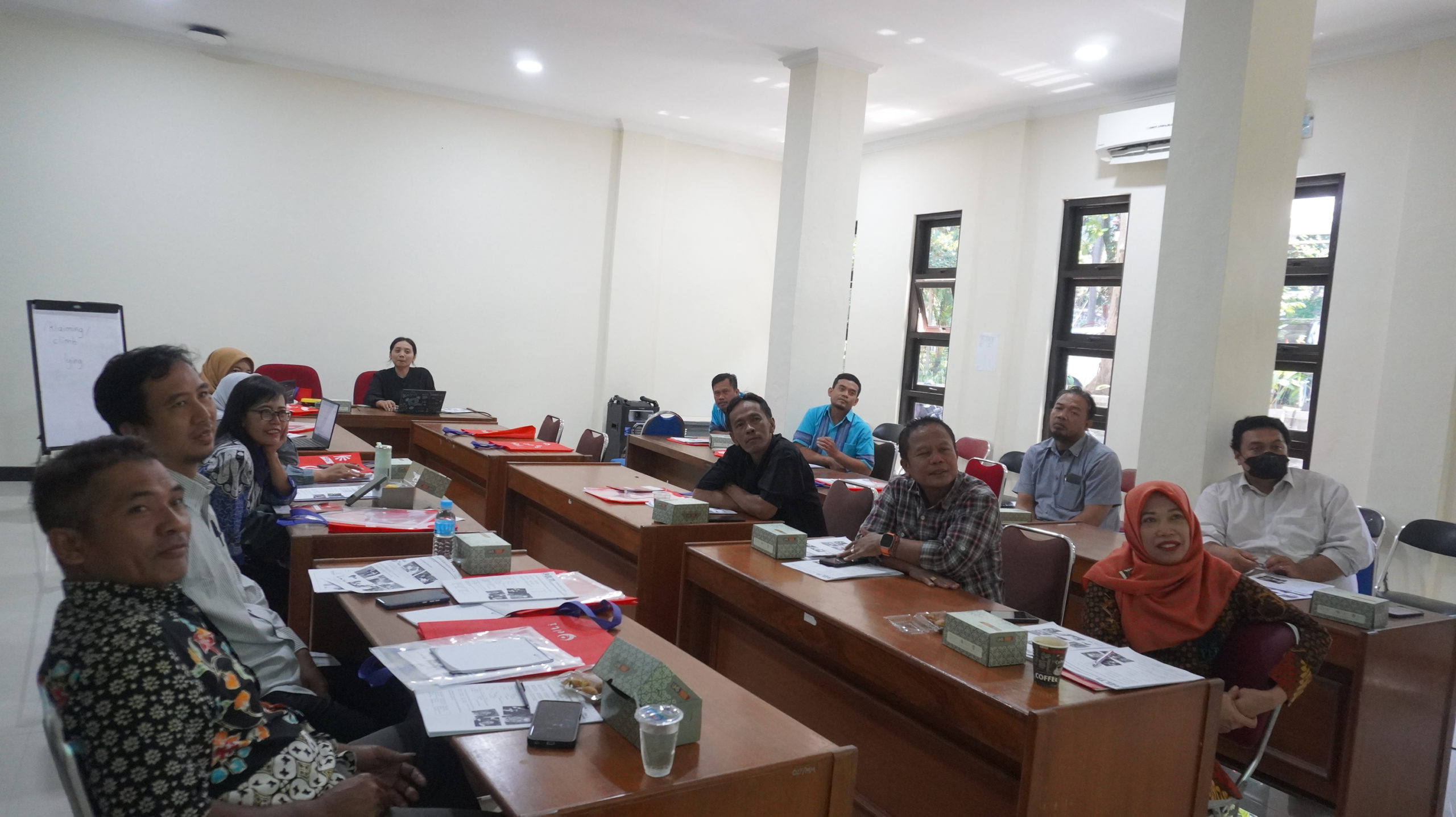
 The training took place over three days on 7, 9, and 14 October 2025 at Meeting Room 2, Soeharno TS Building, 1st Floor, FEB UNS. Academic Support Staff from various units across FEB UNS participated in two sessions of the workshop.

 He also encouraged staff to use technology to support their language learning process, such as translation applications and digital assistants. “Many tools are available now, from translators to AI tools. What matters most is the willingness to try and get used to it, because without practice, the skill will fade,” he added.
 He also shared plans to conduct regular training sessions for Academic Support Staff every quarter, covering various themes such as public speaking, work ethics, and public service improvement, as part of the faculty’s commitment to strengthening human resource capacity.
 Vice Dean for Student and Alumni Affairs FEB UNS, Tastaftiyan Risfandy, S.E., M.Sc., Ph.D., in his opening remarks, highlighted the importance of student readiness in facing an increasingly competitive job market. “You are now at the final stage of your campus life. It’s natural to feel both eager to graduate and anxious about entering the workforce. Securing a job is not easy; it takes time and preparation. Today, you will learn directly from practitioners about what companies truly expect from fresh graduates,” he stated.
 He further outlined Pertamina’s commitment to creating an inclusive work environment through the Respectful Workplace Policy, which ensures a workplace free from discrimination, violence, and harassment. Pertamina is the first state-owned enterprise to launch official guidelines on diversity, equity, and inclusion (DEI), with 20% female employees and 19.24% women in leadership positions as of Q1 2024.