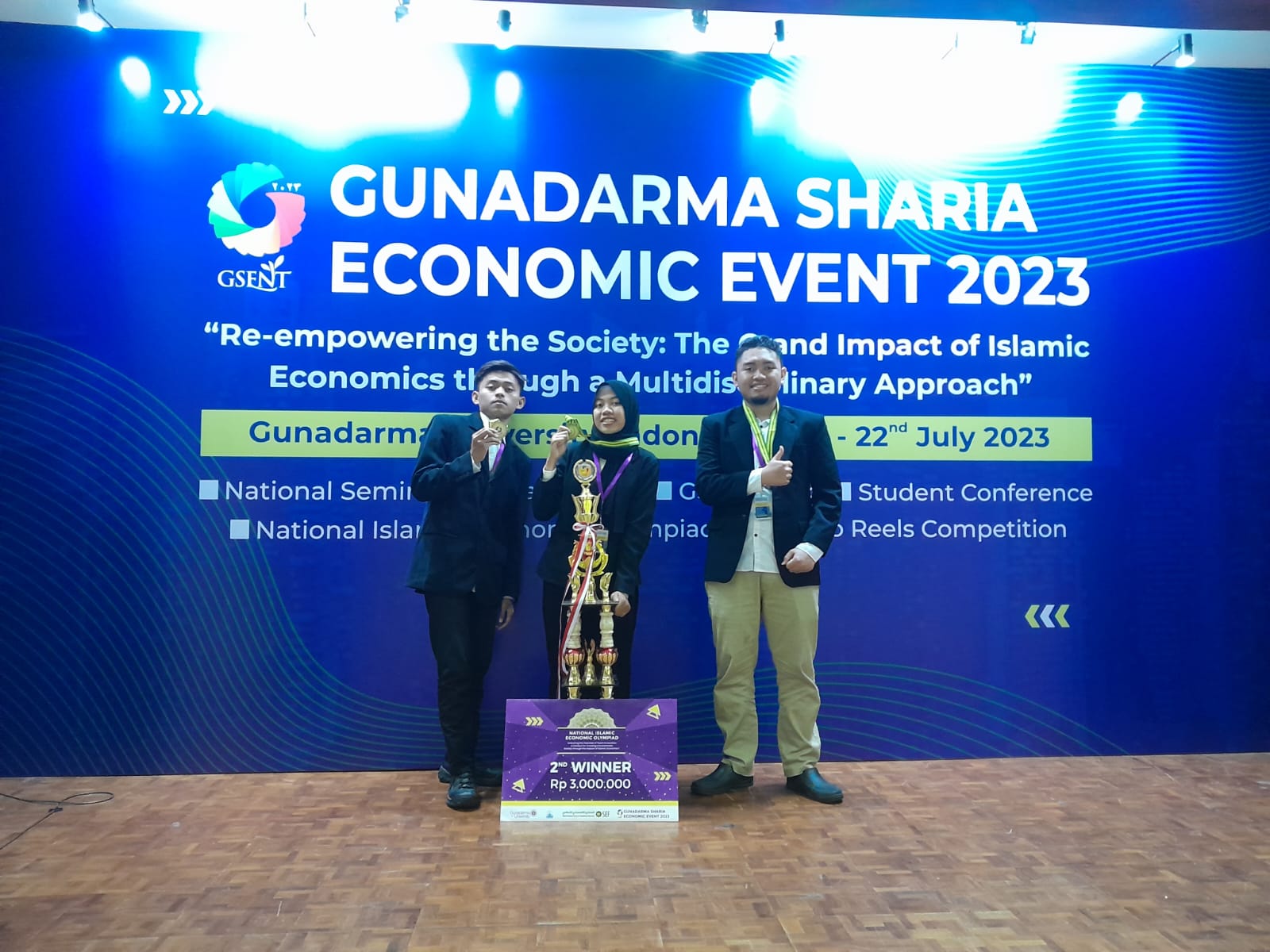
A Team of the Faculty of Economics and Business (FEB) Universitas Sebelas Maret (UNS) students, won 2nd place in the National Islamic Economic Olympiad, held at Gunadarma University, 18-22 July 2023. The collaboration of three FEB students, Novita Anggun Pratiwi (S1 Management Study Program), Fathir Faiq Aqil Murtadlo (S1 Development Economics Study Program), and Fathir Fikro Al Ishlah (S1 Development Economics Study Program), led the three to achieve the victory.
 There are 50 teams from universities in Indonesia competing in the preliminary round, and 12 teams qualify for the semi-final round. Out of these teams, there are only 4 teams competing in the final round. Proposing an innovation entitled ‘Sharia Financial Services Cooperative Program Indonesia Berdaya Ukhuwah,’ derived from the three members’ idea, the team was able to attract the attention of the jury.
The idea developed by Novita and her colleagues took a modification of the Grameen Bank that had been carried out in Bangladesh, initiated by Muhammad Yunus.
“We are interested in highlighting the issue of poverty in Indonesia, which remains to this day. Grameen Bank is one of the concepts initiated by Muhammad Yunus in Bangladesh to alleviate poverty. Grameen Bank is only intended for women with the aim of minimizing poverty. This idea was modified by directing it to a group of peasant women in Karanganyar Regency,” explained Novita, the Leader of the FEB UNS Team in the National Islamic Economic Olympic.
Previously, PPK Ormawa BEM FEB UNS organized a community service program at the Karanganyar Regency Farmers Women’s Group and focused on MSMEs. The idea proposed by Novita and the Team focused on a type of financing for women farmers of Karanganyar Regency, by adhering to the principles of sharia, with a system based on members’ trust. The main goal is to alleviate poverty in Karanganyar Regency.
Later, this group of peasant women will form an association like the PKK. When the farmer group needs financing from KJKS (Sharia Financial Services Cooperative), they only need to fulfill the applicable prerequisites.
This initiative proposed by the FEB Team, which is strengthened by presenting and supporting evidence, is considered by the jury as a good program idea and is expected to be implemented in the future.

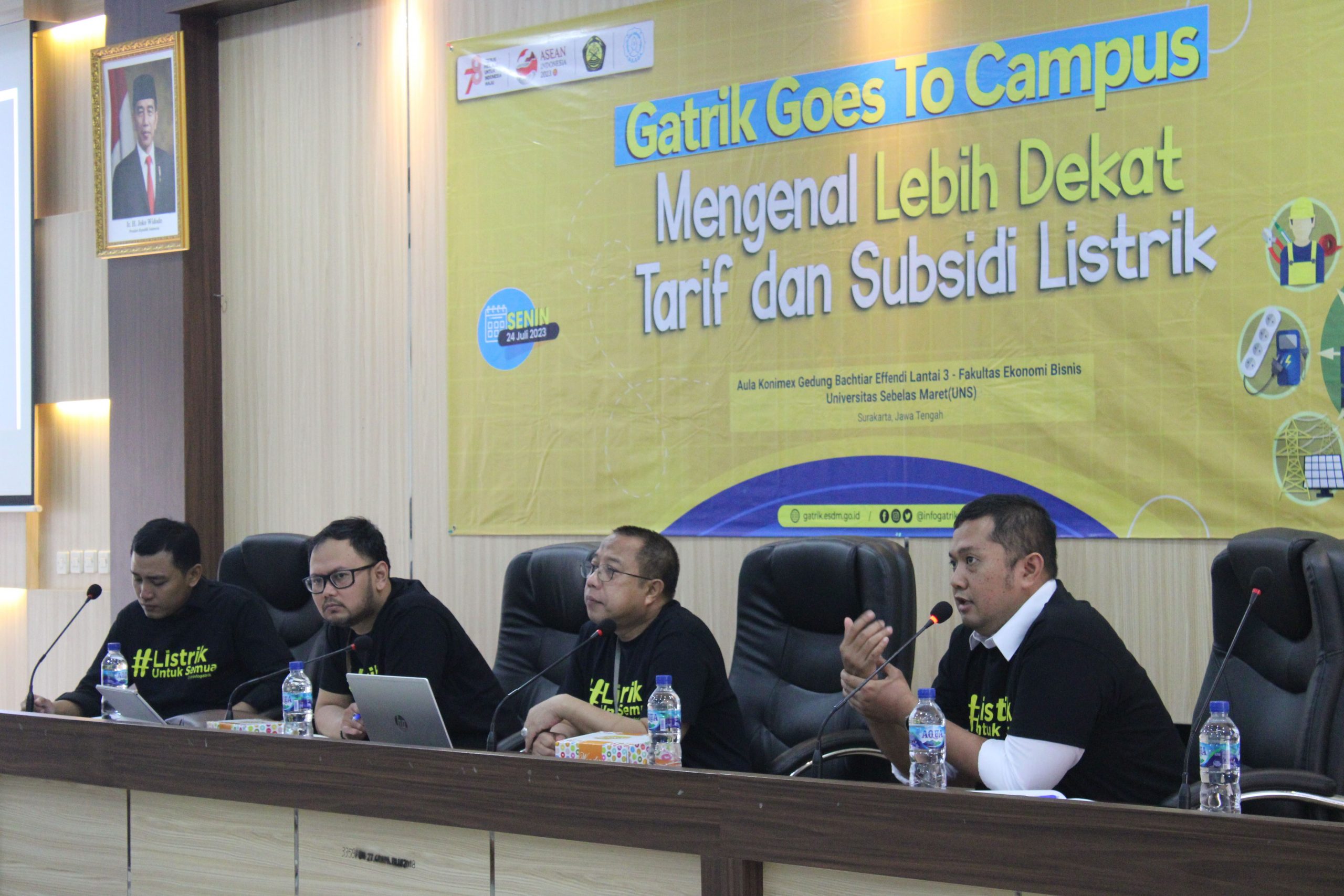

 Furthermore, it is said that there are approximately 83 million electricity customers, almost half of which get subsidies. There are 38 types of customers. Out of the 38 customers type, 25 customers are still subsidized and 13 are not. But every 3 months there is a tariff adjustment and if Gatrik does not adjust the tariff, then the government will provide compensation. Both subsidies and compensation are a burden on the government finance.
 The Tariff adjustment policy is determined by the Board of Directors of PT PLN (Persero) after obtaining the approval of the Minister. Tariff Adjustment itself is applied to non-subsidized customers every three months due to several uncontrollable factors (exchange rate, inflation, ICP, and coal prices). Tariff Adjustment is a national-scale policy, a crucial, strategic, and has a broad impact on the community, thus in its own discussion, it is carried out at the Plenary Cabinet Session or Limited Meeting.
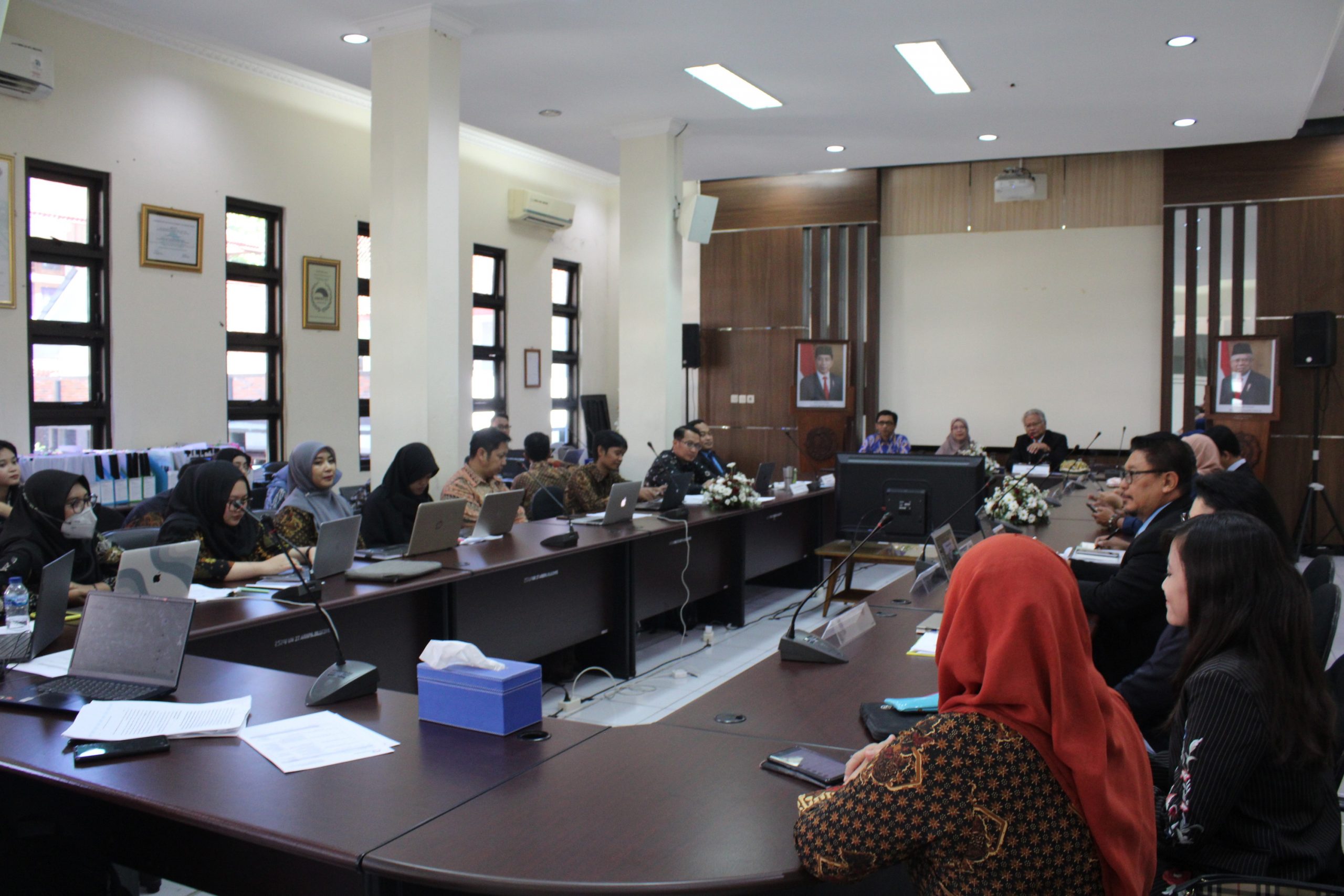


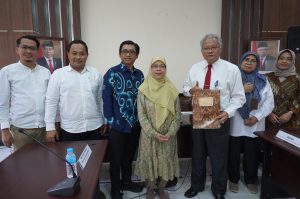
 Meanwhile, Dr. Wuryan emphasized that the purpose of both assessor’s visit to UNS is not to audit and shall not be feared, because they only confirms the information reported in the DED and the DKPS. She said that the purpose of accreditation is for the university to make continuous improvements to provide better education and professional services. Dr. Wuryan is confident that Prof. Djoko as the FEB UNS Dean and some LAMEMBA Assessors at UNS know what tasks the assessors have to do.
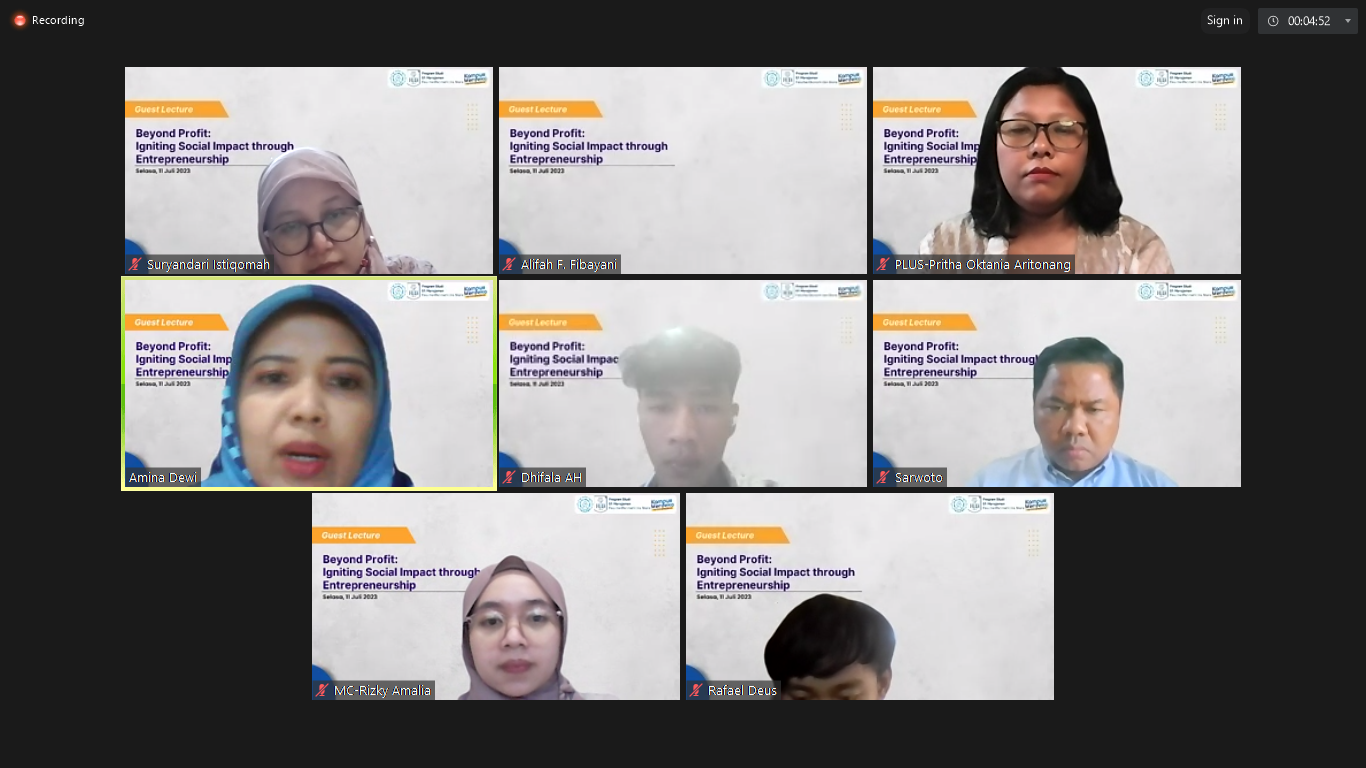
 Opening the guest lecture session, Dr. Atmaji, MM., Head of the Management Study Program, delivered an opening remark as well as officially started this guest lectures session. Through his speech, Dr. Atmaji expressed his gratitude and wishes, especially to Mrs. Pritha who has been willing to take her precious time for delivering some insights, at the same time hoping that the material will enlighten PSM FEB UNS students on the current condition of social entrepreneurship.
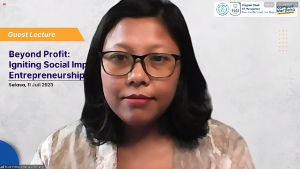 In Indonesia, there is an increasing trend in the number of social businesses with the number of businesses established reaching almost more than 100 businesses in 2017. The majority of these businesses are engaged in the field of creative industries, followed by the agricultural and fisheries sectors, as well as education. However, according to data presented by Pritha, the distribution of social business is still centralized on Java. Where the majority of social entrepreneurs (47%) stated that the most frequent challenge faced was the lack of capital. In addition, they also stated that there are still difficulties in accessing funding sources and difficulties in improving managerial skills.