FEB

Kategori: faculty

  • 267 Prospective Students of FEB UNS, Register On-desk

    267 Prospective Students of FEB UNS, Register On-desk

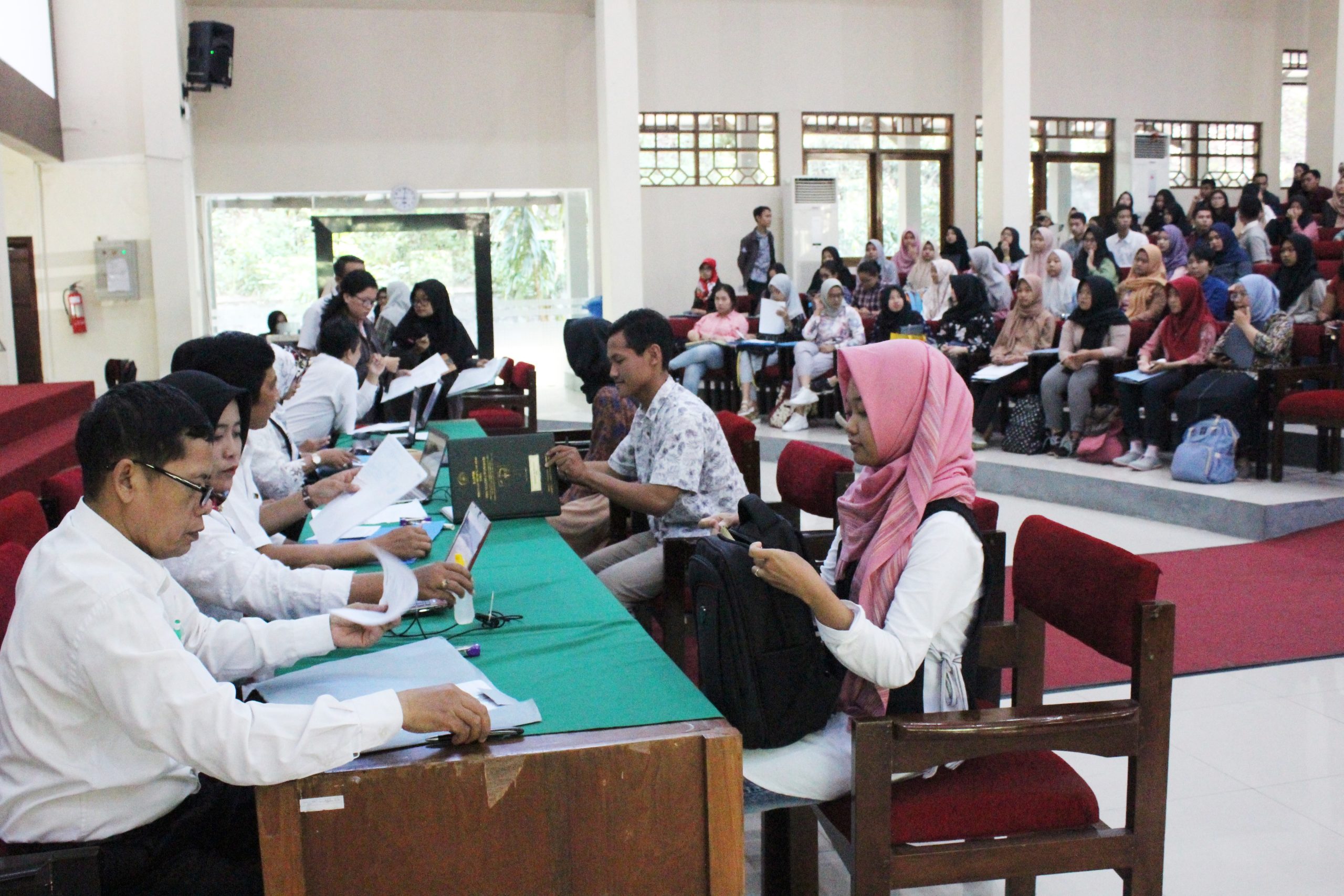
    The on-desk registration for the students who passed the undergraduate program selection (SNMPTN) and Diploma program selection (PMDK) in FEB UNS is conducted on Monday May, 20th 2019 in FEB UNS Hall 3rd Building. In total there are 267 (two hundred and sixty-seven) applicants who attend the on-desk registration that consist of 124 applicants for diploma program and 143 applicants for the undergraduate program. From the total applicants, there are 4 (four) applicant who are Hafidz Qur’an and 43 Bidik misi awardee.

    The applicants are required to hand over documents such as pass photo, tuition fee payment slip, statement of parents’ income, letter form doctor’s examination, and online registration print-out. Other documents such as original High school certificate, Certificate of Graduation, as well as achievement certificate is only shown to the registration officers.

    Nur Hariawan as the Head of Academics Unit FEB UNS in his opening remarks congratulate the participants who has passed the selection process and reach the registration stage. He also explains the stage of registration in FEB UNS that should be followed by the participants. “For those who cannot fulfil the registration requirement (supporting documents) are given the opportunity to complete the required document on the next day. The document should be submitted to the FEB UNS Academic Service Office or can be posted to the Head of Academic Unit of FEB UNS for those who live outside of Solo.”

    The new students’ inauguration ceremony will be held on August 15th, 2019, starts from 7 am, in front of the Dr. Prakosa Building UNS. For the ceremony the students should wear all white attire (white blouse and white skirt or trouser) and wearing UNS alma mater jacket.

    Humas FEB


  • For the Development of Hajj Fund, the Hajj Financial Management Agency (BPKH) Establish a Partnership with FEB UNS

    For the Development of Hajj Fund, the Hajj Financial Management Agency (BPKH) Establish a Partnership with FEB UNS

    The Hajj Financial Management Agency (BPKH) is an agency established by the President of the Republic of Indonesia to manage the hajj financial affairs covering income, development, expenditure, and accountability.

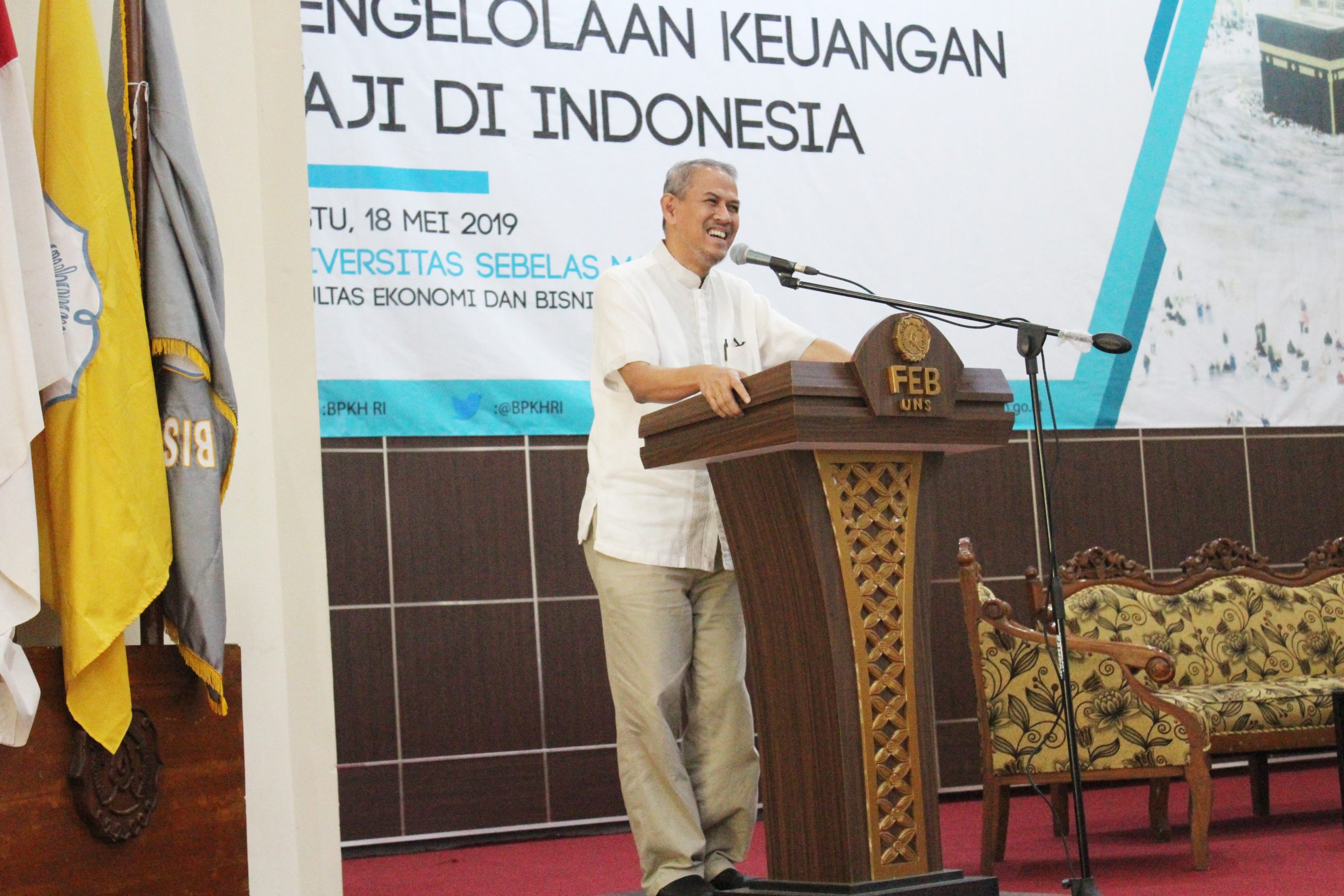
    “BPKH, which established in 2017, is responsible for the management of hajj funds derived from the pilgrims who has paid for the initial deposit, all the hajj funds is managed and used to provide pilgrimage services,” said Anggito Abimanyu as the Head of BPKH during the Seminar of Hajj Financial Management in FEB UNS on May, 5th 2019.

    “The total of Hajj funds as in December 2018 is 113 trillion Rupiah, and this number is keep increasing. This encourage us to consider future use and development of these funds,” he adds.

    Anggito hopes there will be a partnership between BPKH and FEB UNS to establish a research institution to study the utilization and development of Hajj funds. Research on the development of hajj funds that can be explored for further partnership and collaboration are including direct investment, securities, banking products, exchanges rate, management efficiency, and various other topics.

    Anggito also mentions that to date, the hajj funds that transferred to Saudi Arabia are amounted to 15 trillion Rupiah, thus we need to find a method to promote Indonesian product to enter Saudi’s market. “For instance, the prayer beads, worship clothes, and slippers sold in Saudi are not Indonesia product, this is a great opportunity for Indonesia’s product to penetrate Saudi’s market.”

  • UNS is Assessed by AUN-QA for the Second Time

    UNS is Assessed by AUN-QA for the Second Time

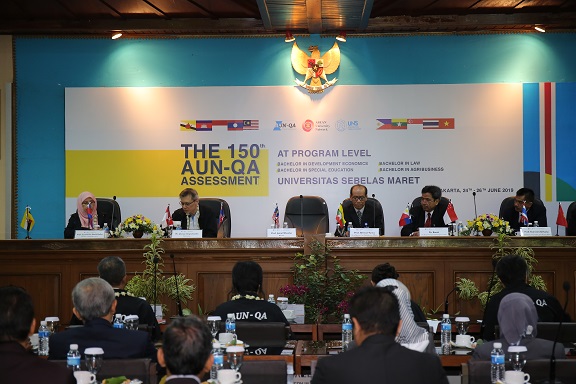
    The assessor team of the ASEAN University Network Quality Assurance (AUN-QA) appreciate the Universitas Sebelas Maret (UNS), especially for the assessed study programs on June 24th to 26th 2019. This was mentioned by the Vice Rector of Academic Affairs, Prof. Dr. Ir. Ahmad Yunus, MS, after the closing meeting on Wednesday, June 26th, 2019 in Dr. Prakosa Building UNS.

    The 150th AUN-QA Assessment at Program Level is the second assessment at program level by the AUN-QA for the study programs in UNS, after the first assessment conducted in 2018 for 4 (four) study programs namely, the Study Program of Bachelor in Management, Bachelor in Mechanical Engineering, Bachelor in Civil Engineering, and Bachelor in Biology. All the study programs are successfully accredited and certified by the AUN-QA.

    From the assessment result, Prof. Yunus is optimistic that UNS will obtain the certification for the four study programs being assessed this year. “This is the second opportunities for UNS to obtain an acknowledgement from an international accreditation organization at ASEAN level, thus UNS will be on the same level with other advanced study programs in ASEAN,” he explained. Further, he mentions that the assessor team found several areas of improvements for each study program. However, in general the assessment shows a positive result.

    Prof. Yunus congratulate the four study programs assessed on this opportunity, they are the Study Program of Bachelor in Development Economic, Bachelor in Special Education, Bachelor in Law, and Bachelor in Agribusiness, for conducting a series of activities in the 150th AUN-QA Program Assessment. He also expresses his gratitude to the Faculty of Economics and Business (FEB) for organizing the site visit and coordinating the whole assessment process.

    The assessment process took 3 (three) days to be completed. On the first day, Monday June, 24th 2019, the assessor team is welcomed by the Rector of UNS, Prof. Dr. Jamal Wiwoho, S.H., M.Hum, together with the Rectorate Officials, the Deanery of the assessed programs, and the Self-Assessment Report (SAR) Team from 4 (four) study programs, followed with Gambyong dance. This was followed with an Opening meeting. After the Opening Meeting the assessors follow an University site visit to several facilities such as Central Library, International Office, Taiwan Centre, UNS Museum, Medical Centre, Pusbangnis UNS, UNS Hospital, and UNS Medical Centre.

    The next assessment process after the University level site visit is centralized in FEB UNS and is conducted separately for each study program. Each study program is assessed by two assessors. Johnson Ong Chee Bin and Prof. Dr, Aleth Therese L. Dacanay serve as the assessor for the Bachelor in Development Economic; Prof. Dr. Suzeini Binti Abd Halim and Mrs. Siriluck Kiewkong as the assessor for Bachelor in Law; Assoc. Prof. Dr Kamulwan Lueprasert and Prof. Dr. Irfan Naufal Umar as the assessor for the Bachelor in Special Education; and lastly Assoc. Prof. Dr. Amalina M. Afifi and Asst. Prof. Dr. Thasaneeya Ratanaroutai Nopparatjamjomras as the assessor for the Bachelor in Agribusiness. The assessment process is accompanied by the Secretary of AUN-QA, Mr. Korn Ratagosoom.

    The assessors conduct several interviews with the Deanery, SAR Team, Academic staff, Support staff both at Faculty and University level, students, alumni, and user. All the interviews were conducted in consecutive manner. In between the interviews process, the assessors also conduct a Faculty level site visit. In FEB UNS there are some facilities visited by the assessors such as Students Activity Unit Room, Internship and Career Development Center, Computer Laboratory, Banking Simulation Laboratory, Export and Import Laboratory, Investment Gallery Room, and Teacher’s Transit Room.

    The Chief Assessor Johnson Ong Chee Bin expressed that he impressed with how the Assessment in UNS is being organized. “Since the time we arrived at the airport and the time we arrived at the assessment site today we are greeted with a very well organizing activities such as dancing, the assessment process, the document, the organization of the logistics were very well organized and efficient,” he said to the Public Relation team.

    Further he added that the campus is very green, and he finds it lovely that the campus has many trees and flowers. During the university site visit he saw some uniqueness of the campus such as of the inclusion of different religious buildings for example the mosque, the temple, the church.

    Humas FEB UNS
  • FEB UNS Held a Deanery Official Position Hand-Over

    FEB UNS Held a Deanery Official Position Hand-Over

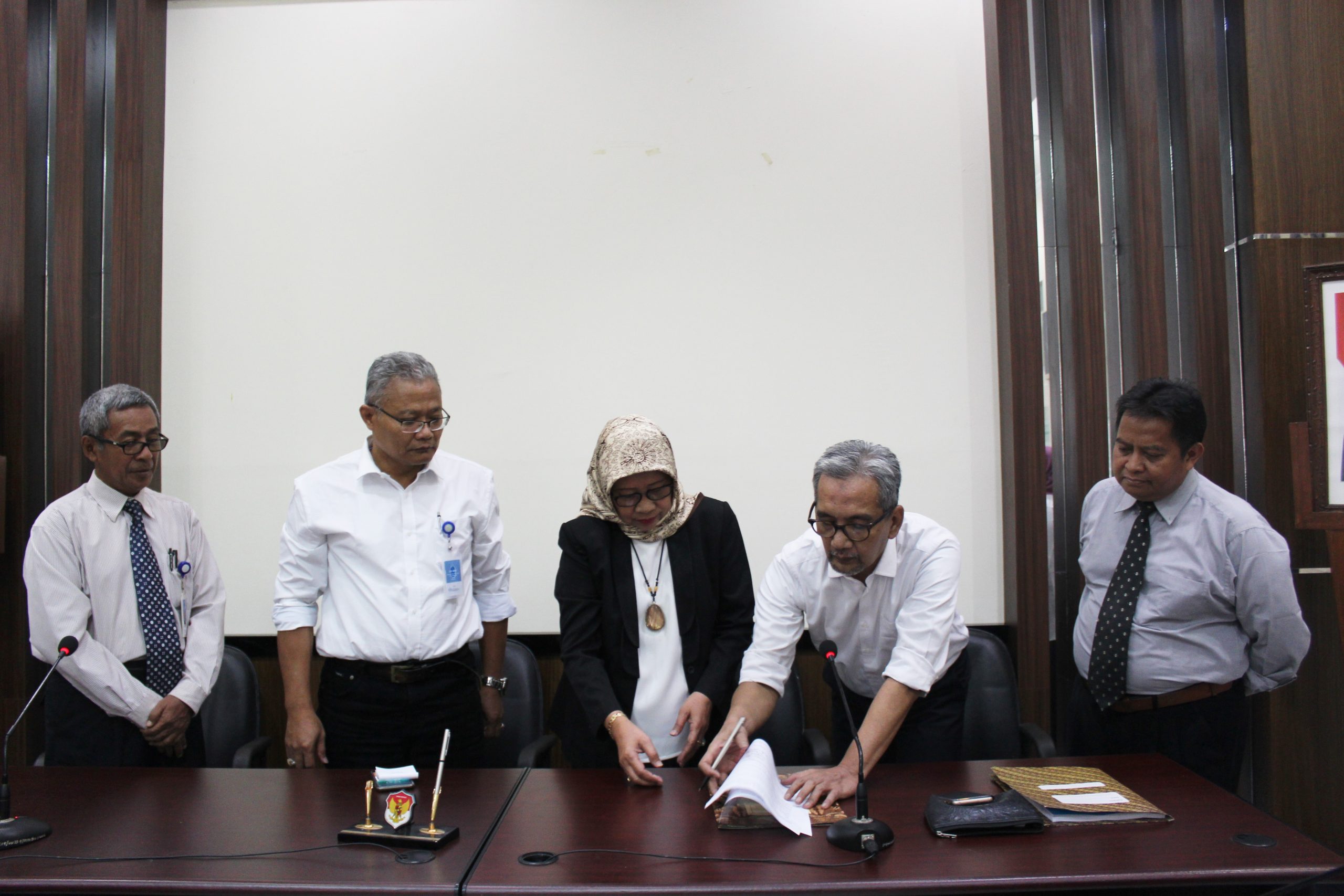
    After the inauguration of the new Dean in the University Auditorium on Friday, May 5th, 2019, FEB UNS conduct an Official Position Hand-Over from the previous Dean to the new elected Dean. This ceremony was held in FEB UNS 1st Assembly Room.

    The ceremony, attended by all of FEB UNS Division Head, begins with the recitation of the Position Hand-over manuscript, manuscript ratification, and followed with the submission of FEB UNS Dean final position memorandum report.

    Dr. Hunik Sri Runing Sawitri, the Dean for the Period of 2015-2019, is grateful that the election of the new Dean has been conducted smoothly and finally electing Prof. Drs. Djoko Suhardjanto, M.Com.(Hons)., PhD., Ak as the Dean for the period of 2019-2023.

    During the ceremony, Dr. Hunik express a gratitude to all the Head of Department and Unit in FEB UNS, who has served the Faculty for the last 4 (four) years. Dr. Hunik also commend to the elected Dean the continuation and completion of few program such as the establishment of Islamic Economy Study Program, establishment of Financial Technology Program, Optimization of KPPMF with a synergy with Internationalization Team, and Promotion System Automation.

    “Shortly, FEB should prepare to be the host for AUN-QA site visit that organized for 4 (four) study programs in UNS namely Economic Development, Law, Agribusiness, and Special Education, which will be held by the end of June. Shortly after, there will be a National re-accreditation for Economic Development Program and for the Postgraduate programs,” she explains.

    Prof. Djoko Suhardjanto, in his remarks, give an analogy that FEB UNS is a “Great House” where its occupant should support each other, thus accelerating the achievement of its vision and missions.

  • FEB UNS Obtain the Erasmus Capacity Building Grant from the European Commission

    The Faculty of Economics and Business Universitas Sebelas Maret (FEB UNS) collaborate with 4 (four) European universities and 5 (five) national universities in Indonesia, is selected to receive the grants from the European Commission for the Capacity Building Erasmus+ with a theme of “OPTtimizing Research and Doctoral Program in BANKing and Finance in Indonesian universities” (OPTBANK).
    The grants valued for 999,904 € for three years period, starts from October 2017 to September 2020. The coordinator for European universities is the University of Limoges in France, while UNS is will act as the coordinator for Indonesian universities consortium. The Indonesian universities involved in this consortium are Institut Teknology Bandung (ITB), Universitas Syiah Kuala (Aceh), Universitas Islam Negeri (UIN) Syarif Hidayatullah (Jakarta), Universitas Tanjungpura (Pontianak), and Universitas Sriwijaya (Palembang). For the European universities, there are 3 (three) universities Bangor University (UK), University of Rome III (Italy), and Technical University Crete (Greece).

    The main objective of this project is to strengthen and improve the research activities in Banking and Finance field in Indonesian universities. Specifically, this program aims to increase the international exposure of the junior academic members in Indonesia through research training and collaboration with European universities partner, revitalize the doctoral and program in banking by introducing new modules, which prepared and adapted from local needs.

    Moreover, OPTBANK also strengthen the governance for research center and doctoral program through ‘good practices’ exchange among the partner universities in Indonesia and Europe, as well as increasing the interaction among the Indonesian universities, the regulator of banking and finance sector, financial and banking industry, and community.

    The Dean of FEB UNS, Hunik Sri Runing Sawitri, explains that the Proposal for Capacity Building OPTBANK is prepared by FEB UNS in collaboration with the LAPE University of Limoges since May 2016. The proposal is submitted to the European Commission by February 2017. In August 2017, the OPTBANK is selected among 149 proposals funded by the European Commission out from 756 proposals submitted for Higher Education-International Capacity Building.

    In 15th, September 2017, a Pre-Kickoff Meeting was conducted in FEB UNS regarding the implementation of the Indonesian partner universities consortium, with objective to equate the perception among the partners and to reinforce the commitment, as well as preparing for the Kick-off meeting that will be held in January 2018 in Limoges, France.

    The achievement of FEB UNS and partner universities shows that UNS reputation is recognized Nationally and Internationally.

    humas-red.uns

  • Academic Discussion Forum: Highlight on the Latest Development in Indonesia

    Academic Discussion Forum: Highlight on the Latest Development in Indonesia

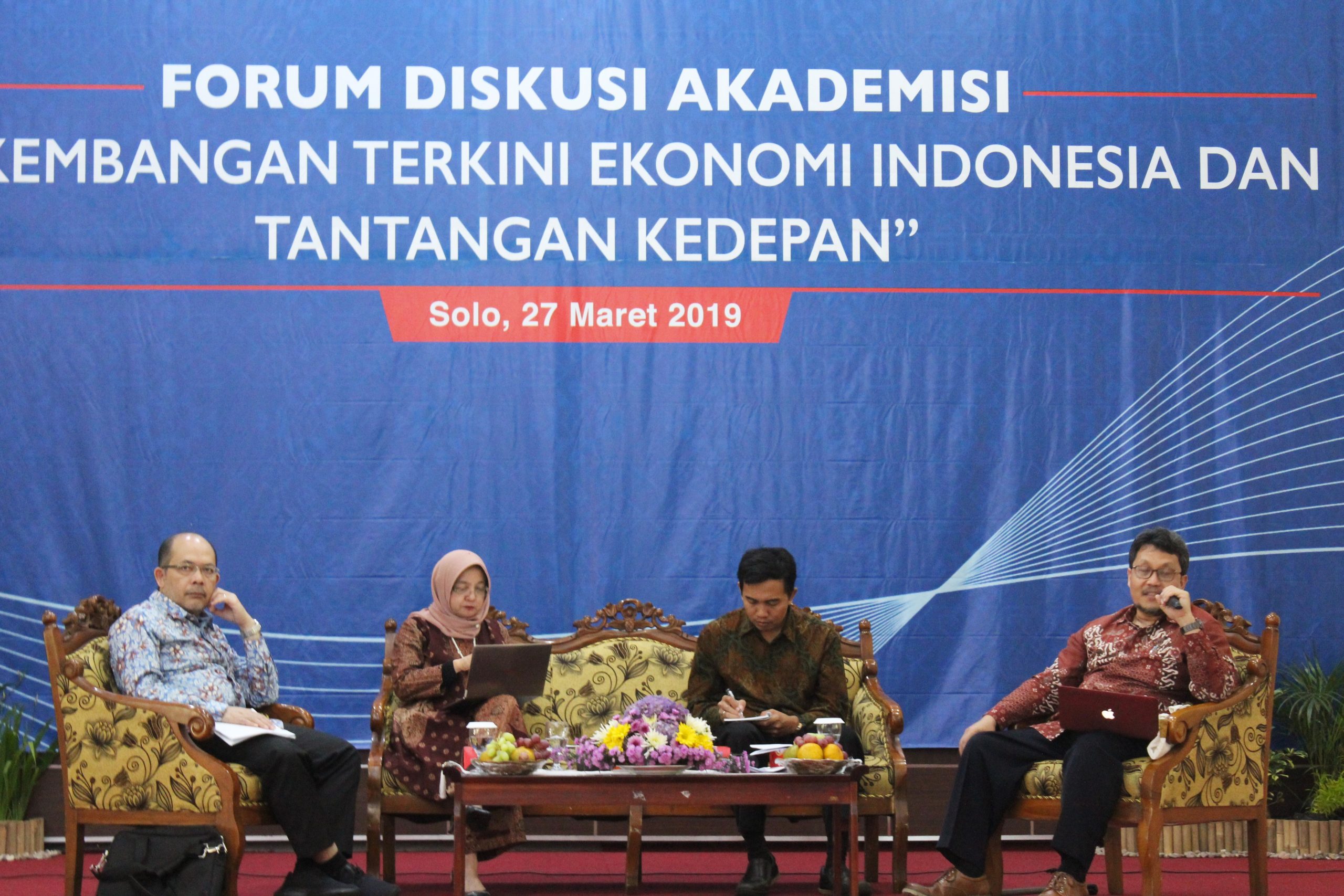
    Approximately 200 participants from academics field and practitioners on Wednesday, March 27th 2019. The event with a theme “Current Development in Indonesian Economics and Future Challenges” is a collaboration between FEB UNS and the Bank Indonesia.

    There are three speakers invited in this event, they are Sahmian from Department of Economic and Monetary Policy, Hermanto Siregar (the Rector of Perbanas), and Lana Soelistianingsih (economics observer).

    Dwi Mukti Wibowo, the Deputy Director of the Communication Department of Bank Indonesia, in his opening remarks states that, the current economics condition is not only affected by the economics issues, but also various factors. Security and orderliness have a huge impact on the economic development in Indonesia.

    Further, Mukti says that “Hence, we need to build a synergy among the Government institution, Bareskrim POLRI (Police Criminal Investigation Agency), Coordinating Ministry for Politics, Law, and Security of the Republic of Indonesia (Kemenko Polhukam), Republic of Indonesia Intelligence Agency, Lazis (amil, zakat, infaq, and shodaqoh institutions), and academicians. This also followed by synergy with the media to provide positive information to build national reputation.” 

    Addressing the development of Indonesia economy, Hermanto Siregar, the Rector of Perbanas mention that in the middle of global economy slow-down, Indonesia’s economic growth face a gradual increase. With the Natural Resource and Indonesia market size, regional economy has a role to accelerate national economic growth.

    “We need great investment especially foreign investment, to achieve the potential. Therefore, the competitiveness of our economy should be improved through the improvement in infrastructure, human resource quality and labor market, as well as lowering corruption level and governance,” he explains.

    In line with this, Lana states that the economic policy that should be examined is regarding on how the global economy will not confined by two economics power in the US and China.

    “From the domestic side, the condition is relatively secure, we need to encourage the domestic expenditure level, this will become one of the stimuli to improve the economy condition,” Lana says.

    On the other side, the government has prepared a social safety measures, for instance significant social assistance, which aims to escalate the economic condition of those in lower-class economy, village funds, and independencies on the subsidize of engine fuel funds.  (Tetri/Humas FEB)

  • The Joy of PSM Award 2018

    The Joy of PSM Award 2018

    The Managerial Simulation Practice (PSM) established in 2005 is motivated by the drive to change a course order that tends to be theoretical. The Undergraduate Degree in Management Study Program should be able to make their student ‘to take action’ and experience the essential affairs that a manager should deal with. This has become the essence of PSM, which can be achieved only through a direct collaboration with the practitioners from various business field.

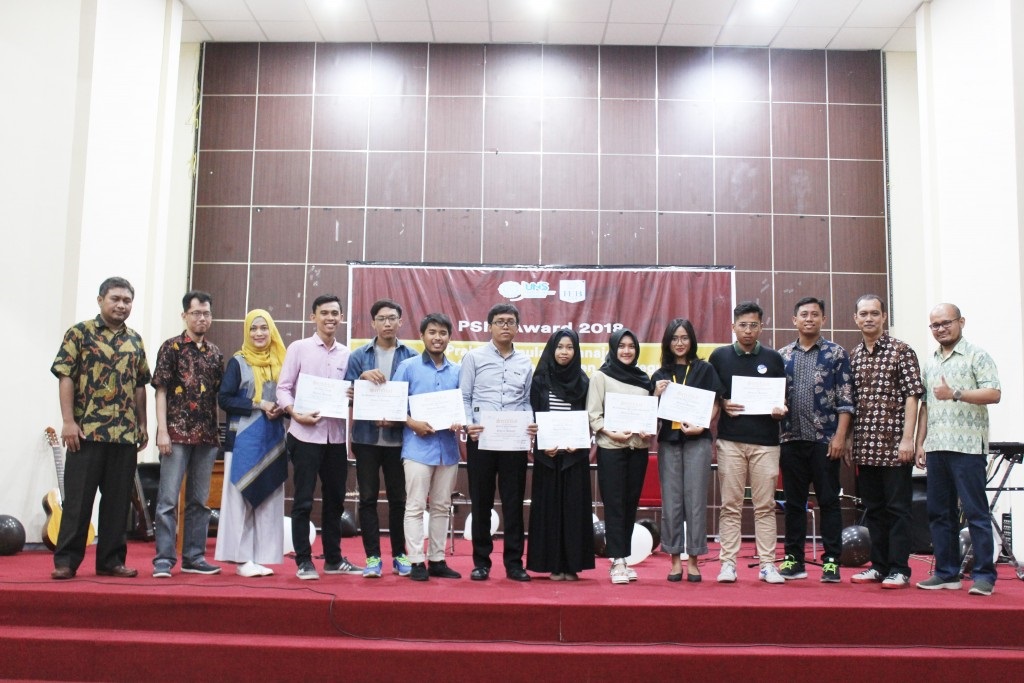
    This was conveyed by Reza Rahardian, Head of the Undergraduate Degree in Management Study Program who are also one of the Board of Directors (BOD) in the PSM, during his speech at the 2018 PSM Award. The event is held on Friday, December 14th 2018 in FEB Hall, which marks the end of PSM course followed by eight teams of 4th year students of the Undergraduate Degree in Management Study Program.
    The award is given for several categories: market mapping, product development, feasibility, grand strategy, general manager, and company. The event itself is delivered through a quite interesting concept, aside from the awarding ceremony, there are various performance from the students.
    This year, the PSM take a theme of music school and collaborate with Gilang Ramadhan Studio Band (GRSB) Solo, as well as presenting the famous drummer to FEB UNS to give an assessment.
    In his evaluation, Reza appreciates the students who show their best effort to prepare a business plan for a music school. From the eight teams, there is a team that propose a plan that crossing the designed area, which obviously needs additional cost.
    “Based on our observation, most students are less expressive. Each group has not shown their business image, uniform is generally okay, but has not shown team solidarity, the image that should be built as a real firm/company is not yet visible, and mostly they still need coercion and encouragement,” Reza explains.
    During the last presentation, however, it seems like the teams already show their improvement. The general manager for each team managed to present their grand strategy in short time. The presentation amaze Gilang Ramadhan himself, who serve as one of the jury for the assessment. He also gives his appreciation to the students’ competency.

  • Fintech Goes to Campus: Young Generation Should Understand the Financial Technology

    Fintech Goes to Campus: Young Generation Should Understand the Financial Technology

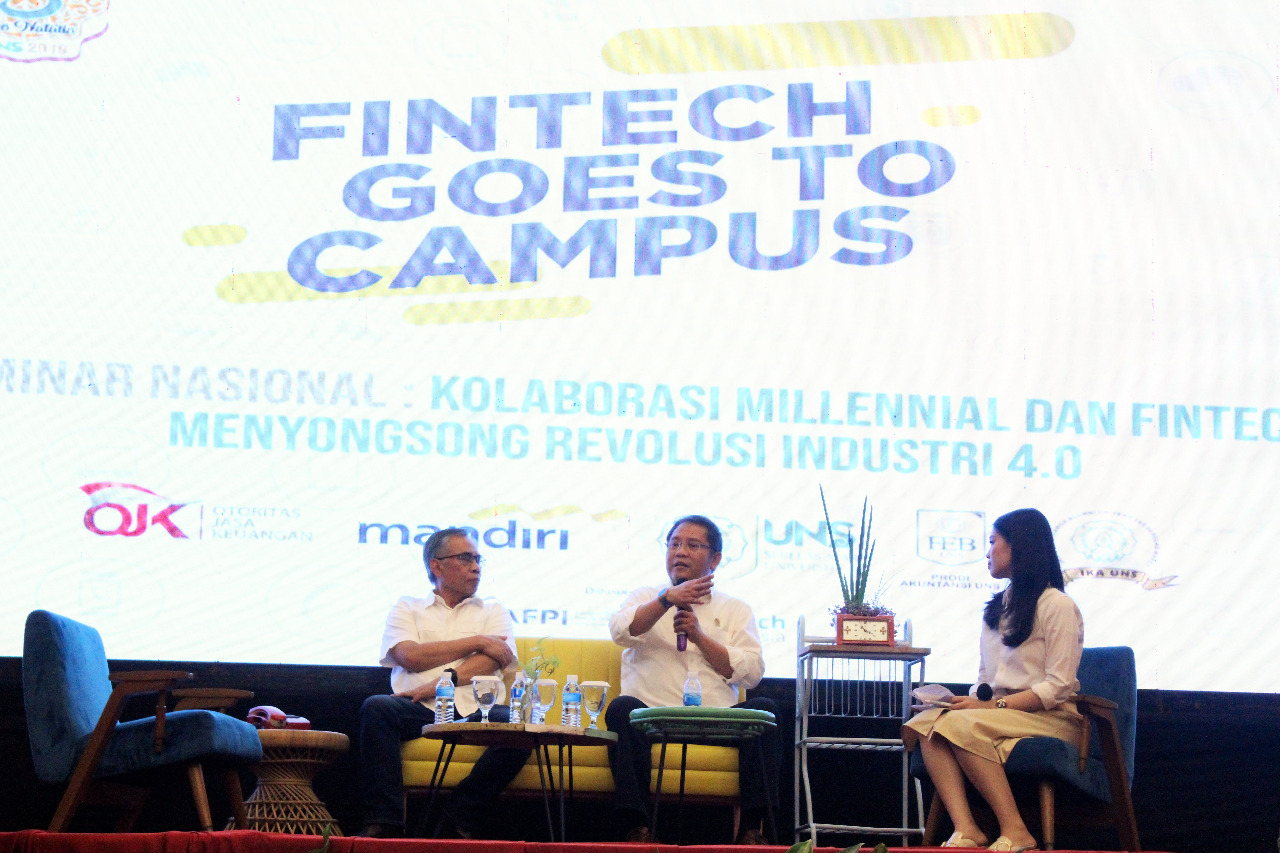
    More than 3000 students’ participants attend the National Seminar Fintech Goes to Campus, on Saturday March 3rd 2019 in GPH Haryo Mataram building, Universitas Sebelas Maret (UNS). The event with a theme “Digital Cooperation to Stimulate Economic Growth in 4.0 Industrial Era” is organized by the Otoritas Jasa Keuangan (OJK), in collaboration with the Undergraduate in Accounting Study Program FEB UNS, and Ikatan Alumni (IKA-Alumni Association) UNS. The keynote speaker for the event is the Minister of Communication and Information, Rudiantara, S.Stat. MBA and the Head of Commissioner Board of OJK, Dr. Wimboh Santoso, S.E., M.Sc., Ph.D.
    Other speakers who also deliver a speech on the event are M. Ihsanuddin, the Deputy Commissioner for Non-Bank Financial Industry, Adrian Gunadi, the Head of The Indonesian Fintech Joint Funding Associationt (AFPI), Rico Usthavia Frans, the Director of Information Technology and Operation for Bank Mandiri, Chris Antonius, the Co-Founder of PT Toko Modal Mitra Usaha, and Irwan Trinugroho, PhD, Faculty members of the FEB UNS.

    The development of fintech brings many benefit such as shorter time of information delivery, as well as faster and more precise decision making process. Fintech also improve economic growth, create new employment, reduce poverty, and improve financial inclusion.

    The Rector of UNS, Ravik Karsidi, in his opening remarks states that in this digital era the young generation should adapt quickly. Awareness on Fintech development is important as Fintech can create various new business opportunity that use digital platform as business base. In line with the opening remarks, in his presentation, Wimboh states that technology development is unstoppable and currently has reach the economics sector including the financial industry. Nowadays there are many Fintech companies emerges in the cyberspace. Hence, OJK made an effort to regulate the fintech companies by requiring every fintech companies to be listed as AFPI member.

    Supervision is conducted comprehensively and directly to the fintech lending office to assess whether the companies comply with the regulation on requirements and prohibitions, in accordance with the regulation of law in financial service.

    OJK also conduct a report-based supervision, either Periodical Report (monthly, quarterly, or annually) or other report such as consumer report, legal aid agency report, or the report from the community member. In the future OJK will implement the Host to Host supervision or IT-based supervision. “Until February 2019, OJK together with the members of the Investment Alert Task Force has stopped 803(accumulative total) illegal peer-to-peer lending entities,” he explained.

    Before the seminar started, a memorandum of understanding between UNS, OJK, and AFPI, was signed by the Rector of UNS, Ravik Karsidi, the Head of Commissioner Board of OJK, Wimboh Santoso, and the Chairman of AFPI, Adrian Gunadi.

    This memorandum of understanding is a part of collaboration between UNS, OJK, and AFPI to improve the quality of education in digital economics, which covers scholarship, internship, training, curriculum, research, and various other collaboration activities.

    In line with the collaboration with UNS, OJK will continue to socialize and collaborate with other universities, by targeting the young generation to encourage the development and improvement of Fintech, thus it could be beneficial for the wider community.


  • FEB Got More Visitation After Accredited by AUN-QA

    FEB Got More Visitation After Accredited by AUN-QA

    The Undergraduate in Management Study Program is one of the study program in Universitas Sebelas Maret that has earned the ASEAN University Network Quality Assurance (AUN-QA). The AUN-QA is a certification given by the AUN to give an assurance for the quality of the study program that are the member of AUN.

    After obtaining the certification, the FEB UNS has received visitation from two universities that wish to know more about AUN-QA. Within two weeks, in January 2019, FEB UNS received two visitation from Universitas Negeri Surabaya in January 22th and Universitas Muhammadiyah Yogyakarta in January 31st.

    Further, Dr. Irwan Trinugroho, the Head of Internationalization Team who was also the head of AUN-QA Self-Assessment Report (SAR) preparation team for undergraduate in management program, often get invited specifically to deliver a presentation and explanation of AUN-QA, such as the invitation from Universitas Islam Indonesia (UII) Yogyakarta and Universitas Islam Negeri (UIN) Syarif Hidayatullah Jakarta. In every occasion he always provide a detailed explanation on his experience helping the study program, start from the registration through the site visit by the assessor team.

    Moreover, as he explains there is a guidelines from the AUN-QA that should be followed in the SAR preparation. The SAR document consists of three parts: Introduction, SAR explanation, and SWOT. “We are required to submit the first chapter to obtain the site visit slot,” Irwan says.

    To simplify the preparation process, the SAR team is preferably has a small number of member; five member is enough. This way the team will have better teamwork and the SAR document will be more solid.

    During site visit, Irwan explain that the assessment in each study program is carried out by two assessors. On the first day, all 8 (eight) assessors will conduct an interview with the faculties dean. Afterward the interview with faculty member, staff, and students are conducted in a consecutively. On the second day of site visit, the assessors will interview the alumni and user, which followed with site visit to several facilities in the Faculty.

    “Even though there is a translator or interpreter in the interview room, it is best to ensure that the faculty members, alumni, and students invited have a good English proficiency. Except for academic staff or user, English proficiency is not a requirement,” he explains.

    Further, he also mention that during the site visit the FEB UNS empower the students as the Liaison Officer (LO). The students are not only helping the assessors but also supporting other site visit activities.

    On the same occasion, Reza Rahardian the Head of Undergraduate in Management express that the site visit that took place for 3 days on May 8th to 10th is very exhausting. The FEB is appointed by the Rector to be the host for the site visit of AUN-QA for 4 (four) study programs, the undergraduate in management, biology, teknik, and civil engineering.

    “For the site visit preparation, the requirements and regulation given by the AUN-QA is very detailed and strict, this includes little things such as electrical plugs, room assignment, ASEAN member flags placement, even the documentation needs to get approval from the AUN team, which also applies for banquet service also not allowed during site visit process,” Reza explains.

    Reza is grateful that the site visit process is conducted smoothly and the certification will give an added-value to the study program and university, as well as the graduates. It is expected that the graduates will be able to compete in their future work place.

  • Visitation from SMA IT Asy-Syukriyyah Tangerang: Faculty of Economics and Business, UNS Prepares its Graduate to Compete

    Visitation from SMA IT Asy-Syukriyyah Tangerang: Faculty of Economics and Business, UNS Prepares its Graduate to Compete

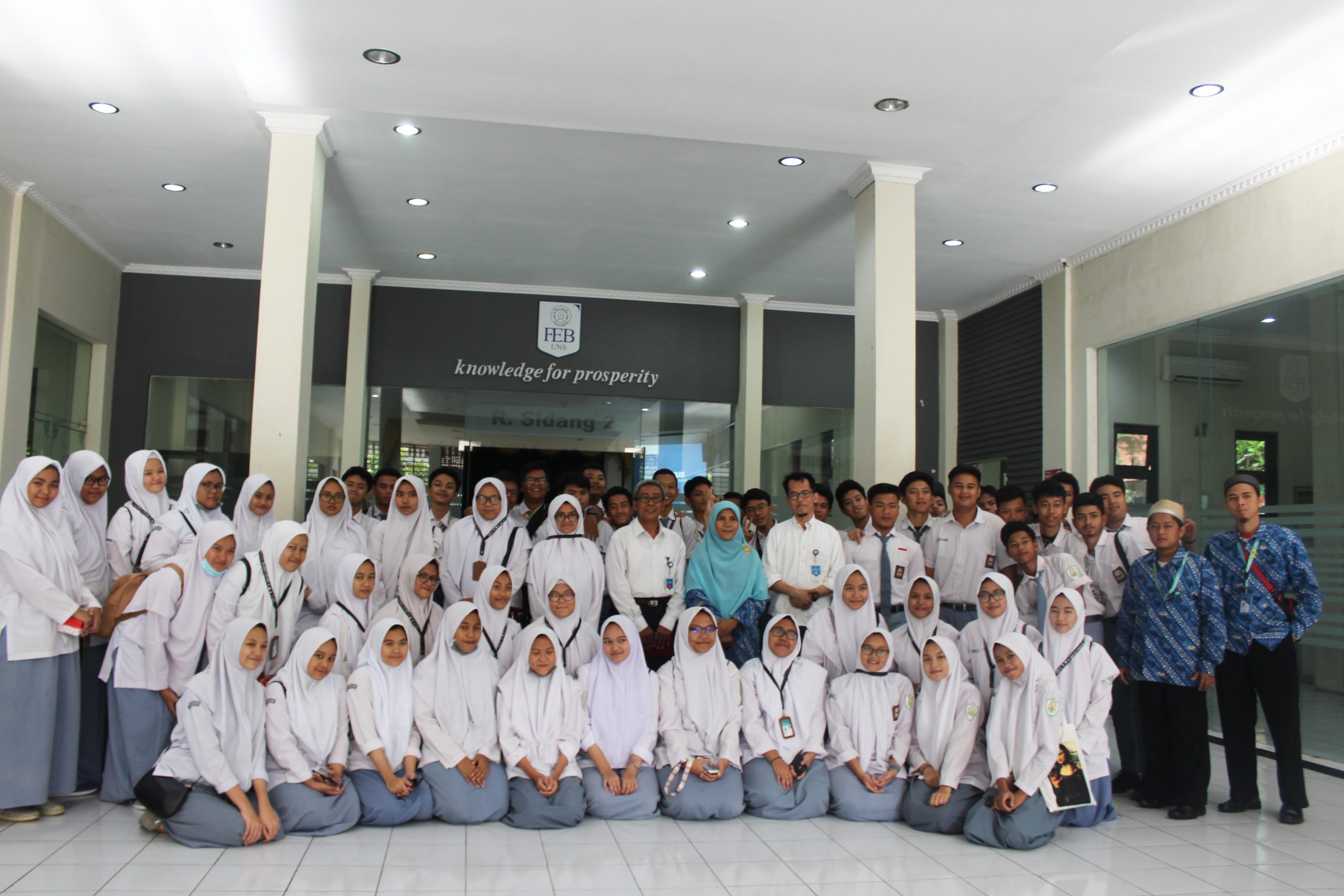
    The Faculty of Economics and Business (FEB) has 13 study programs, starts from Diploma program until the Doctoral program that has accredited with “A” standard. FEB UNS always strive to compete in the international arena. Currently the Master in Management Study Program has been accredited by ABEST21 that based in Tokyo, Japan, while the Undergradate in Management Study Program has been accredited by the AUN-QA. FEB UNS also has become the member of AACSB. These are delivered by the Associate Dean of General Affairs, Harmadi, during his welcoming remarks for the visitation from SMA IT Asy-Syukriyyah Tangerang on Monday, March 18th, 2019 in Ruang Sidang 2, FEB UNS.

    The group consist of 9th grade students or last year of high school students and several teachers are welcomed by the Associate Dean of General Affairs of FEB UNS, the Head of the Undergraduate in Management Study Program, Reza Rahardian, and Yaman Umaran a member of Universitas Sebelas Maret admission office.

    Mairatu Sisriyeni, the Principal of SMA IT Asy-Syukriyyah deliver a speech and express that the main objective of the visit is to prepare the students with information and insights from UNS to enter the higher education level. The students’ enthusiasm can be seen from the questions given to UNS such as the admission process, internship program, collaboration, teaching and learning activities, further study opportunity, and how far the faculty provide an education and support for the graduates to be able to compete other graduates from other universities in entering the job market.

    “Our faculty does not offer a commitment to work for the government after graduation, but we facilitate the students to be ready for job. Our institution is accredited with “A” standard, this become initial provision for the graduates to enter the job market,” answer Reza for the question about guarantee of getting a job.

    Furthermore, the faculty, especially the undergraduate program in management, has prepare the student with various knowledge and experience, one of them is the Managerial Simulation Practice course. In this course, the students are not faced with the theoretical aspect but they are required to participate in a real work setting condition. The students will be assigned a special task or position in a virtual company and they are required to carry out the task according to their role in the company. They also given the authority to take decision while practicing various role in company managerial activity such as human resource, finance, marketing, and operation management. The Managerial Simulation Practice will polish students’ hard skill and soft skill through the work practice simulation to finish the business assignment. The learning model applied in this course is problem based learning.

    “We facilitate, but the student should have their effort to improve their competency, thus they have an expediency,” he adds.

    The event is closed by exchanging souvenirs followed with a group photo. (Tetri – Humas FEB)