FEB

Kategori: s1_mnj

  • Entrepreneurship is Powerful in the Academic and Non-Academic Activities

    Entrepreneurship is Powerful in the Academic and Non-Academic Activities

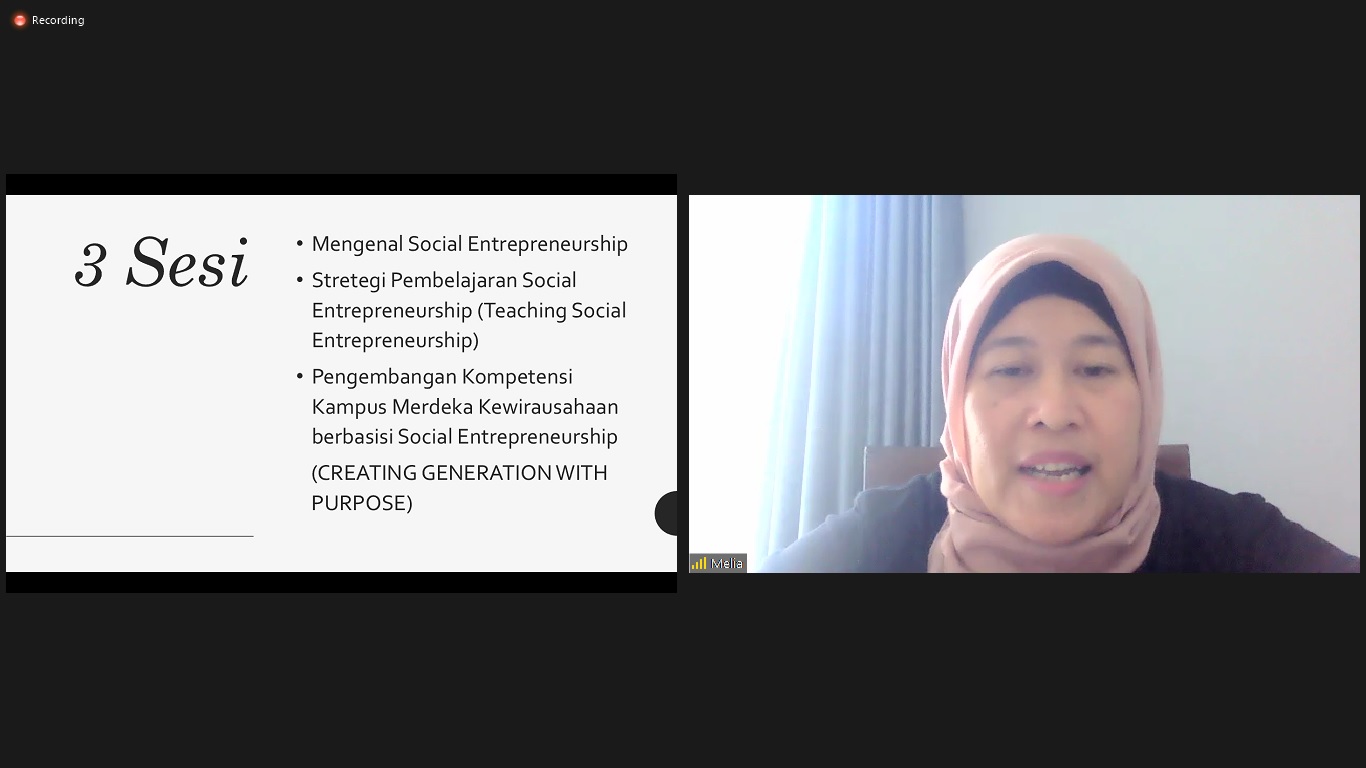
    The Management Study Program, Faculty of Economics and Business (FEB) Universitas Sebelas Maret (UNS) held a Technical Assistance for the Kampus Merdeka-Entrepreneurship Program: Social Entrepreneurship, Tuesday, August 3, 2021. The activity that was attended by lecturers and students from various study programs invites Melia Famiola, STP, MT, Ph.D., a lecturer from the School of Business and Management ITB.

    At the beginning of her presentation, Melia, Ph.D., introduced more details about social entrepreneurs and shared the involved parties’ experiences in this sector. According to her, the issue of social entrepreneurship was initiated with movements carried out by several people. People who choose to be social entrepreneurs must be smart, as it is not easy for them to see the gaps in their social activities in order to create transformation leading to an economic turnaround for the community.

    “This is the reason why the current entrepreneurship has become quite powerful in the academic and extracurricular activities. Even the long-established businesses are required to contribute to the achievement of the SDGs, whether in reducing poverty, hunger, addressing health, tackling environmental problems and various other problems around us,” he explained.
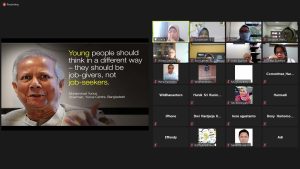
    Furthermore, according to Portales, there are four essential elements of a social entrepreneur. In a social entrepreneur, there must be a social mission within a systemic change. In order for the social mission to create systemic change, it must be explored along with social and economic activities. The end goal is how to create a positive impact.

    Social entrepreneurship attributes include social motivation, economic intelligence, courage, and quick and alternative thinking. A social entrepreneur is a person who has a social mission, empathy, and particular social interests. Social impact will not happen just by doing charity or charitable activities, but it must be creating transformation on how people can change toward a positive direction as expected. Additionally, what social entrepreneurs have is economic intelligence, the ability to find business opportunities.

    Two other characters possessed by social entrepreneurs are bravery, a person who dares to make difficult decisions. A social entrepreneur must be more courageous than those involved in certain businesses because sometimes the social value proposed through their opinion has no economic value, more leaning to charity in nature. However, a social entrepreneur must dare to take the risk and must be creative in looking for economic strategies, have more guts, and be stronger than an ordinary entrepreneur. The second attribute is quick-witted to find alternative ideas. This attribute refers to the condition when a person is dealing with the community, dealing with a lot of people’s behavior, that requires them to adapt to find a strategy on how to make changes.

    Further, Dr. Melia said that there are three things required to develop the Kampus Merdeka-Entrepreneurship program in social-based entrepreneurship: mindset transformation, educational ecosystem support in entrepreneurship development, and the new role of the campus as a hope.

    Furthermore, the entrepreneurship education ecosystem is built based on three roles, stimulation, support, and sustainability. Stimulation includes entrepreneurship education, motivational training, assistance and guidance in selecting products, project reports preparation, product and process development, entrepreneurial forums creation, and skills recognition.

    Supporting includes funding assistance, provision of working space, guidance, legal assistance, and provision of other public facilities. Sustainability can be provided in the form of modernization assistance, additional financing for capacity utilization, product orders, quality testing and services improvement, as well as public facilities based on needs. (Humas FEB)
  • Humanitarian Project Trains Students to Have Social Sensitivity

    Humanitarian Project Trains Students to Have Social Sensitivity

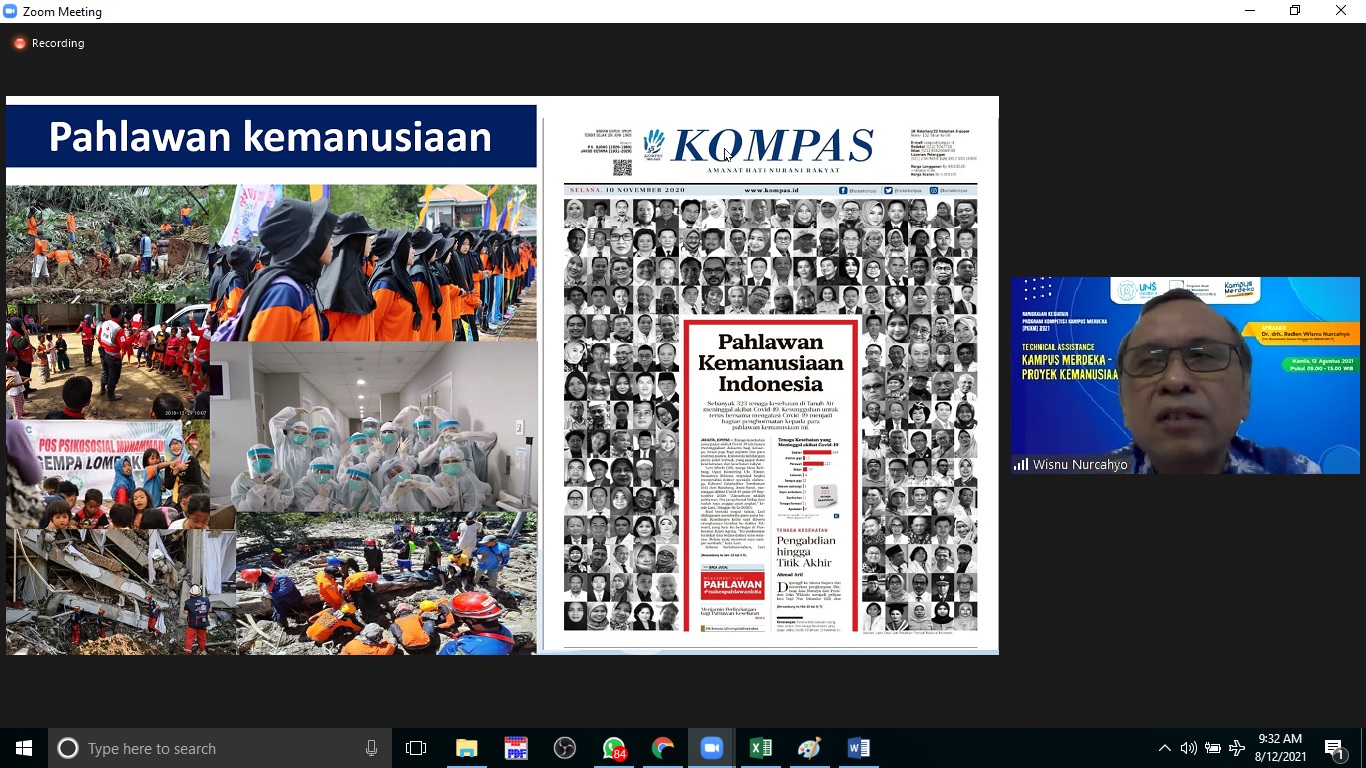
    The Humanitarian Project is a part of the Kampus Merdeka program. Students with a young spirit, scientific competencies, and interests can become the “foot soldiers” in humanitarian and other development projects both in Indonesia and abroad. A humanitarian project aims to prepare excellent students who uphold humanity in carrying out their duties based on religion, morals, and ethics. The project also trains students to have social sensitivity to investigate and explore existing problems at the same time providing solutions according to their respective interests and expertise.

    This message was conveyed by Dr. drh. Raden Wisnu Nurcahyo, member of the Dissemination Lecture Team for MBKM Dikti Program, in the Technical Assistance Program for the Kampus Merdeka-Humanity Project organized by the Management Study Program, Faculty of Economics and Business (FEB) Universitas Sebelas Maret (UNS), Thursday, August 12, 2021.

    Furthermore, he explains that for the implementation of the program, the study programs or faculties can establish agreements with partners in the form of a Memorandum of Understanding (MoU/SPK). This collaboration can be established with domestic institutions such as with the Regional Government, PMI, BPBD, BNPB, sub-districts, religious organizations, and others, or foreign institutions such as UNESCO, UNICEF, WHO, UNOCHA, UNHCR, and so on.

    In order for the program to run well, program ambassadors are needed, namely lecturers from each study program who are responsible for providing assistance, supervision, assessment, and evaluation of humanitarian project activities carried out by students. Lecturers together with partner institutions compile a logbook form.

    In the next stage, study programs need to make technical guidelines for learning activities through humanitarian projects. It is necessary to form a strong task force to support the implementation, final evaluations, and equalization of student humanitarian project activities into relevant subjects. “Lecturers can help in identifying activities, finding program partners, assisting students until the final evaluation, equalizing humanitarian activities into relevant courses according to the faculty Semester Credit, and encourage sustainability of the program,” Wisnu said.
    All activities must be reported by the study program to the Faculty, then the Faculty to the University MBKM task force. Finally, the university should report the results of learning activities to the Directorate General of Higher Education through the Higher Education Database.

    For curriculum equalization in humanitarian projects, there are several methods available, including free forms, which are formulated in hard skills, problem-solving methods according to graduate learning outcomes, technical adjustments formulation, and synthesizing capabilities. Students’ soft skills achievement includes communication skills, cooperation, leadership, hard work, and creativity. Equalization can also create a structured form, structured according to the curriculum taken by students. Credits are stated in the form of equivalent courses. Actually, the easiest method to do this is to combine free form and structure form.

    Students can collect data when participating in a humanitarian project for their thesis, for example, preparing a budget and cost plan for a humanitarian project, managing logistics, networking with partners, and many others. In the event, which was attended mostly by lecturers, Dr. Wisnu also explained about scientific research grant schemes, including lecturers’ independent research grants, entrepreneurship research, rural research, and humanitarian activities grants.

    Humanitarian activity grants aim to produce designs or models related to humanitarian activities management that are useful in disaster relief handling, producing beneficial science and technology, equipment or policies according to the type of disaster. This grant is also useful in combining each lecturer’s expertise in research activities to learning programs in a humanitarian project and disseminating the humanitarian research results.

    The focus of scientific research for humanitarian activities includes scientific research on Covid 19 prevention, scientific research on technology and geological disaster management, scientific research on technology and hydrometeorological disaster management, scientific research on technology and disaster management of land/forest fires, scientific research on technology and environmental management, and scientific research on disaster-related policy or governance. (Humas FEB)

  • Management Study Program FEB UNS Invites Dr. Alexander Bauer in Technical Assistance: Project-Based Learning Method

    Management Study Program FEB UNS Invites Dr. Alexander Bauer in Technical Assistance: Project-Based Learning Method

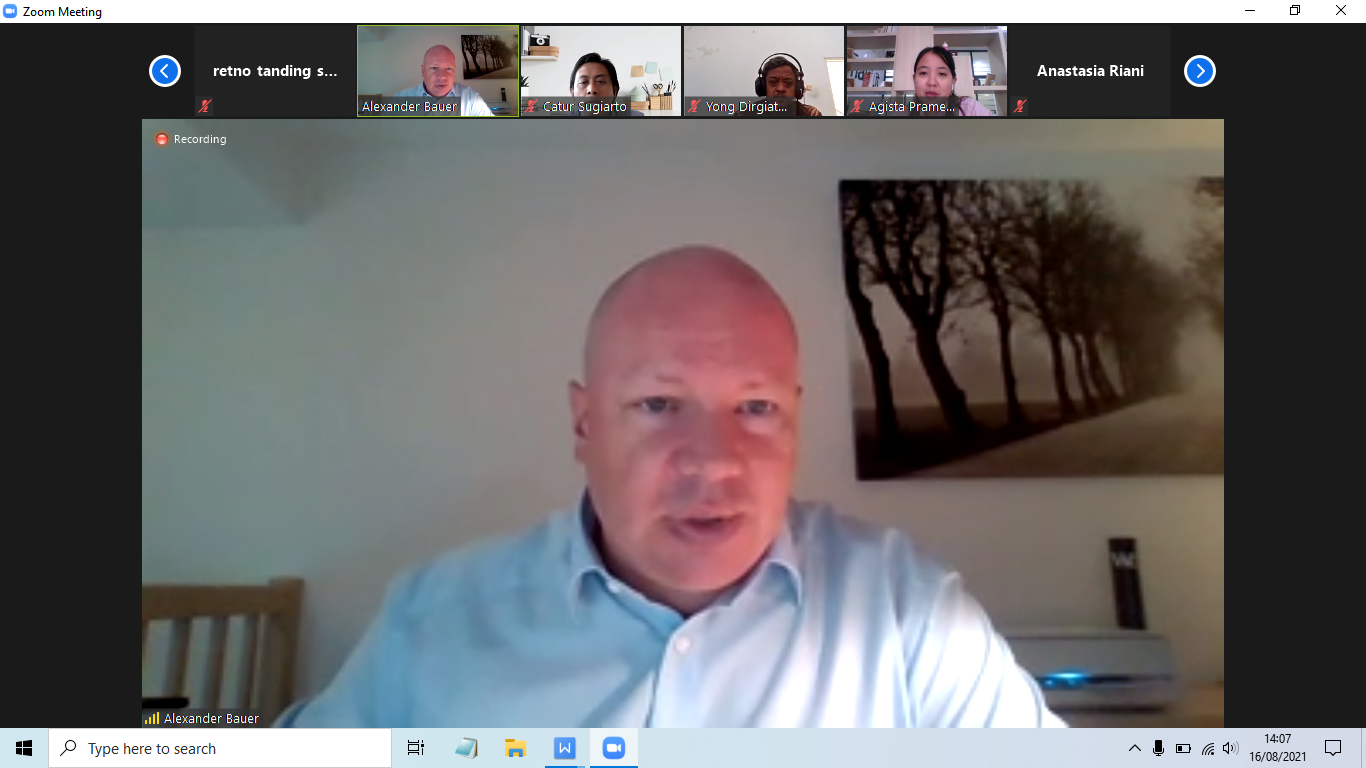
    The Management Study Program, Faculty of Economics and Business, Universitas Sebelas Maret (FEB UNS) Surakarta invited another international academician in a series of activities for the 2021 Program Kompetisi Kampus Merdeka (PKKM), Monday (16/8/2021). The event, which was attended by FEB UNS faculty members, invited Dr. Alexander Christian Bauer from the Wittenborg University of Applied Science.

    Starting the presentation of the material, Dr. Bauer explained the definition of Project-Based Learning (PBL), the forms of PBL implementation in the teaching and learning process at universities, and examples of PBL that he has applied. In general, Dr. Bauer explained that PBL is a form of learning method in which students are encouraged to identify problems that occur in the real world and find solutions to these problems.

    Through this method, students are required to conduct in-depth research to be able to answer complex questions and collaborate in teams to solve problems and find solutions.
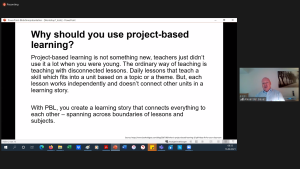
    The PBL method no longer relies on lectures delivered by lecturers but encourages students to think critically through stories or problems related to the theories that students learn. In addition, the advantages of PBL include providing opportunities for students to use technology in the process of completing projects, introducing lifelong learning techniques to students, introducing students to problems that occur in the real world, developing skills, creativity, and imagination of students, and motivate students to be more involved in the active learning process.

    “Student projects help them (the students) to review the lecture material they have received and prepare them for the next material,” said Dr. Bauer.

    The material is followed by examples of project-based learning applied by Dr. Bauer, which can generally be divided into two criteria. An integrated project (implemented within the course) and an external project which does not include in a course. Each project implemented begins with the delivery of general project information related to business conditions and problems that arise, followed by project research questions, where the level of difficulty is adapted to the semester. To answer these questions, students must conduct research on the problems that occur.

    Students are divided into small groups that include several special roles such as team leader, research department, secretary, and finance department. The team that has been formed then carries out a series of projects assisted by the lecturers of related subjects to provide suggestions and input. At the end of the session, the student team is required to make a final report and present their work.

    The event, which was attended by more than 30 participants, went interactively with a question and answer session between the lecturers of the Management Study Program FEB UNS and Dr. Bauer.

    Reporter: Aulia
    Editor: Humas FEB

  • Welcoming New Students, Dean of FEB Invites Students to Accomplish Achievements at National and International Levels

    Welcoming New Students, Dean of FEB Invites Students to Accomplish Achievements at National and International Levels

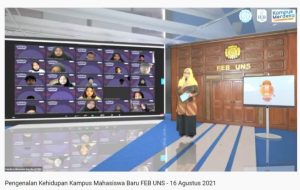
    More than 700 new students from the Undergraduate Study Programs in the Faculty of Economics and Business, Universitas Sebelas Maret (FEB UNS), participated in the Virtual New Student Introduction to Campus Life (PKKMB) on Monday, August 16, 2021. The Dean of FEB UNS, Prof. Drs. Djoko Suhardjanto, M.Com. (Hons). Ph.D., Ak., welcomed new students and symbolically handed students’ Semester Course Plan to three student representatives from each study program, Widya Zhafira from Accounting Study Program, Devina Alfa Levia Rizky Alharis from Management Study Program, and Perdana Gilang Yudha Firmansyah from Development Economics Study Program.

    “The Deanery of FEB UNS congratulate the new students. We are thrilled and proud because all of you have joined our Faculty as new students. Once again, congratulations, you have become the faculty members of FEB UNS. Please stay enthusiastic in your study, strengthen your capacity in the FEB UNS Candradimuka crater (t/n: Candradimuka represents an ancient stringent training ground for great champions in old Javanese manuscript), a cultivating place to nurture your competencies to achieve success,” said the Dean encouragingly.
    All study programs at FEB UNS, both the Undergraduate and Postgraduate Study Programs, have been accredited ‘A’ by the National Accreditation Board for Higher Education (BAN-PT). Various international accreditation certifications are also achieved by the study programs such as EPAS, AUN QA, and ABEST21. Starting on October 6, 2020, UNS obtained the status as a State University with Legal Entity (PTN-BH). In addition, UNS is included in the first cluster or the main cluster of the best universities in Indonesia.

    Further, the Dean also advised that while studying in FEB UNS, new students must maintain good interaction with all existing educational components on the campus and alumni who are often visiting FEB UNS. Numerous alumni of FEB UNS are successful figures occupying important positions both in governmental and private sectors. The notable alumni, among others, are Prof. Wimboh Santoso, who currently serves as Chairman of the Board of Commissioners of the Indonesian Financial Services Authority (OJK), Doni P Joewono, the current Deputy Governor of Bank Indonesia, Didik Hartantyo, President Director of PT KAI, and several other successful alumni in the private sector including Harijanto, and Nur Harjanto.

    At the end of his remarks, the Dean hopes that students would be able to accomplish numerous achievements, both at the national and international levels, while still promoting the nation’s noble cultural values and upholding the life principle of ‘urip sing urup memayu hayuning bawana’ (life should provide benefits for others as well as for the universe).

    The PKKMB activity that lasted from morning until late afternoon was also filled with explanations from the FEB UNS Vice Deans, Laboratory Administrator, Supporting Units, Academic Support Staff, and the lecturers from each study program. Several successful alumni are invited to deliver a motivational speech to the new students, such as Doni Primanto Joewono, SE, M.Si, Ubaidi Socheh Hamidi, SE, MM., Endang Kurniawan, SE, Ak., and Dr. Nur Harjanto, MM.

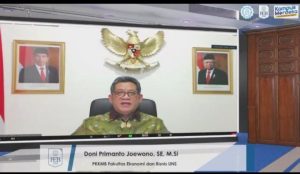
    The Deputy Governor of Bank Indonesia, Doni P. Joewono, in his speech, conveyed four important things to guide students to be successful in pursuing studies and careers, namely, being grateful, finding role models, having passion, and being adaptive. The success achieved by the students is due to Allah’s and parents’ blessing. Gratitude must always be expressed for the opportunity to be enrolled on this campus because currently, the achievements of FEB UNS are growing rapidly. All study programs at FEB have been accredited A and obtained international certification.

    Furthermore, it was conveyed that students must also have a role model to encourage them in achieving future success in their studies and career. “Role models provide motivation and encouragement in learning. Having a role model allows us to explore ourselves, we have a dream, knowing our future goals, whether to continue our studies or to be an economist or to be an entrepreneur, who will be our example,” Mr. Doni said enthusiastically.

    Students must also have passion, must have an interest. Passion will encourage students to find role models and be active in organizational activities to enrich and expand students’ knowledge and experience. Fourth, students must be adaptive. Successful people are adaptive people, not just smart and intelligent people. How many people are having mediocre academic achievements but are successful at work because they are highly adaptive to their job environment. (Humas FEB)

  • Undergraduate Management Program Introduces Exciting Topic of Creative Thinking Learning

    Undergraduate Management Program Introduces Exciting Topic of Creative Thinking Learning

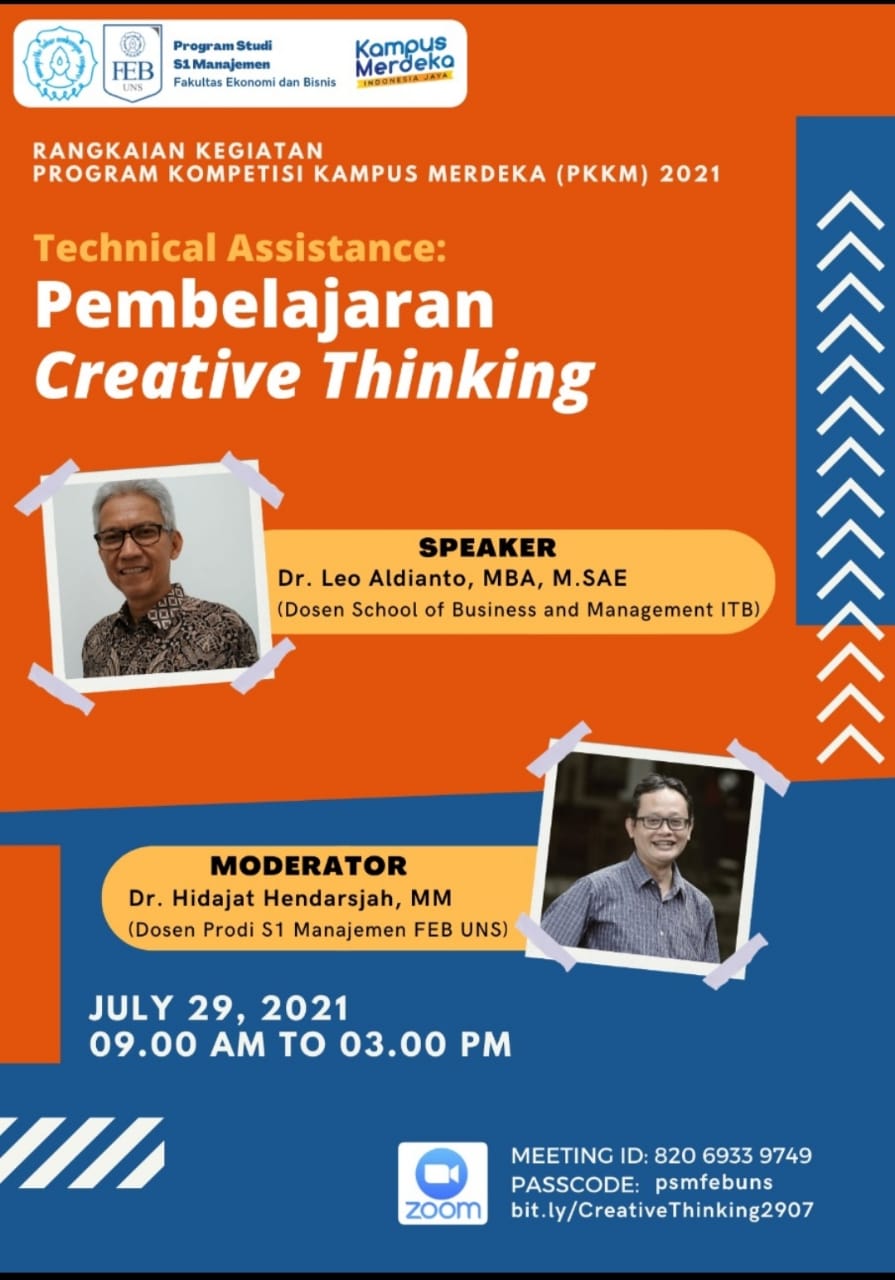
    The Technical Assistance for Creative Thinking Learning became an engaging topic in the recent agenda hosted by the Undergraduate Management Program, Faculty of Economics and Business (FEB), Universitas Sebelas Maret (UNS), on Thursday, July 29, 2021. The event, attended by faculty members and students from various programs, featured Dr. Leo Aldianto, MBA., M.SAE., a lecturer from the School of Business and Management, ITB.

    Summarizing insights from various experts, Dr. Leo stated that creativity is the process of creating something new, unique, and useful. Meanwhile, creative thinking is the ability to think in new, original, and conscious ways, departing from habitual routines, and different approaches, deviating from the ordinary, and abandoning conventional ideas.

    “What may affect and crucial in fostering creative thinking is how one typically works, behaves, and acts. Additionally, the creative process begins with preparation, generating ideas, and selecting prioritized ideas for implementation. Ultimately, there must be a tangible outcome, whether a physical product, concept, or idea. Most importantly, the environment must be designed to facilitate creativity,” explained Dr. Leo.
    Teachers should encourage students to generate new ideas, expand upon them, be flexible, provide detailed suggestions, and diversify their approaches.

    Examples of courses integrating creative thinking include Creativity & Innovation, Start-up Creation (a series of courses), Design Thinking, and Introduction to Business. Fundamental courses can also incorporate creative thinking. Essentially, in all course aspects, students should be encouraged to apply creative thinking, enhancing their skills and applying them directly to problem-based and project-based learning.

    “In basic courses like Human Resource Management, Finance, and Accounting, the main focus remains on introducing creative thinking. Students must think of alternative ways and apply them. As they are still learning, they can utilize resources such as articles, magazines, books, papers, or the internet to explore various company issues,” Dr. Leo emphasized.

    “The direct application in problem-based learning starts from identifying local issues to those faced by companies. Recently, we invited two companies to present their challenges. Seventy-two students were divided into 8 (eight) groups, each tackling problems from Company A and Company B. By the evaluation stage, the companies themselves assessed the students’ work,” he added.

    The process of creative problem-solving involves several steps: identifying the problem, gathering facts and opinions, rephrasing the problem, brainstorming possible solutions, evaluating them, implementing the chosen solution, and assessing the results. (Humas FEB)

  • UNS Signs MoU with the Expertise Board of DPR RI

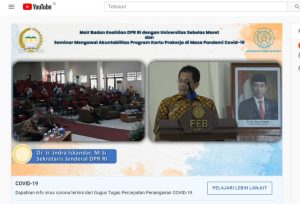
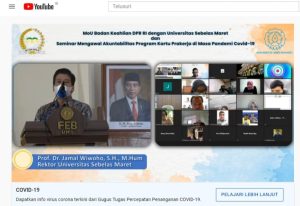
    Universitas Sebelas Maret (UNS) signed a Memorandum of Understanding (MoU) with the Expertise Board of the House of Representatives of the Republic of Indonesia (DPR RI), Thursday, May 27, 2021, in the Faculty of Economics and Business (FEB) UNS Hall. The ceremony was also broadcasted virtually.

    The MoU was signed directly by the Rector of UNS, Prof. Dr. Jamal Wiwoho, SH, M. Hum., and the Expertise Board of DPR RI, Dr. Inosentius Samsul, SH, M.Hum., witnessed by the Secretary-General of the DPR RI, Dr. Ir. Indra Iskandar, M.Si, and Vice-Rector for Planning, Partnership, Business, and Information Affairs UNS, Prof. Dr. rer. nat. Sajidan, M.Si.

    The scope of the MoU includes the implementation of education and training such as research, studies, scientific activities, seminars and workshops, human resource competencies improvement and development, integrated management assistance in improving academic quality, and experts mentoring or Journal Peer-Reviewer.

    Additionally, the cooperation will also cover data sharing or open access to research or libraries, preparation of Response to the Constitutional Court, implementation of expert support in the formation of laws, preparation of academic texts, budget functions, and supervisory functions, as well as internship programs for lecturers/students at the Expertise Board of the Secretariat General of the DPR RI, and other activities agreed upon by the parties.

    After the MoU signatory ceremony, a seminar entitled “Guarding Accountability of the Pre-Employment Program during the Covid-19 Pandemic” was conducted, delivered by Rahmad Handoyo, S.Pi, MM, the Member of Commission IX DPR, Prof. Drs. Djoko Suhardjanto, M.Com. (Hons), Ph.D., Ak., the Dean of FEB UNS, Prof. Dr. Adi Sulistiyono, S.H. M.H., the Chairman of the UNS Academic Senate, Prof. Dr. Izza Mafruhah, SE, M.Si., Vice Dean for Academic, Research, and Student Affairs FEB UNS, and Dr. Atmaji MM, the Head of the Management Study Program FEB UNS.

    In his speech, the Secretary-General of DPR RI, Dr. Indra Iskandar, states that the Covid-19 pandemic had encouraged the government to carry out policies to reduce the significant impact of the pandemic on the community. One of the policies implemented is the Pre-Employment Program to reduce the soaring open unemployment, as one of the major impacts of the economic contraction during the pandemic.

    “In terms of evaluation, we have a record of supervision activities carried out by DPR RI members on the implementation of the Pre-Employment Program in 2020 and 2021. To strengthen the analysis on the Pre-Employment Program management, the Center for State Financial Accountability Study (PK AKN), Expertise Board of the DPR RI, views that the collaboration and seminars inviting speakers from DPR RI members and UNS academic members are necessary to ensure that the studies conducted can be applied to the society,” he explained.

    Dr. Indra also hopes that various inputs will provide significant benefits for PK AKN to create studies that will support the supervisory function of the DPR RI, especially in the supervision of state finances.

    UNS Chancellor, Prof. Jamal Wiwoho, thanked the Expertise Board of DPR RI for trusting UNS in this cooperation. He hopes that the ideas and discussions with the seminar speakers can be beneficial both at the national and international levels, contributing to the significant improvement of employment quality in Indonesia.
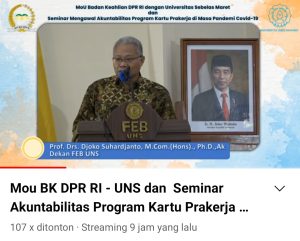
    Meanwhile, the Dean of FEB UNS. Prof. Drs. Djoko Suhardjanto, M.Com. (Hons), Ph.D., Ak., conveyed that FEB UNS institutionally is willing to support the role and function of the Expertise Board of DPR RI in creating a Professional Parliament to support the 3 (three) main functions of the DPR RI, namely Monitoring, Budgeting, and Legislation.

    One of the main functions of the DPR is to supervise the implementation of government programs. In the academic realm, this function is closely related to accountability. FEB UNS, supported by study programs and research groups, is ready to support supervisory functions and scientific studies for the Expertise Board of DPR RI, including providing in-depth reviews and studies on the accountability of the Pre-Employment Program. (Humas FEB)

  • Two FEB Students On The UNS Pilmapres 2021

    Two FEB Students On The UNS Pilmapres 2021

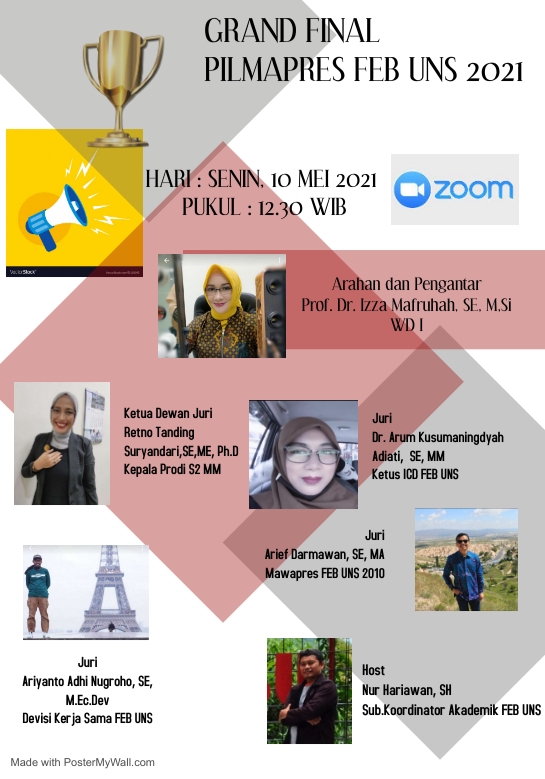
    Shoffan Mujahid, a student from the Development Economics Study Program, Faculty of Business (EP FEB), Universitas Sebelas Maret (UNS) is succeeded in being the Winner in FEB UNS Outstanding Student Selection. The Grand Final stage was conducted virtually on Monday, May 10th, 2021. Meanwhile, Dian Cita Putri, a student from Management Study Program FEB UNS, is determined as the second-place champion. Following this achievement, both Shoffan and Dian will compete as the representative of FEB UNS in the UNS 2021 Outstanding Student Selection (Pilmapres).

    Shoffan Mujahid and Dian Cita Putri

    The grand final stage invites four judges to assess students’ competency. The judges are Retno Tanding Suryandari, Ph.D., Dr. Arum Kusumaningdyah Adiati, Ariyanto Adhi Nugroho, M.Ec. Dev., and Arif Darmawan, M.A. Regarding the outcome, Dr. Retno, as the Chair of the Board of Judges, states that in general, the top five articles submitted to the Judges have unique ideas. The articles are mostly using the application or platform approach as the model of their article development. However, this uniqueness must be supported with an extensive literature review. “Your topic needs more detailed explanation and development to be an interesting scientific article. In terms of presentation, it was excellent, your PowerPoint slides are designed well, and your foreign language proficiency should be improved,” she explains.

    Concluding the event, the FEB UNS Vice-Dean for Academic, Research, and Student Affairs, Prof. Dr. Izza Mafruhah, SE, M.Si., appreciate the articles submitted and the presentation delivered by the top five participants. “Congratulations to Shoffan and Dian, who are selected as the representative of FEB UNS in the UNS Pilmapres. Pay attention to the judges’ suggestions to improve your article and presentation. For the three students in the top five, do not be discouraged. Use this experience to encourage yourself to learn more and get more involved in other students’ activities either inside the UNS campus and in the other campuses,” Dr. Izza suggested.

    FEB UNS Mawapres Grand Final 2021

    Right after Shoffan and Dian, the three other students, who also passed to the top five, get a score that is not far from the two winners. They are Raka Muhammad Iqbal from Accounting Study Program, Namira Fairuz Wibowo from Management Study Program, and Umu Ni’matun Nada Al Muhib from Management Study Program. The five students receive coaching prizes to encourage students to be more active in participating in the next competitions. (Humas FEB)

  • FEB UNS Researcher Won Bank Indonesia Research Grant 2021

    FEB UNS Researcher Won Bank Indonesia Research Grant 2021

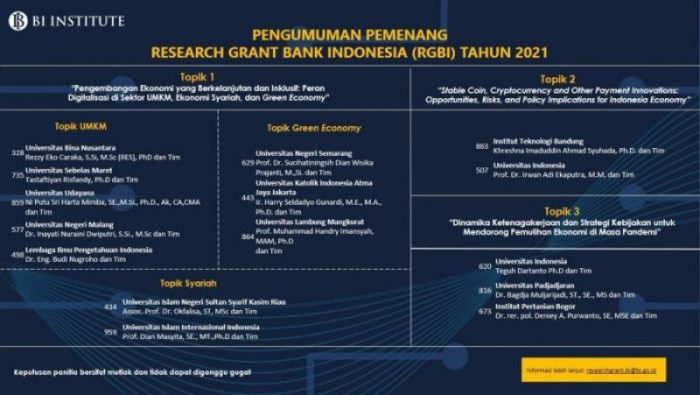
    Faculty of Economics and Business (FEB) Universitas Sebelas Maret (UNS) Surakarta faculty member, Tastaftiyan Risfandy, S.E., M.Sc, Ph.D., successfully won the Research Grant Bank Indonesia (RGBI) 2021. RGBI is an international research competition grant from Bank Indonesia. In his RGBI research proposal, Tastaftiyan has a three-member team, himself as research team leader, and Prof. Dr. Mansor Ibrahim (International Center for Education in Islamic Finance/INCEIF-Malaysia) and Inas Nurfadia Futri, S.M. (UNS) and research team members.

    Their research topic “Sustainable and Inclusive Economic Development: the Role of Digitalization in MSME Sector,” become one of the winners over 1,334 international applicants with total 454 proposals. and received a Bank Indonesia research grant for MSME topic.

    The funding is provided annually under a specific topic each year. This year the RGBI includes three different topics, namely, (1) the Sustainable and Inclusive Economic Development: the role of digitalization in MSME, Sharia Economic, and Green Economy; (2) Stable Coin, Cryptocurrency and Other Payment Innovations: Opportunities, Risk, and Policy Implication for Indonesia Economy; (3) Employment Dynamics and Policy Strategy to Support the Economic Recovery During the Pandemic.

    When contacted by the FEB UNS Media team, Tastaftiyan reveals that his team is confident if the research plan was prepared according to the correct methodology and providing a contribution according to the current issue, they will have a great opportunity to compete for funding grants or publication opportunity.

    “Our team strive to take on the current issues in Covid-19 pandemic and Digital Finance, as well as its contributions. Alhamdulillah, finally our team can become one of the winner in RGBI,” Tastaftiyan states.

    Tastaftiyan’s study is expected to provide a suggestion for Indonesian economic authority in preparing a future policy that supports the development of digital finance in Indonesia. (Humas-FEB)

  • FEB UNS Won First Place in Excellent Product Virtual Exhibition

    FEB UNS Won First Place in Excellent Product Virtual Exhibition

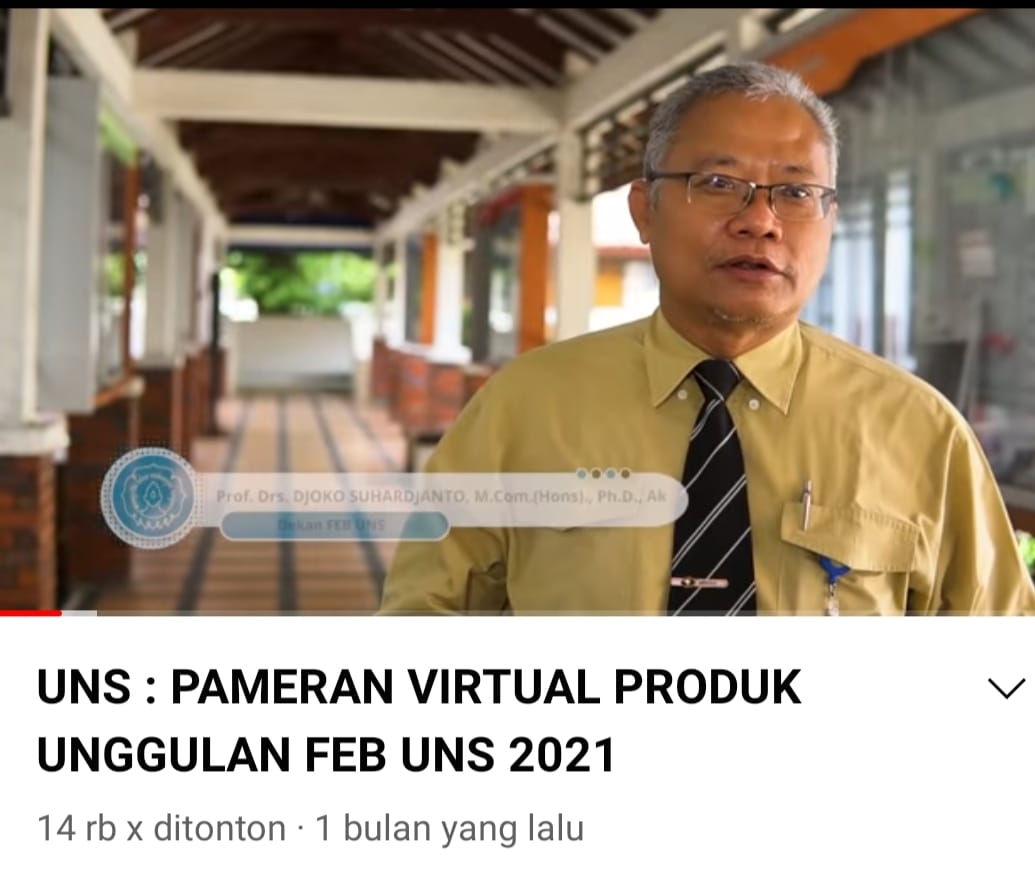
    The Faculty of Economics and Business (FEB) Universitas Sebelas Maret (UNS) succeeded winning the Virtual Exhibition in UNS 45th Anniversary. The result of the competition is announced virtually during the Awarding Ceremony Virtual Exhibition and Virtual Choir Festival, which coincided with the National Education Day on Sunday, May 2nd, 2021.

    In total there are 15 teams participating in the Virtual Exhibition, from the faculties, institutes, and units in UNS campus with their various featured products and innovations. The video participated in the competition must be original and never been participated in another competition.

    Other than the exhibition, FEB succeeded to win various other competitions for the celebration of UNS anniversary, among others are Healthy Canteen competition (3rd place) and Staff Storytelling Competition (2nd place). Both competitions were announced during the virtual shadow puppet performance on March 20th, 2021.

    The Dean of FEB UNS, Prof. Djoko Suhardjanto, M.Com. (Hons), Ph.D., Ak., appreciates the achievements accomplished by the FEB Team. “Congratulations to all the winners. Thank you for your participations as the academic members of the FEB UNS during the UNS Anniversary celebration. We must work together to achieve a stronger FEB UNS,” he states.

    Following these achievements there will be another announcement for other competitions on May 20th, 2021, for external competition in scientific activities, art and culture, as well as virtual exercise. (Humas-FEB)

  • The Top 10 Teams in International Business Canvas Competition Present Their Business Idea

    The Top 10 Teams in International Business Canvas Competition Present Their Business Idea

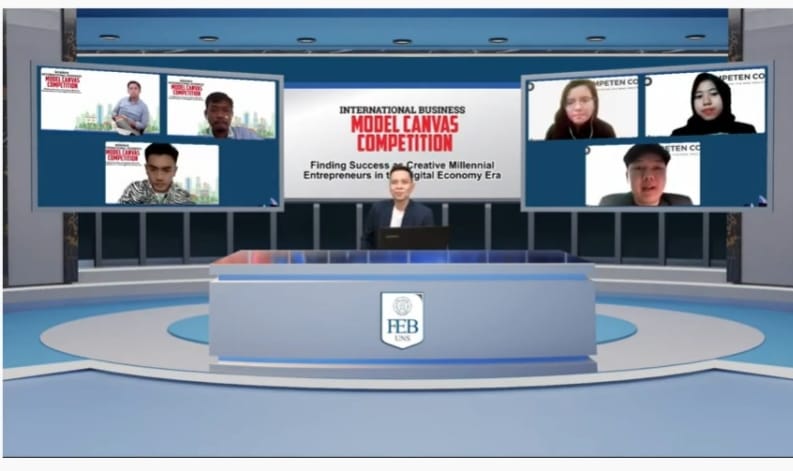
    The top 10 (ten) team passed the elimination stages of the International Business Canvas Competition, organized by the Faculty of Economics and Business (FEB) Universitas Sebelas Maret (UNS) Surakarta. The teams will present their business idea in front of the Board of Judges on Tuesday, April 27th, 2021. The top ten teams are Sentelala Team from Universitas Prasetiya Mulya, ‘Diceritain’ Team from Universitas Indonesia, CoC Unsoed from Universitas Jenderal Sudirman, Labs from Telkom University, CnW from Universitas Negeri Malang, Jetz! from Universitas Gadjah Mada, Team * from Universitas Padjadjaran, Team Deadline Susulan from Univeristas Sebelas Maret, PalePale Team from Institut Teknologi Bandung, and Castelo from Telkom University.

    Jetz! One of the Top Teams in International Business Canvas Competition

    The judges for the session are Catur Sugiarto, S.E., M.S.M. Ph.D., and Ariyanto Adhi Nugroho, SE, M.Ec,Dev, MAPPI., as academics judges from FEB UNS, and Kusdarmawan Aryo Brakoso, CEO Rown Division, Bull Syndicate, and Hallosolo Kitchen, as a judge from the business sector.

    The Dean of FEB UNS, Prof. Drs. Djoko Suhardjanto, M.Com, (Hons), Ph.D., Ak., states that the International Business Canvas Competition aims to nurture the entrepreneurship spirit. The competition that was organized as a part of the UNS 45th Anniversary celebration is expected to be a channel for the students in Indonesia and from abroad countries to deliver new business ideas. Furthermore, the event is expected to bring new entrepreneurs with excellent business ideas and supporting new business initiatives.

    The Competition is open from 22 February 2021, with a total of 51 participating teams from the best universities across Indonesia. Starting with registration, the participating teams must compete among themselves with their excellent business idea virtually on April 5th, 6th, and 9th, 2021.

    The best 10 teams selected must present their business idea on April 27th, 2021, to select the top 5 teams that will be announced on May 20th, 2021. (Humas FEB)