FEB

Kategori: s1_mnj

  • Inviting Prof. Clotilde Coron, Management Study Program Discuss Organizational Theory

    Inviting Prof. Clotilde Coron, Management Study Program Discuss Organizational Theory

    The Visiting Professor Series of the Kompetisi Kampus Merdeka Program (PKKM) 2022, hosted by the Management Study Program, Faculty of Economics and Business (FEB), Universitas Sebelas Maret (UNS) Surakarta, goes on. In their recent agenda, the Management Study Program invited Prof. Clotilde Coron, from Sorbonne Business School, France, to a Guest Lecture Management: Organizational Theories and Flexibility Organizational Design. The event was conducted virtually through the Zoom Cloud Meeting and was attended by 270 participants.
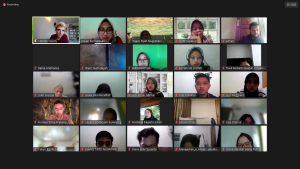
    Guest Lecture Participants

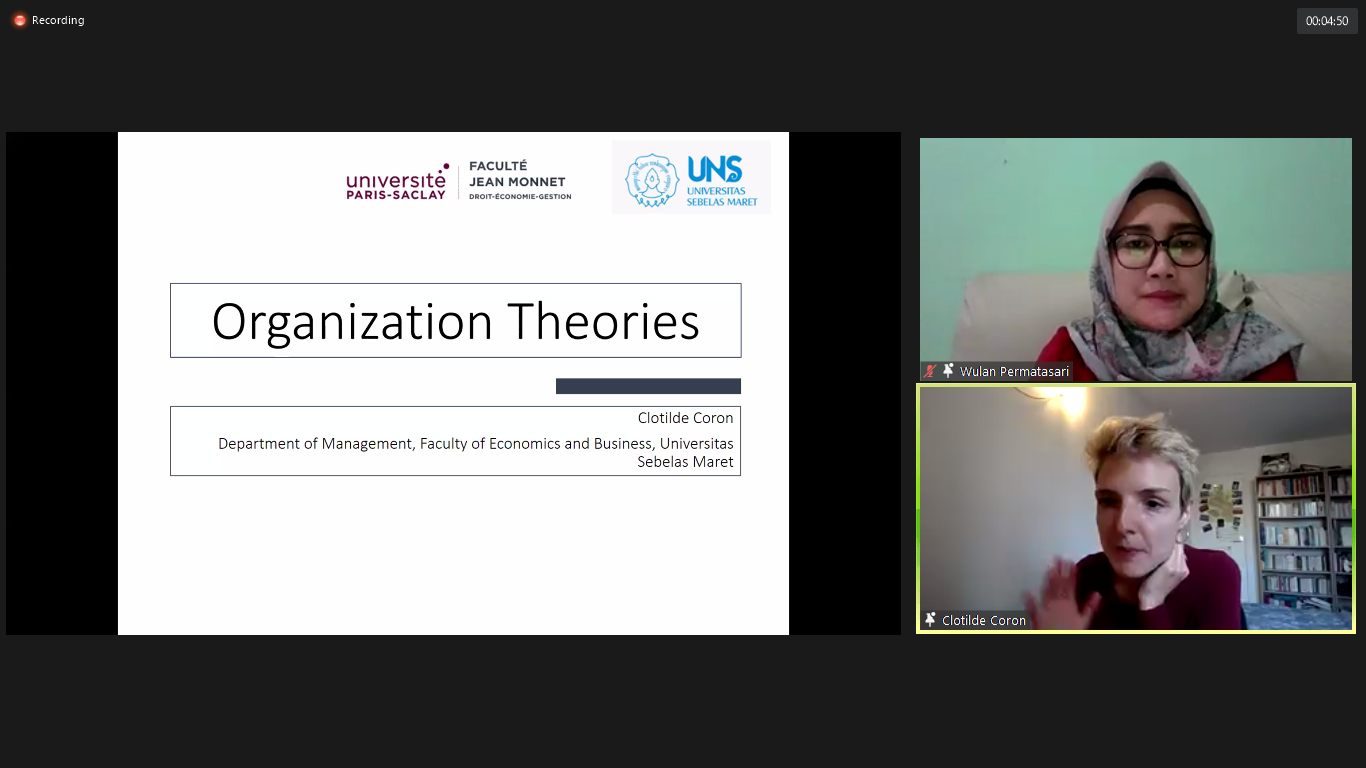
    Starting the discussion of organizational theory, Prof. Coron explains the definition of organization and organizational theory. In general, she explained that an organization is a group of individuals with the objective of accomplishing a specified goal. However, in real life, there must be challenges faced by an organization to achieve its goal. These problems are usually related to the alignment between the individual and organization’s objective, distribution of duties, and control process. “Therefore, in an organization, it is crucial to ensure that all members have a similar objective to the organization’s goal. Hence, an organization must ensure that the collaborative objective within the organization can be internalized as members’ objective,” explains Prof. Coron.

    Prof. Clotilde Coron, from Sorbonne Business School, France

    Meanwhile, regarding organizational theory, Prof. Coron explained various commonly-used theories to understand an organization. Further, she explained the classical theories, human relations, contingency theories, and systemic theories. “Not all organizations have the same system. There is a specific characteristic in each organization, which is affected by internal factors such as technology, strategy, qualification level, organization’s age, and size. In this matter, a theory is focused on the function and objectives of an organization to improve its efficiency,” reveals Prof. Coron.

    After the material presentation, the event conducted on Thursday, October 27th, 2022, continues with a questions and answers session led by Dr. Wulan Permatasari, SE., MM., as Moderator. The participants’ enthusiasm, which was dominated by students, was proved by the number of questions delivered by participants.
  • Management Study Program Invited Prof. Chicksand in Workshop: How to Publish Operation Management Papers in Reputable Journals

    Management Study Program Invited Prof. Chicksand in Workshop: How to Publish Operation Management Papers in Reputable Journals

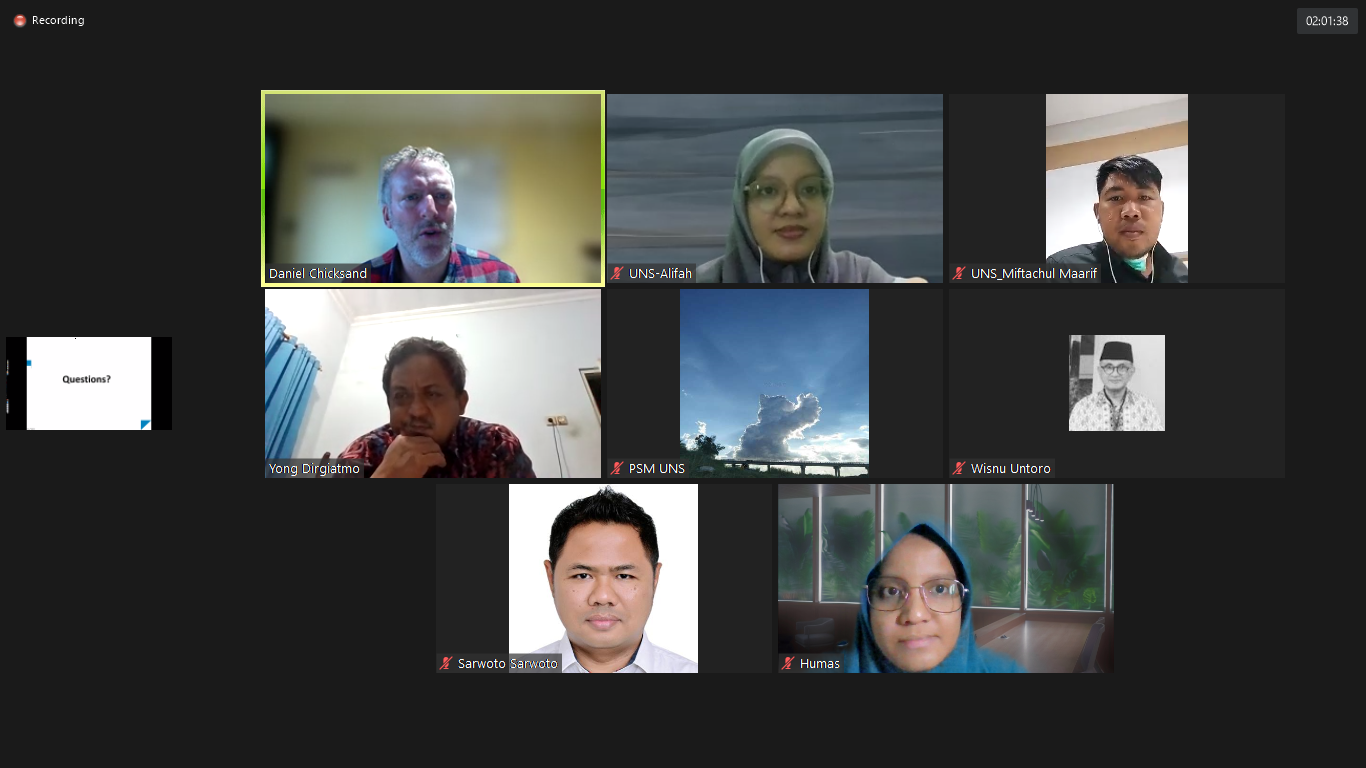
    Management Study Program, Faculty of Economics and Business (FEB), Universitas Sebelas Maret (UNS) Surakarta, invited Prof. Daniel Chicksand from Birmingham Business School (UK) in a Visiting Professor Agenda. The current agenda was part of the Kompetisi Kampus Merdeka Program (PKKM) 2022, conducted virtually on Thursday, October 20th, 2022.

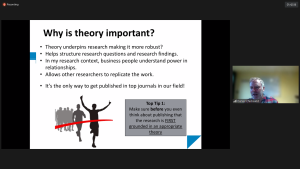
    The event went interactively with the attendance of the lecturers of operation management study from the Management Study Program and was led by Alifah Fibayani, MSc., as the Moderator. Opening the material presentation, Prof. Chicksand invited the participants to answer a question regarding the journal ranking system in Indonesia, whether Indonesia follows the Scopus and Scimago system or adopts a specific system in the country. Following the opening question, the Professor explains the first step to be prepared by a researcher before publishing their research articles. “Right now, getting published in a reputable international journal is getting harder. Before starting the publication process, it is better if you have a specific theme for you to follow, either to develop the existing research or to establish your expertise identity as a researcher,” reveals Prof. Chicksand.

    Further, Prof. Chicksand delivers another question for material discussion regarding the reason for getting published. In line with the participants’ answers, in this case, Prof. Chicksand states that one of the reasons for publication is to disseminate potential solutions to the problems in the community or business.

    The discussion is followed by the stages or aspects that need to be considered by the author in choosing a publication outlet. Two aspects that need to be considered in choosing the right outlet are the journal’s impact factor and ranking. Aside from journal selection, Prof. Chicksand also shares specific reasons for a publisher to reject a manuscript. “Sometimes the problem lies in how you formulate the research problem because sometimes authors like to understate the contribution of their research.

    Concluding the discussion, Prof. Chicksand delivers four top tips for a successful publication process. The first is to choose the right theory for the planned research. The second is to establish a continuous process from article preparation through collaboration. Third, the author and researcher need to establish resilience and flexibility, and lastly, a researcher needs to learn from their past mistake. “Sometimes we need to build a resilient and persistent stance, while at the same time, we need to quickly move on from a rejection,” reveals Prof. Chicksand.

    The agenda, which is filled with interactive discussion and experience sharing, will be followed-up with participants’ article review by Prof. Chicksand.

  • MSME in Polengan Village Participated in Digital Marketing, Branding, and Packaging Training

    MSME in Polengan Village Participated in Digital Marketing, Branding, and Packaging Training

    Technology transformation has motivated the industrial sector to improve their product and service. This improvement is applicable not only to big corporations but also to MSMEs, which must adapt to the current condition to survive in the highly competitive market. One of the transformations that can’t be avoided by business is the penetration of the internet, which has become a crucial part of daily human life.

    The existence of the internet has brought a substantial effect on the business sector, encouraging corporations and MSMEs to expand their business by taking advantage of the internet, especially e-commerce. The Polengan Village’s BUMDES and MSMEs have long realized this opportunity, but many of the MSMEs in the village are yet to know and understand how to adopt digital marketing.
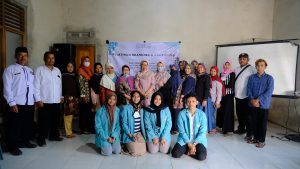
    Considering this problem, the Creative Economy Research Group’s Community Service Program Team, led by Prof. Dr. Asri Laksmi Riani, MS., along with its members Prof. Dr. Hunik Sri Runing Sawitri, S.E., M.Si., Suryandari Istiqomah, SE, MSc., Dra. Anastasia Riani Suprapti, M.Si., and Dr. Intan Novela Qurrotul Aini, S.E., M.Si., provided a Digital Marketing, Branding, and Packaging Training.

    In this training, the Community Service Team involves students in delivering training material to the MSMEs in Polengan Village. The training is divided into three sessions, starting with training in branding delivered by Brillian Raiszhul, who encourages MSMEs entrepreneurs to learn how to attract prospective customers through product photographs. The picture provided, indeed, must consider a favorable angle and color composition.

    The following session was packaging training, considering that after understanding how to attract customers’ attention through a picture, the MSMEs’ entrepreneur can enhance their packaging to add value to their product. This session is delivered by Salsabilla Indah, who shows the stages of designing beautiful and enticing packaging for prospective customers.
    The last session was concluded with digital marketing training, delivered by Afifah Hanindia, who invited the participants to register their MSMEs to several social media, such as Instagram and Facebook, as well as Shopee e-commerce that can allow them to distribute their product to more locations, thus increasing the income of Polengan Village residents.

    After the material dissemination, the agenda goes on with monitoring and assistance for the participants.

  • Creative Economy Research Group Hosted Product Innovation Training for BUMDES and MSMEs in Polengan Village

    Creative Economy Research Group Hosted Product Innovation Training for BUMDES and MSMEs in Polengan Village

    The Covid-19 pandemic has affected all sectors of our daily life, starting from health, education, and the economy, which brought challenges and alterations to various business levels. The effect of the pandemic hit the MSMEs sector hard, where its business was managed by individuals or households.

    To survive, the MSMEs sector must keep on innovating to deliver premium products and services to their customers. This problem brought concern to BUMDES and MSME in Polengan Village, Srumbung Sub-District, Magelang Municipality, which attempted to initiate an innovation to process material available in their surrounding environment.

    The wish of BUMDES and MSME in Polengan Village later received a response from a community service team from the Creative Economy Research Group, Faculty of Economics and Business (FEB) UNS, led by Prof. Dr. Asri Laksmi Riani, MS., in the form of a Vegetable Product Innovation Training.

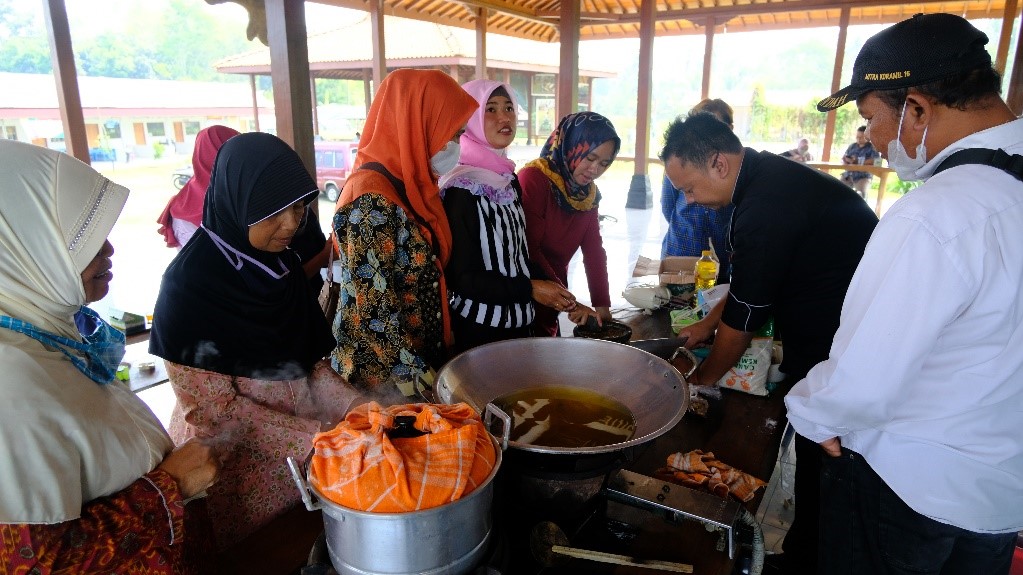
    This training was conducted on 20 July 2022 in collaboration with Mr. Bambang Tri Admojo, who demonstrated several dishes and cuisines using local vegetables in front of the BUMDES and MSMEs in Polengan.
    The demo shows how to cook three types of dishes, namely cassava leaf chips, crispy spinach, and tiwul sponge cake.

    During the training, the coach provided material and invited the participants to keeping-up with the cooking process. Participants are allowed to inquire many questions during the training.

    The participants’ enthusiasm and interest during the training are shown in their efforts to keep up with the cooking process.
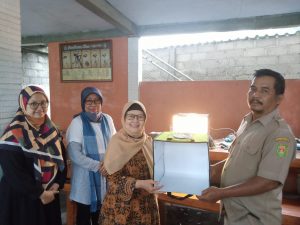
    Besides production innovation, this community service program also encourages Polengan Village BUMDES and MSMEs to participate in marketing innovation through the internet. Therefore, the community service team provided supporting equipment to aid online sales to the village apparatus on 10 October 2022.

  • Management Study Program Discuss Queuing Theory in Guest Lecture Operation Research

    Management Study Program Discuss Queuing Theory in Guest Lecture Operation Research

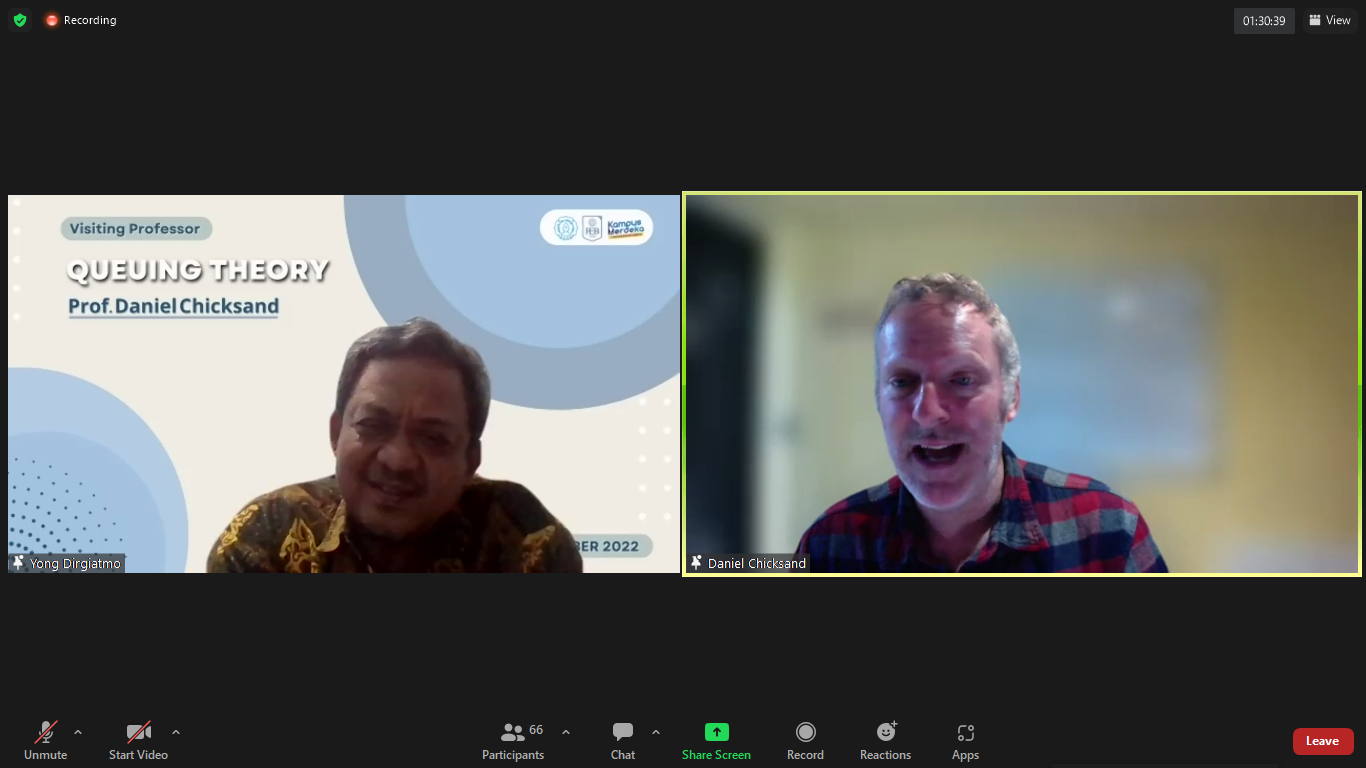
    Conducting the Visiting Professor series under the Kompetisi Kampus Merdeka Program (PKKM), Management Study Program, Faculty of Economics and Business (FEB), Universitas Sebelas Maret (UNS) Surakarta, invited Prof. Daniel Chicksand from Birmingham Business School, UK. The event conducted virtually on Thursday, October 6th, 2022, discusses Queuing Theory in Operation Management Research.

    Through the Zoom Cloud Meeting platform, the agenda was attended by 80 participants and was led by Dr. Yong Dirgiatmo, a lecturer of the Management Study Program, as Moderator. In this agenda, Prof. Chicksand delivered material entitled ‘Operation Research, Capacity Management, and Queuing Theory’ for about 75 minutes, divided into two sessions.
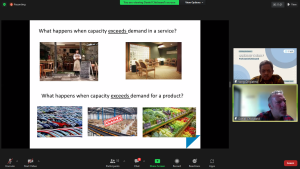
    Starting the presentation, Prof. Chicksand explained the definition of capacity management, which involves business capacity, market demand, and forecast. Meanwhile, a business needs capacity management because of the need to align production capacity to market demand. Production capacity that is lower than market demand will lead to production delay and loss of sales opportunity, on the contrary, when production capacity is too big, it will lead to higher costs.

    “You can manage long-term market demand by storing products. For instance, when inventory (low capacity) is not aligned with market demand, such as the Covid-19 case leading to long queues at a hospital and empty products in a supermarket. Meanwhile, when product inventory exceeds market demand, there will be many unsold products, leftover, or, in a restaurant setting, empty table,” said Prof. Chicksand.

    Further, Prof. Chicksand explains about the techniques available to measure market demand fluctuation, alternative production planning, and mixed planning. Meanwhile, regarding queuing theory, Prof. Chicksand states that ‘queue’ does not always bear a negative connotation because the absence of queue signs an over-capacity. “Queuing theory is usually applied in staff downsizing, schedule planning, and inventory planning to improve customer service,” he explains in the guest lecture as the continuation of the Supply Chain Management Guest Lecture.

  • Guest Lecture Human Resource Management: Diversity and Gender Equality

    Guest Lecture Human Resource Management: Diversity and Gender Equality

    The Management Study Program, Faculty of Economics and Business (FEB), Universitas Sebelas Maret (UNS) Surakarta, hosted another Guest Lecture as part of the Visiting Professor Series in Kompetisi Kampus Merdeka Program (PKKM) 2022, Thursday, October 6th, 2022. In this guest lecture series, the Study Program invited Associate Professor Clotilde Coron from Sorbonne Business School, France, to deliver material on Diversity and Gender Equality.

    MSP FEB UNS Guest Lecture
    Associate Profesor Clotilde Coron delivering lecture material

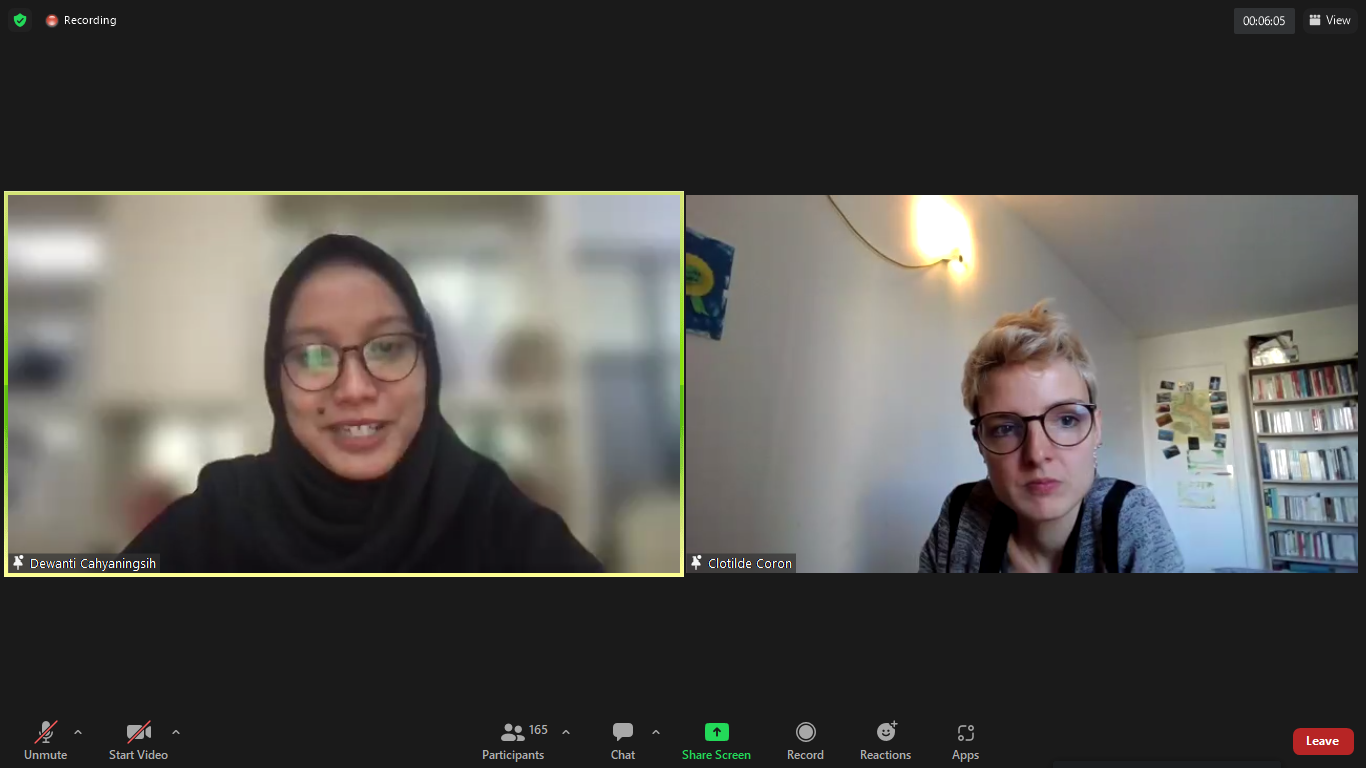
    Led by Dewanti Cahyaningsih SE, M.Rech., the guest lecture was attended by more than 230 participants through the Zoom Cloud Meeting platform. Starting the material dissemination, Assoc. Prof. Coron explains that the topic of diversity is starting to attract the industrial sectors’ attention. However, there are numerous different approaches to discussing diversity. “There are many different approaches in this topic discussion, this including the different significance of subjects and topics in each country, for instance, the USA with the black life’s matter (BLM) topic or France with sexual orientation. Therefore, it is important to consider your point of view on diversity and equality,” explains Prof. Coron.

    The current guest lecture with Prof. Coron will cover the definition of diversity and equality, gender equality, disability inclusion, and bias in human resource management, as well as methods available to reduce the bias. Regarding the definition of diversity, Prof. Coron invited students to choose the most appropriate words to describe diversity through the Wooclap platform.

    “Diversity in this matter refers to the condition of the workforce representing the natural condition of the population in a country. The idea of diversity aims to avoid discrimination because when a company does not discriminate against people, then the composition of the workforce in the company will represent the composition of the community,” said Prof. Coron.

    Material discussion continues with the difference between inclusion and equality, where inclusion is a crucial idea within diversity. Diversity with no inclusion will never lead to equality. “Because the objective of inclusion is to empower people through mutual respect and appreciation for personal condition as the inherent factor of diversity.”

  • Management Study Program Invites Prof. Daniel Chicksand in Supply Chain Management Guest Lecture

    Management Study Program Invites Prof. Daniel Chicksand in Supply Chain Management Guest Lecture

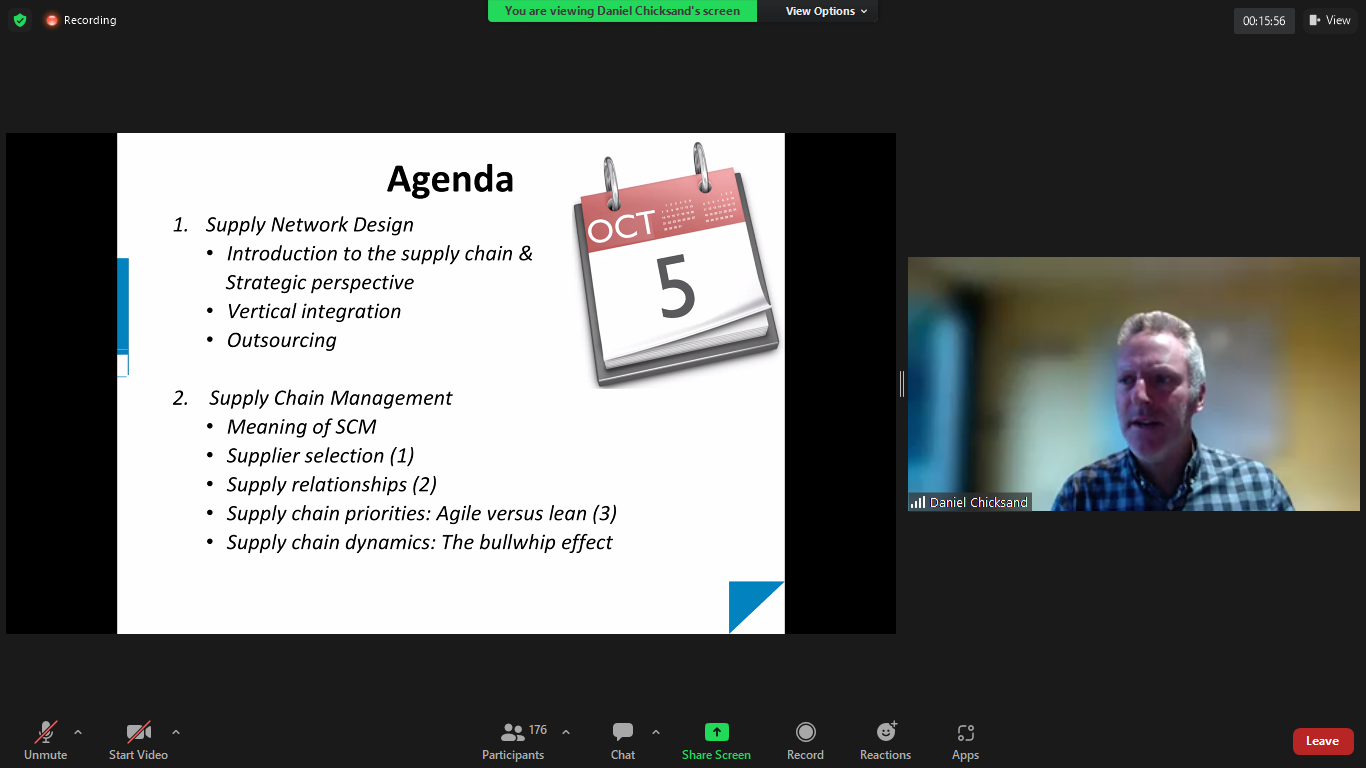
    Management Study Program, Faculty of Economics and Business (FEB), Universitas Sebelas Maret (UNS) Surakarta, hosted a guest lecture visiting professor series as part of the Visiting Professor Kompetisi Kampus Merdeka Program (PKKM) 2022. In an event entitled Guest Lecture Operation Management “Supply Chain Management in 5.0 Industry,” hosted virtually through the Zoom Cloud Meeting on Wednesday, October 5th, 2022, the Study Program invited Prof. Daniel Chicksand from Birmingham Business School, UK, and Dewanti Cahyaningsih M.Rech., as event moderator.

    Invited speaker, Prof. Daniel Chicksand

    Through the event attended by more than 230 students and lecturer participants, Prof. Chicksand discusses the supply chain from a theoretical and professional point of view. “Supply chain does not suddenly appear, it needs design. A business needs to decide the design and how they will manage their supply chain,” he explains, starting the material dissemination.

    Further, Prof. Chicksand also explains the difference between operation management and supply chain management, where operation management is more focused on the transformation process, while supply chain management is more focused on input and output. In general, the lecture session was divided into two parts, the first part discussed supply chain network design and the second part about supply chain management. Supply chain network design is affected by two aspects, structure and network, and the supply chain network implemented. Meanwhile, for the supply chain sub-management, Prof. Chicksand explains several points about supplier selection, relationship with the supplier, and priority between the agile and lean supply chains.

    “Recently, we saw numerous news regarding supply chains, where management must face the black swan effect anytime, which is caused by military turmoil in a certain region that can affect the supply chain process, leading to potential delivery delay. Supply chain management becomes crucial because this aspect affects how we use supply constantly,” explains Prof. Chicksand.

    Following the material dissemination that lasted for around one hour, students were given the opportunity to deliver questions interactively with Prof. Chicksand. Some students show their enthusiasm through inquiries regarding outsourcing and other aspects related to the supply chain.

  • Reviewing Entrepreneurship Program, Management Study Program Invites Visiting Professor From Malaysia

    Reviewing Entrepreneurship Program, Management Study Program Invites Visiting Professor From Malaysia

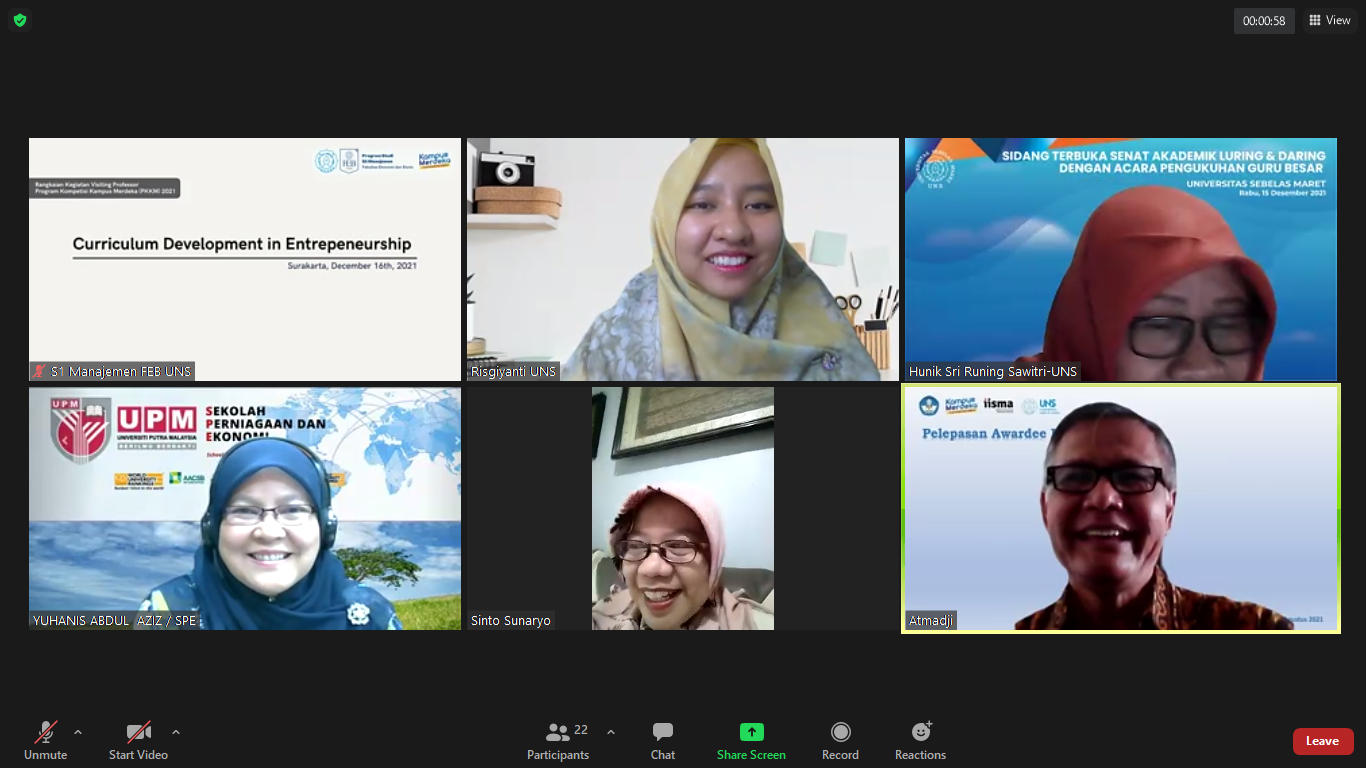
    In line with the Merdeka Belajar Kampus Merdeka (MBKM) Program launched by the Ministry of Education and Technology, the Bachelor in Management Study Program, Faculty of Economics and Business (FEB), Universitas Sebelas Maret (UNS) Surakarta, held a virtual Visiting Professor inviting Associate Professor Dr. Yuhanis Abdul Azis, on Thursday, 16 December 2021, via Zoom Cloud Meeting. This agenda is part of a series of Visiting Professor programs within the 2021 Independent Campus Competition Program (PKKM).

    The meeting agenda entitled ‘Curriculum Development in Entrepreneurship’ discusses Entrepreneurship MBKM program implementation, which the Study Program currently hosts. The MBKM program is an independent study program that provides opportunities for students to study material or topics according to students’ interests. Eleven students are currently participating in the MBKM entrepreneurship program, divided into 8 (eight) groups.
    On this occasion, Prof. Yuhanis presented the review outcome related to the entrepreneurship program conducted by the Bachelor in Management Study Program FEB UNS, summarized into feedback, recommendations, and conclusions.

    Related to the course rubric development, Prof. Yuhanis stated that the rubric prepared by the Management Study Program was quite good. “The Assessment Rubric has been prepared well by the study program, although there is still room for improvement such as the importance of maintaining consistency of the terms used and minor revisions to ensure that the rubric can reflect the subject being assessed.”

    Further, Prof. Yuhanis admitted that the report prepared by the study program seemed quite concise. Thus, further elaboration can be added to provide more detailed information and guidelines for the appointed student supervisor. Regarding the final project system applied in the program, Prof. Yuhanis emphasized the importance of the expected targets of the Final Assignment assessment, whether students are expected to do research or not. For the Final Assignment, an assessment rubric is also required.
    Regarding the syllabus, Prof. Yuhanis revealed three findings points: information on Expected Outcome (Target) that need adjustment, subject suitability, naming of course subjects, and the assessment system. After delivering the review conducted by Prof. Yuhanis, the event continued with a question and answer session, led by Risgiyanti (Lecturer of Management Study Program) as the session’s moderator, between Prof. Yuhanis and participants, consisting of lecturers from the FEB UNS Management Study Program.

    Reporter: Aulia
    Editor: Humas FEB

  • Management Study Program Holds Guest Lecture in Financial Management: Transformation in Banking

    Management Study Program Holds Guest Lecture in Financial Management: Transformation in Banking

    The Management Study Program, Faculty of Economics and Business (FEB) Universitas Sebelas Maret (UNS) Surakarta, held the second part of the Guest Lectures series in the 2021 Program Kompetisi Kampus Merdeka (PKKM) entitled “Financial Management: Transformation in Banking” on Tuesday (19/10/2021).

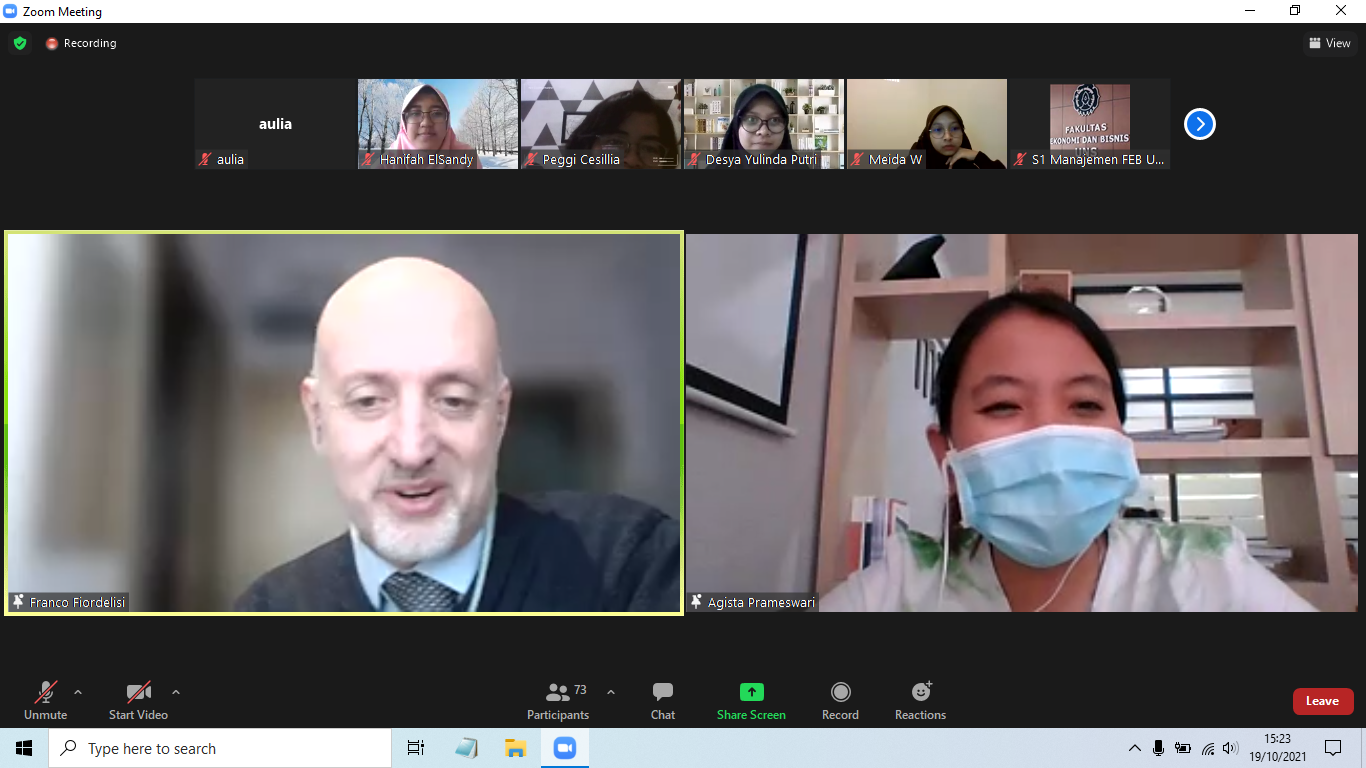
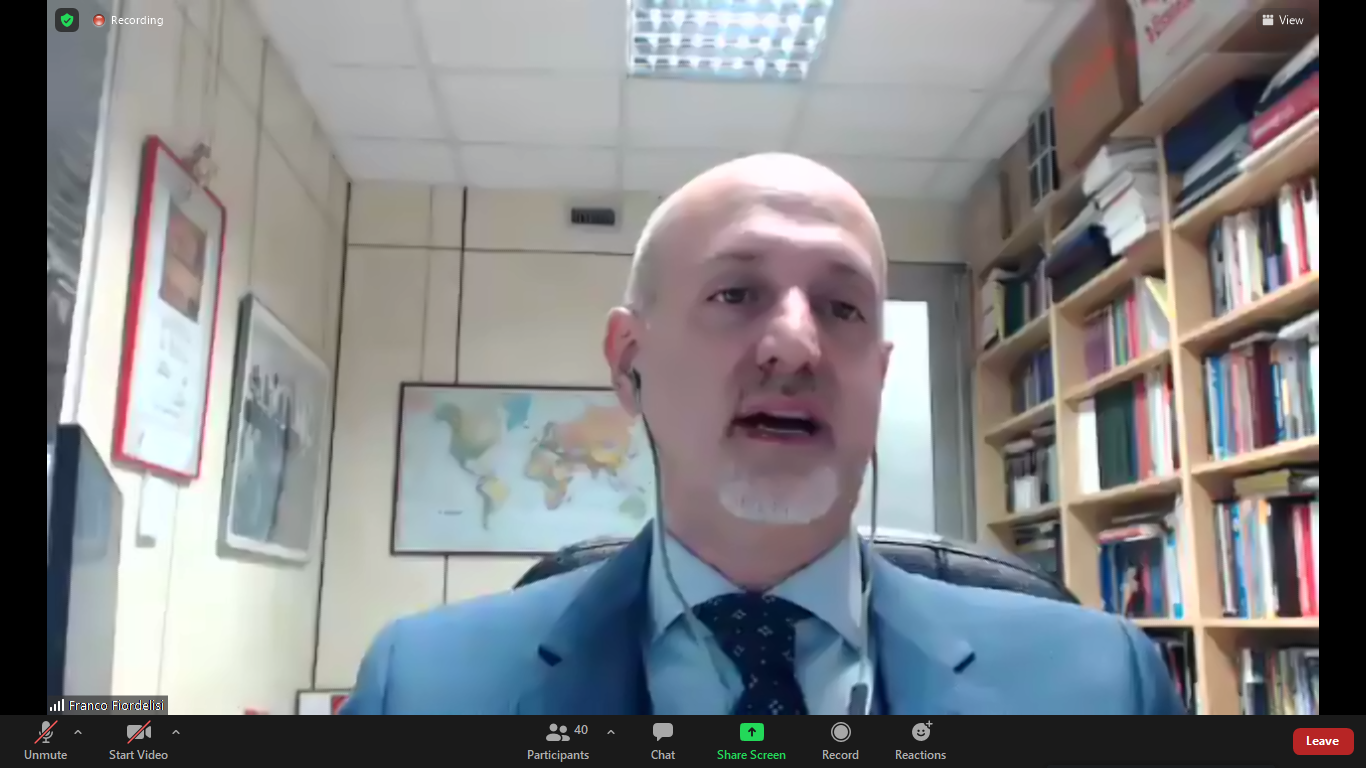
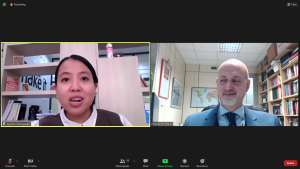
    The Guest Lecture with Prof. Franco Fiordelisi was held virtually through the Zoom Cloud Meeting and was attended by around 70 participants consisting of students and lecturers from FEB UNS.

    Before starting his material presentation on Liquidity Risk in the Banking sector, Prof. Fiordelisi expressed his hope to visit UNS directly. “I hope to be able to visit UNS in person because your university has interesting stories and facilities,” said Prof. Fiordelisi.

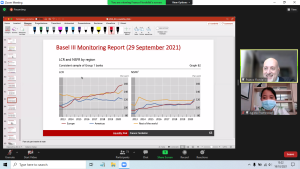
    As part of the Guest Lecture series on financial management, the material presented by Prof. Fiordelisi in this guest lecture aims to help students in understanding how banks are managing their sources of liquidity risk.

    The material is started with the definition of liquidity from three different views, namely the securities, markets, and financial liquidity. Liquidity viewed from the security instrument refers to the condition where a security instrument can be traded easily in the capital market.

    On the other hand, a market (stock/capital market) is considered liquid when there is a good or balanced level of demand and supply. On the other hand, financial liquidity is a condition where a financial instrument can be used to obtain funding or to pay off obligations. Hence, it can be concluded that, in general, liquidity can be defined as the number of assets that can be immediately used in transactions.

    In relation to banking institutions, Prof. Fiordelisi mentioned that banks are the only institutions dealing with tremendous liquidity pressures due to their obligation to maintain customer trust.

    According to him, banks must be able to manage liquidity well to ensure that customers can withdraw funds for their daily needs.

    Liquidity risk can occur under two types of circumstances, a result of specific events or due to systemic conditions. Specific events liquidity risk normally occur due to internal conditions of the bank or a specific event happened, for example, debtors that fail to settle periodic installments, which then disrupts the bank’s liquidity level. This condition, according to Prof. Fiordelisi, requires more attention from bank managers.
    On the other hand, liquidity risk due to systemic conditions usually occurs in other banking institutions but has a systemic impact on a country’s financial system. “Although this systemic condition does not actually involve the concerned bank, such condition could affect customer confidence in the banking sector as a whole. Therefore, managers still have to pay attention to this systemic condition in making decisions,” explained Prof. Fiordelisi.

    The topic of discussion continues to the types of calculation approaches in liquidity risk management, which consist of a stock-based approach, cash flow, and hybrid. The discussion is closed with the explanation of various regulations in the banking sector, which are globally regulated by the Basel Committee on Banking Supervision within the Basel III provision.

    Reporter: Aulia
    Editor: Humas FEB

  • Management Study Program Invited Prof. Franco Fiordelisi in Visiting Lecture’ Financial Management, Recent Issues in Finance’

    Management Study Program Invited Prof. Franco Fiordelisi in Visiting Lecture’ Financial Management, Recent Issues in Finance’

    The Management Study Program, Faculty of Economics and Business (FEB) Universitas Sebelas Maret (UNS) Surakarta invited another well-known professor in a series of visiting lectures for the 2021 Program Kompetisi Kampus Merdeka (PKKM). This time around, the Management Study Program invited Prof. Franco Fiordelisi, a professor in finance and banking from the University of Rome III, Italy. Prof. Fiordelisi also serves as the President of the Financial Intermediation Network of European Studies (FINEST).

    At the virtual guest lecture conducted through the Zoom Cloud Meeting on Tuesday (12/10/2021), Prof. Fiordelisi delivered material on financial management, specifically in risk management. At the beginning of his material presentation, Prof. Fiordelisi explained the definition of risk management in the banking sector, which includes two types of risk, interest risk and credit risk. He further explains the difference between risk and uncertainty, which is often considered to have the same meaning. In this case, according to Prof. Fiordelisi, there is little difference between risk and uncertainty.
    “Risk is a future condition with a measurable probability of occurrence, while in uncertainty, this possibility is unlimited or incalculable,” said Prof. Fiordelisi.

    After the brief explanation of risk and uncertainty, Prof. Fiordelisi explains the general definition of risk management as a logical process to reduce the possibility of loss. In between his presentation, Prof. Fiordelisi asked the participants about today’s biggest risks faced by the banking sector. The session provided an opportunity for students to interact directly with Prof. Fiordelisi.

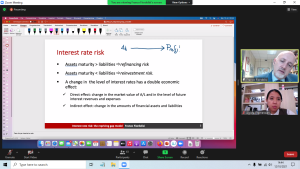
    Afterward, Prof. Fiordelisi explains the stages/steps in risk management and interest rate risk. “Interest rate risk occurs due to a mismatch in value between assets (maturity) and profits,” explained Prof. Fiordelisi.

    Regarding interest rate risk, there are two effects of interest rates changes, the first effect changes in the market value of assets/debt as a direct effect of interest rates fluctuation. The second is the changes in the number of financial assets/debt as an indirect effect of interest rate movements.

    Reporter: Aulia

    Editor: Humas FEB