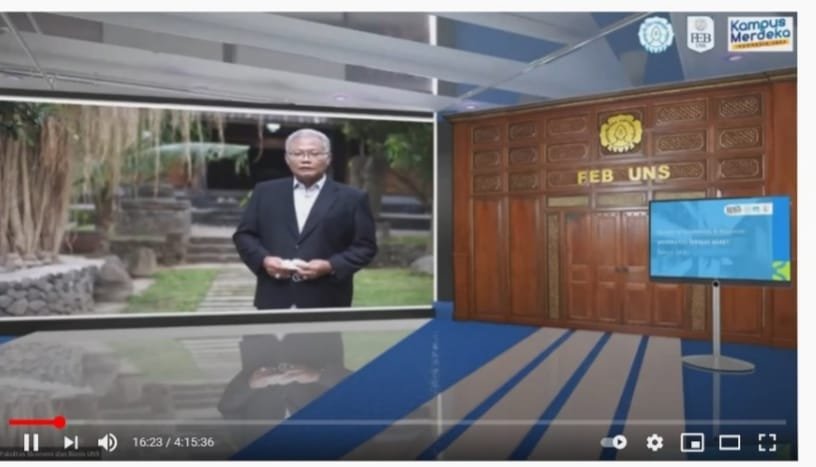
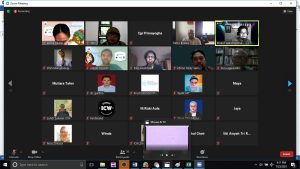
More than 700 new students from the Undergraduate Study Programs in the Faculty of Economics and Business, Universitas Sebelas Maret (FEB UNS), participated in the Virtual New Student Introduction to Campus Life (PKKMB) on Monday, August 16, 2021. The Dean of FEB UNS, Prof. Drs. Djoko Suhardjanto, M.Com. (Hons). Ph.D., Ak., welcomed new students and symbolically handed students’ Semester Course Plan to three student representatives from each study program, Widya Zhafira from Accounting Study Program, Devina Alfa Levia Rizky Alharis from Management Study Program, and Perdana Gilang Yudha Firmansyah from Development Economics Study Program.
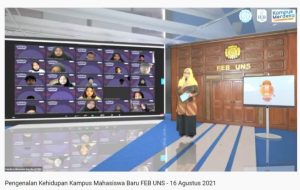 “The Deanery of FEB UNS congratulate the new students. We are thrilled and proud because all of you have joined our Faculty as new students. Once again, congratulations, you have become the faculty members of FEB UNS. Please stay enthusiastic in your study, strengthen your capacity in the FEB UNS Candradimuka crater (t/n: Candradimuka represents an ancient stringent training ground for great champions in old Javanese manuscript), a cultivating place to nurture your competencies to achieve success,” said the Dean encouragingly.
All study programs at FEB UNS, both the Undergraduate and Postgraduate Study Programs, have been accredited ‘A’ by the National Accreditation Board for Higher Education (BAN-PT). Various international accreditation certifications are also achieved by the study programs such as EPAS, AUN QA, and ABEST21. Starting on October 6, 2020, UNS obtained the status as a State University with Legal Entity (PTN-BH). In addition, UNS is included in the first cluster or the main cluster of the best universities in Indonesia.
Further, the Dean also advised that while studying in FEB UNS, new students must maintain good interaction with all existing educational components on the campus and alumni who are often visiting FEB UNS. Numerous alumni of FEB UNS are successful figures occupying important positions both in governmental and private sectors. The notable alumni, among others, are Prof. Wimboh Santoso, who currently serves as Chairman of the Board of Commissioners of the Indonesian Financial Services Authority (OJK), Doni P Joewono, the current Deputy Governor of Bank Indonesia, Didik Hartantyo, President Director of PT KAI, and several other successful alumni in the private sector including Harijanto, and Nur Harjanto.
At the end of his remarks, the Dean hopes that students would be able to accomplish numerous achievements, both at the national and international levels, while still promoting the nation’s noble cultural values and upholding the life principle of ‘urip sing urup memayu hayuning bawana’ (life should provide benefits for others as well as for the universe).
The PKKMB activity that lasted from morning until late afternoon was also filled with explanations from the FEB UNS Vice Deans, Laboratory Administrator, Supporting Units, Academic Support Staff, and the lecturers from each study program. Several successful alumni are invited to deliver a motivational speech to the new students, such as Doni Primanto Joewono, SE, M.Si, Ubaidi Socheh Hamidi, SE, MM., Endang Kurniawan, SE, Ak., and Dr. Nur Harjanto, MM.
The Deputy Governor of Bank Indonesia, Doni P. Joewono, in his speech, conveyed four important things to guide students to be successful in pursuing studies and careers, namely, being grateful, finding role models, having passion, and being adaptive. The success achieved by the students is due to Allah’s and parents’ blessing. Gratitude must always be expressed for the opportunity to be enrolled on this campus because currently, the achievements of FEB UNS are growing rapidly. All study programs at FEB have been accredited A and obtained international certification.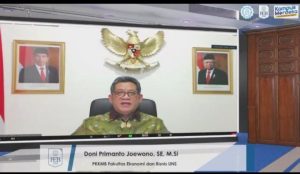
Furthermore, it was conveyed that students must also have a role model to encourage them in achieving future success in their studies and career. “Role models provide motivation and encouragement in learning. Having a role model allows us to explore ourselves, we have a dream, knowing our future goals, whether to continue our studies or to be an economist or to be an entrepreneur, who will be our example,” Mr. Doni said enthusiastically.
Students must also have passion, must have an interest. Passion will encourage students to find role models and be active in organizational activities to enrich and expand students’ knowledge and experience. Fourth, students must be adaptive. Successful people are adaptive people, not just smart and intelligent people. How many people are having mediocre academic achievements but are successful at work because they are highly adaptive to their job environment. (Humas FEB)
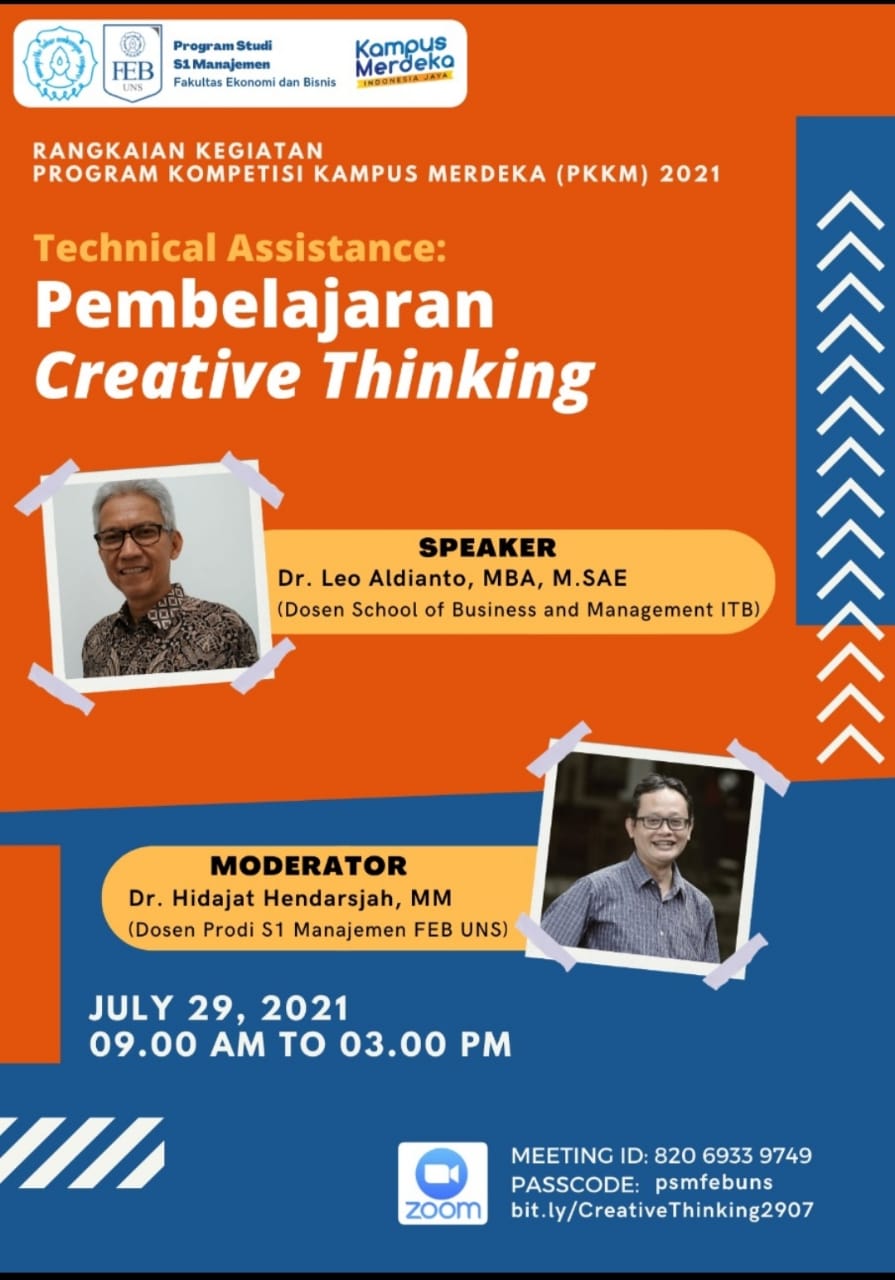
 “What may affect and crucial in fostering creative thinking is how one typically works, behaves, and acts. Additionally, the creative process begins with preparation, generating ideas, and selecting prioritized ideas for implementation. Ultimately, there must be a tangible outcome, whether a physical product, concept, or idea. Most importantly, the environment must be designed to facilitate creativity,” explained Dr. Leo.
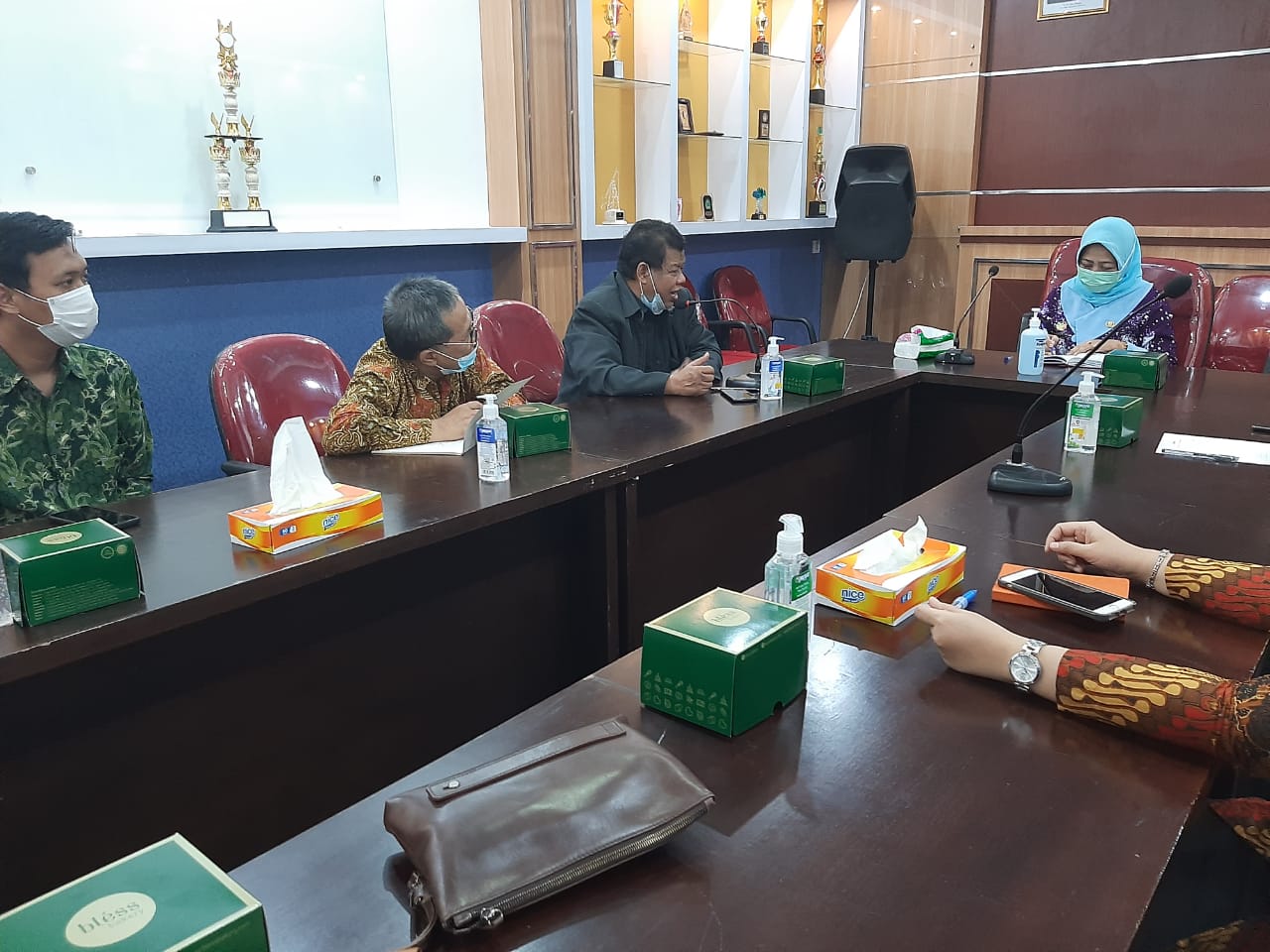
 During the PKM, the Research Group conducted a Focus Group Discussion (FGD) focusing on investment opportunities, mapping investment packages, and implementation strategies. The second part of the discussion centered around the necessity of establishing a Tourism SOE to manage the tourism sector in Magetan. “The objective of this PKM initiative is to develop Magetan into a small city with significant tourism potential,” explained Vita Kartika Sari, S.E., M.Sc.
 Despite challenges posed by the COVID-19 pandemic during its implementation, the event proceeded smoothly with stringent health protocols. “Suboptimal tourism management can lead to reduced Locally Own-Source Revenue (PAD), and thus, we aim to provide assistance in addressing this issue,” she added.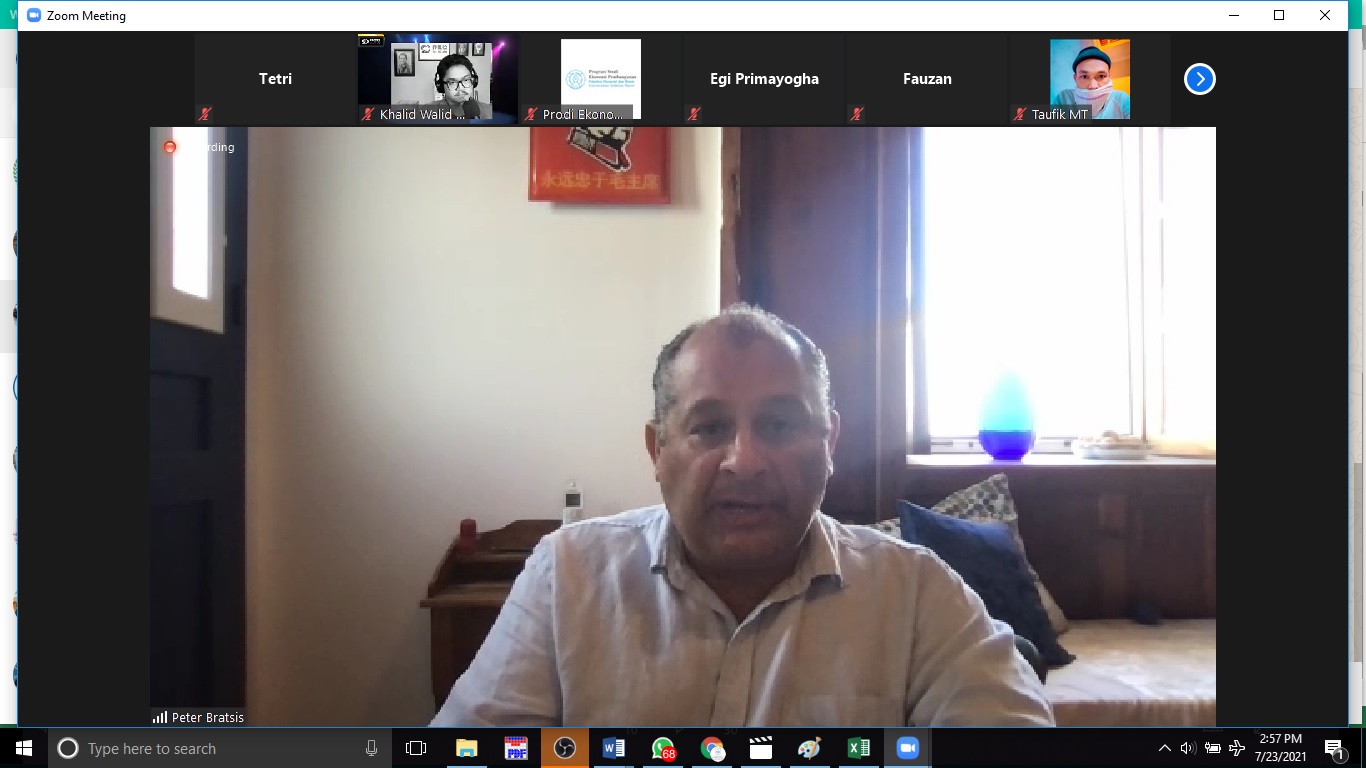
 Dr. Bratsis opens his presentation by defining corruption, noting its evolving definition over time. Initially considered as something outside normal conditions and inherently bad, corruption has transformed into a situation marked by a lack of openness or transparency.