FEB

Blog

  • Accounting Study Program Held a Public Lecture in Banks Performance and Business Development During a Pandemic

    Accounting Study Program Held a Public Lecture in Banks Performance and Business Development During a Pandemic

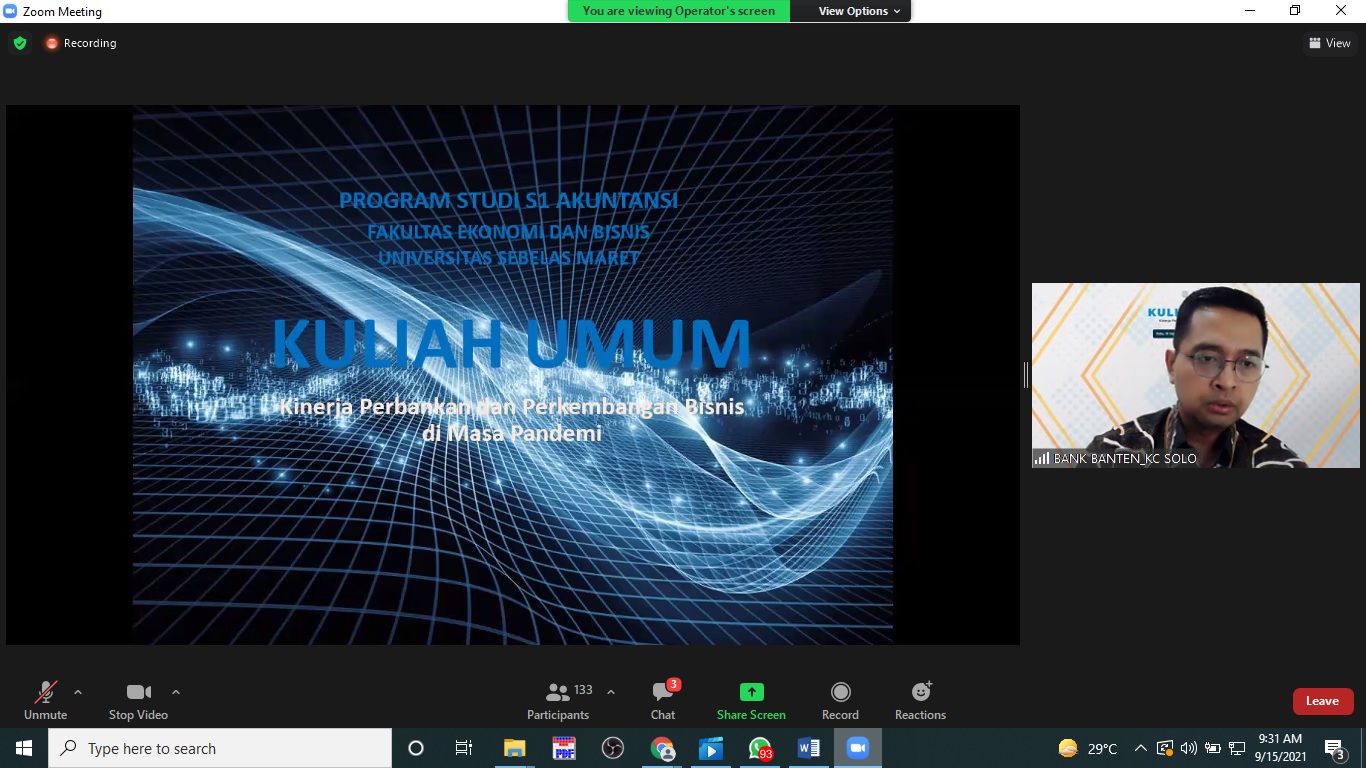
    The COVID-19 pandemic that hit Indonesia for almost two years has caused many changes in the business world. Numerous businesses faced a decline in turnover and even filed for bankruptcies because they were unable to fund their operations. The decrease in people’s income reduces community purchasing power to buy secondary needs. Based on a survey conducted by the Bank Indonesia Representative Office in Solo, business activities are kept on declining until the 4th quarter of 2020. The level of current assets or cash and profitability or operating profit of a business entity had decreased by -2.8% and -25% for the last three consecutive months at the end of the fourth quarter of 2020, respectively.
    This statement was conveyed by Lekso Mirmawan, the Head of the Bank Jateng Solo Branch, in a Public Lecture on Banks Performance and Business Development During the Pandemic, organized by the Accounting Study Program, Faculty of Economics and Business (FEB) Universitas Sebelas Maret (UNS), Wednesday, September 15, 2021. Furthermore, he said that the banking sector is one of the sectors required by the government to take part in the national economic recovery. Banks must make internal and external transformations to contribute to the community, customers, or bank debtors.

    “One of the strategic efforts taken is to provide credit relaxation to debtors affected by the Covid-19 pandemic. This relaxation is provided in the form of deferment for the payment of principal credit installment within a certain period. At the same time, there was an allowance that let some debtors to only pay for the outstanding interest. Following this pattern, we hope that debtors can survive the crisis, funding their working capital, operational costs, and so on,” he explained.

    Another type of relaxation provided is the exemption of principal and interest payment for a certain period. This relaxation is given to companies that are non-essential in nature to encourage entrepreneurs to recover their operations and survive the pandemic.

    Additionally, banks are also diverting commercial loans to consumer loans based on a fixed salary installment. This loan aims to stimulate civil servants borrowing by providing low loan interest.
    During this pandemic, banks are also facing public distrust issues regarding the customers’ fund’s security. Until today, the banking sector seeks to provide education and information dissemination to convince customers that public funds deposited in banks are guaranteed by the Indonesia Deposit Insurance Corporation (LPS).

    Meanwhile, Raja Alkautsar, the Owner of Tanaku Kopi, as the second speaker in the public lecture, which was attended by more than 160 participants, highlights the strategies for those who want to be successful entrepreneurs.

    According to him, to establish a business, one must have passion. Passion can be seen when someone is thrilled to do something and is not bored even though he does it for a long time, always enjoying the specific activity. Passion, if honed, will be a great business opportunity.

    “People who have passion will be more detailed, do not want to make mistakes, and do not want to lose. Some of the successful people I have met usually carry out their work activities beyond reasonable limits, very hard-working, even when they are hanging out, their discussion revolved around work. They come home just to sleep,” he said.

    Raja added that the requirement to become an entrepreneur is to never give up. If you fail, you need to immediately get up again. The pressure in the business world is indeed very high, especially when working with other people because there will be a profit-sharing mechanism.

    When starting a business, it is important to visit, record, and analyze competitors’ businesses continuously. Find out why their business is crowded to understand the clues. Most importantly, it is crucial to always provide satisfactory service to the customers. Thus they will always repeat their visits. (Humas FEB).
  • Kuliah Umum Prodi S1 Akuntansi Angkat Tema Kinerja Perbankan dan Perkembangan Bisnis di Masa Pandemi  

    Kuliah Umum Prodi S1 Akuntansi Angkat Tema Kinerja Perbankan dan Perkembangan Bisnis di Masa Pandemi  

    Pandemi Covid 19 yang telah menerpa negeri ini selama hampir dua tahun banyak menimbulkan perubahan di dunia usaha. Banyak usaha yang mengalami penurunan omset bahkan ada beberapa pengusaha yang menutup usahanya karena tidak sanggup membiayai operasionalnya. Berkurangnya pendapatan masyarakat menyebabkan turunnya daya beli untuk membeli barang-barang di luar kebutuhan pokok.

    Berdasarkan hasil survei Kantor Perwakilan Bank Indonesia di Solo, kegiatan usaha hingga triwulan ke 4 tahun 2020 mengalami penurunan. Harta lancar atau uang tunai yang disimpan di bank dan rentabilitas atau laba usaha selama tiga bulan berturut-turut 3 bulan terakhir pada triwulan ke empat tahun 2020 turun masing-masing indikatornya minus 2,8 % dan minus 25%.

    Pernyataan itu disampaikan Lekso Mirmawan, Kepala Cabang Bank Jateng Cabang Solo saat menjadi narsumber di acara Kuliah Umum Kinerja Perbankan dan Perkembangan Bisnis di Masa Pandemi yang diselenggarakan  Program Studi (prodi) S1 Akuntansi Fakultas Ekonomi dan Bisnis (FEB) Universitas Sebelas Maret (UNS),  Rabu 15 September 2021.

    Peserta kuliah umum mengikuti secara daring

    Selanjutnya disampaikan, perbankan termasuk salah satu bagian yang diminta pemerintah untuk mengambil bagian dalam melakukan pemulihan ekonomi nasional.  Perbankan harus melakukan perubahan baik secara internal dalam perusahaan sendiri maupun secara eksternal memberikan kontribusi kepada masyarakat, nasabah  atau debitur- debitur bank.

    “Salah satu upaya yang dilakukan kepada nasabah adalah memberikan relaksasi kepada debitur yang terdampak covid. Relaksasinya adalah penundaan pembayaran pokok kredit, ditangguhkan sampai periode tertentu.  Debitur diberi keringanan, hanya melakukan pembayaran bunga saja. Dengan pola seperti ini diharapkan debitur bisa memanfaafkan agar bisa survive, membayar biaya usahanya, membayar biaya operasional dan seterusnya.” urainya.

    Relaksasi lainnya yakni pembebasan pokok dan bunga kepada pengusaha untuk periode tertentu. Relaksasi ini diberikan kepada perusahaan yang sifatnya non esensial untuk mendorong agar para pengusaha kembali bangkit, bersama berjuang menghadapi pandemi.

    Selain itu, perbankan juga mengalihkan kredit komersial kepada kredit konsumer dengan jenis pembayarannya menggunakan gaji tetap. Menstimulus para pegawai negeri dengan kredit konsumer dengan memberi bunga kredit yang rendah.

    Dalam masa pandemi ini, perbankan juga diterpa isu ketidakpercayaan masyarakat terkait keamanan dananya. Pihak perbankan hingga saat ini terus memberikan edukasi, terus  menyapa nasabah bahwa dana masyarakat yang tersimpan di bank dijamin oleh Lembaga Penjamin Simpanan (LPS).

    Sementara itu, Raja Alkautsar, Owner Tanaku Kopi, narasumber kedua di kuliah umum yang diikuti lebih 160 peserta itu lebih menyoroti strategi yang harus dilakukan orang yang ingin menjadi seorang wirausahawan yang sukses.

    Raja Alkautsar saat pemaparan materinya

    Menurutnya, untuk melakukan usaha, seseorang harus punya passion. Passion bisa terlihat ketika seseorang sangat senang mengerjakan sesuatu dan tidak bosan meski melakukannya dalam waktu yang lama, selalu enjoy melakukannya. Passion jika diasah akan menjadi peluang bisnis yang besar.

    “Orang-orang yang memiliki passion kelihatan lebih detil, tidak mau salah, tidak mau kalah. Beberapa orang sukses yang saya temui biasanya melakukan aktifitas perkerjaanya hingga dalam waktu di luar batas kewajaran, sangat keras dalam bekerja, jika sedang nongkrong pun yang dibahas itu kerjaan. Pulang ke rumah hanya untuk tidur” katanya.

    Raja menambahkan, syarat menjadi pengusaha adalah jangan pernah pantang menyerah, jika gagal segera berdiri, bangkit lagi. Tekanan di dunia bisnis itu memang sangat tinggi, apalagi jika kerjasama dengan orang lain karena harus berbagi profit.

    Penting dalam memulai usaha adalah selalu mengunjungi, mencatat, menganalisa tempat usaha kompetitor. Pelajari mengapa ramai dikunjungi hingga mendapatkan clue-cluenya. Dan yang terpenting ketika sudah menjalankan usaha adalah selalu memberikan pelayanan yang memuaskan kepada pelanggan sehingga pelanggan akan selalu mengulangi kunjungannya. (Humas FEB)

  • Latih Kekompakkan, FEB UNS adakan AMT dan Outbond

    Latih Kekompakkan, FEB UNS adakan AMT dan Outbond

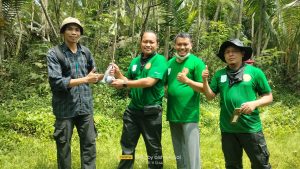
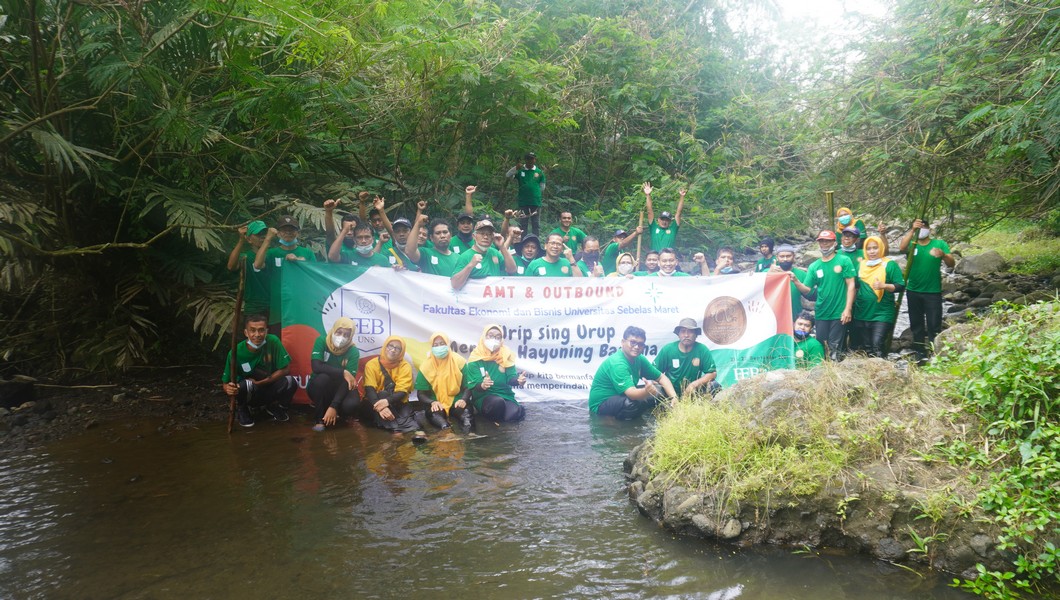
    Fakultas Ekonomi dan Bisnis (FEB) Universitas Sebelas Maret (UNS) menyelenggarakan kegiatan Achievement Motivation Training (AMT) dan Outbond, Sabtu, 11 September 2021 di Tempel, Sleman, Yogyakarta.

    Kegiatan di periode pertama yang diikuti oleh lebih dari 40 orang tenaga kependidikan (tendik) FEB UNS, juga dihadiri oleh Dekanat dan beberapa pimpinan prodi.

    Sebelum outbond, Prof. Djoko Suhardjanto, M.Com., Hons., Ph.D, Ak. Dekan FEB UNS memberikan arahan bahwa kegiatan ini selain untuk refreshing juga memberikan motivasi agar tendik lebih kuat dalam menjalani tantangan hidup dan juga melatih kekompakkan pada sebuah tim.

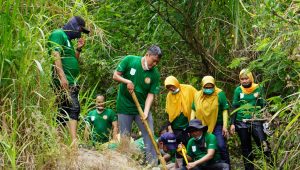
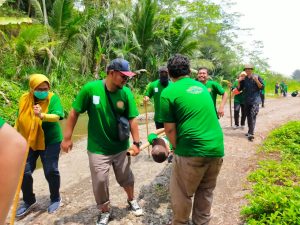
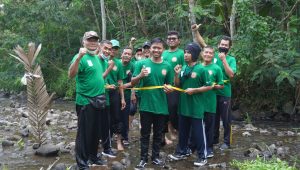
    Kegiatan outbond yang digelar tahun ini berbeda dengan tahun sebelumnya. Tendik akan berlatih untuk melakukan perjalanan yang cukup jauh di sekitar kaki Gunung Merapi dengan berbagai rintangan, menyusuri kebun salak, menerabas hutan dan juga berjalan di sepanjang aliran sungai.

    Dekan berharap dari kegiatan ini, tendik FEB bisa selalu guyub rukun menjaga kekompakkan untuk mencapai tujuan bersama.

    “Mari kita jaga agar hidup ayem tenteram, urip sing urup memayu hayuning bawana. Hidup hendaknya memberikan manfaat bagi orang lain, memberikan kebahagiaan, keselamatan kesejahteran bagi alam sekitar” katanya memotivasi.

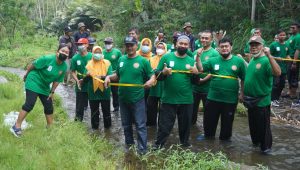
    Saat outbond, tendik yang terbagi dalam 3 kelompok wajib mengikuti arahan dari pemandu perjalanan. Setiap kelompok harus selalu bersama dan membantu kesulitan setiap anggotanya. Beberapa aturan yang harus ditaati selama perjalanan diantaranya, tidak boleh mengambil apapun saat memasuki area perkebunan masyarakat, tidak boleh membuang barang apapun, tidak boleh membunuh hewan apapun kecuali dalam keadaan yang terpaksa.

    Selama perjalanan, tendik harus ekstra hati-hati, naik turun bukit yang tanahnya licin, menyusuri aliran Sungai Krasak yang cukup deras dan dalam serta tebing air terjun yang curam. Tendik juga harus menerabas sepanjang Hutan Sempadan. Di akhir perjalanan, untuk menjaga kelestarian alam, dilakukan penanaman sebuah pohon gayam di pinggir sungai Krasak.

    Usai outbond, di pendapa Omah Noto Plankton, tendik mengikuti kegiatan sharing dan evaluasi perjalanan yang telah ditempuh selama kurang lebih 4 jam .

    Seluruh tendik memiliki kesan yang menyenangkan dalam pengalaman perjalanannya menyusuri kebun, hutan dan sungai serta permainan yang diberikan tim pemandu. Para tendik juga memberikan beberapa saran dan masukan kepada tim Omah Noto Plankton yang memandu pelaksanaan outbond untuk perbaikan ke depan.

    Untuk kegiatan di periode 2 akan diadakan pada tanggal 2 Oktober mendatang di lokasi yang sama. (Humas FEB )

  • FEB UNS Held Achievement Motivation Training and Outbound for Academic Support Staff

    FEB UNS Held Achievement Motivation Training and Outbound for Academic Support Staff

    The Faculty of Economics and Business (FEB) Universitas Sebelas Maret (UNS) held an Achievement Motivation Training (AMT) and Outbound on Saturday, September 11, 2021, in Tempel, Sleman, Yogyakarta. The first stage of training was attended by more than 40 FEB UNS academic support staff (tendik), the Deanery, and the Head of several Study Programs in FEB UNS.

    Before the outbound start, Prof. Djoko Suhardjanto, M.Com., Hons., Ph.D., Ak., as the Dean of FEB UNS, reveals that this activity is not only for refreshment but also to provide motivation in strengthening the academic support staff teamwork in facing work challenges in FEB UNS. This year’s outbound was different from the previous year because participants will need to travel quite a distance around the foot of Mount Merapi and various obstacles, walking through Salak gardens, forest, and cruising along a riverbank.

    The Dean hopes that after the training, the academic support staff can always collaborate harmoniously and maintain cohesiveness to achieve common goals. “Let’s keep a calm and peaceful life, urip sing urup memayu hayuning Bawana. Life should provide benefits for others, provide happiness, safety, and prosperity for the environment,” Prof. Djoko stated.

    During the outbound, the academic support staff was divided into 3 (three) groups that must follow the directions provided by the travel guide. Each group must stay together and help each member in solving the challenges. Some of the rules that must be obeyed during the trip include not taking anything when entering the community’s plantation area, not throwing anything away, not killing any animals except in forced circumstances.

    During the trip, the staff must be extra careful while going up and down hills with slippery soil, traversing the Krasak River with a fairly swift and deep-water level, as well as steep waterfall cliffs. The FEB staff are also required to cut through the Sempadan Forest. At the end of the trip, a Gayam tree was planted on the Krasak riverbanks to preserve nature.

    After the outbound, FEB academic support staff took part in a gathering at the Pendhopo of Omah Noto Plankton to share and evaluate the outbound activities, which lasted for approximately 4 hours.

    Overall, all of FEB UNS support staff had a pleasant impression on the experience on the trip through the gardens, forests, rivers, and the games provided by the guide team. The staff also gave suggestions and input to the Omah Noto Plankton team, as the outbound organizing and leading team, for future improvements. (Humas FEB)

  • Tendik FEB Ikuti Pelatihan Zoom untuk Perkuliahan Hybrid

    Tendik FEB Ikuti Pelatihan Zoom untuk Perkuliahan Hybrid

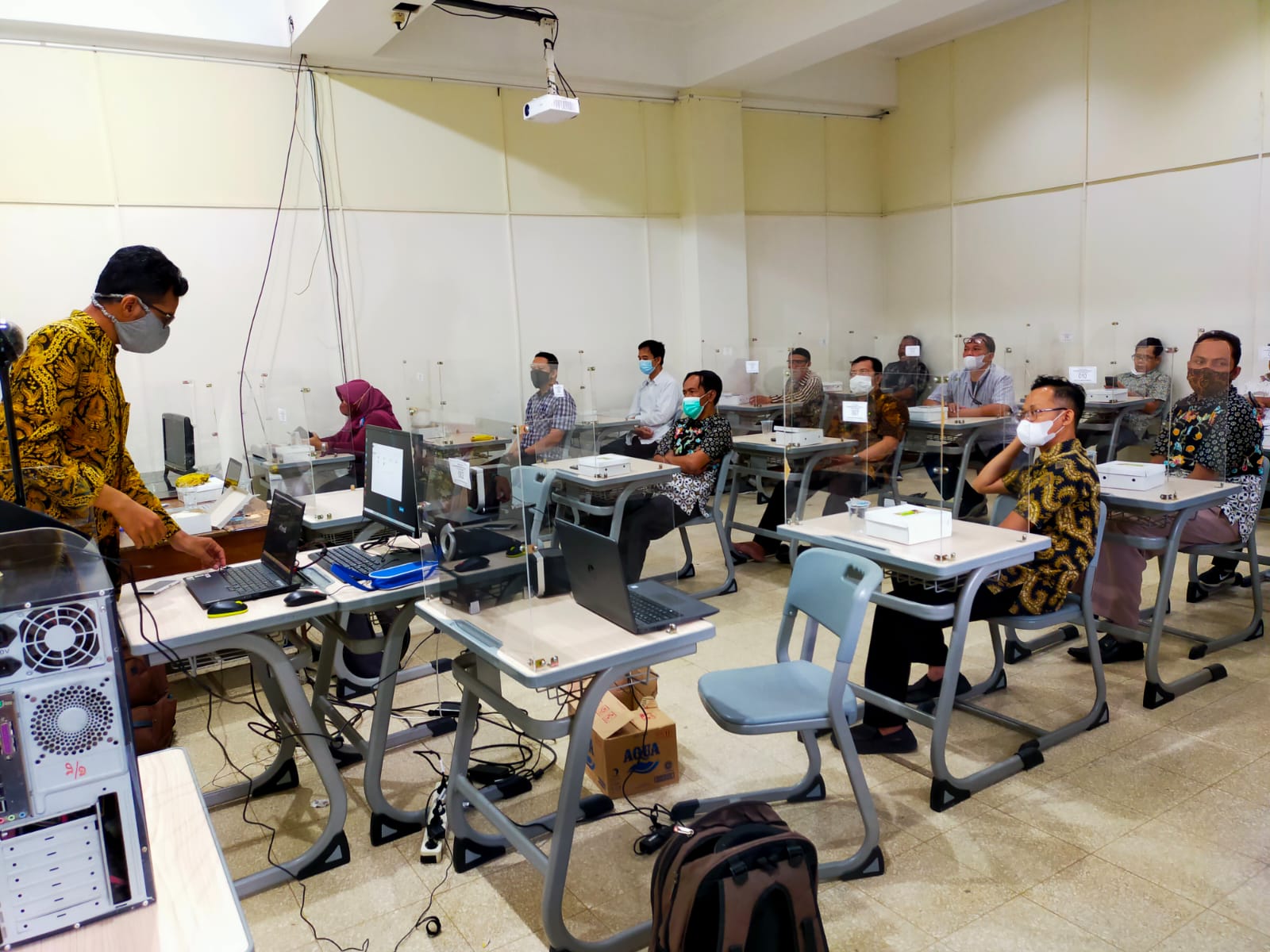
    Sejumlah tenaga kependidikan Akademik Riset dan Kemahasiswaan (Akrima) Fakultas Ekonomi dan Bisnis (FEB) Universitas Sebelas Maret (UNS) mengikuti Pelatihan Zoom Hybrid di ruang 2203 Gedung 2,  Kamis 9 September 2021. Pelaksanaan pelatihan dikoordinir oleh Sub Koordinator Akademik FEB, Nur Hariawan, SH.

    Prof. Dr. Izza Mafruhah, SE, M.Si, Wakil Dekan Akademik, Riset dan Kemahasiswaan FEB UNS dalam arahannya yang disampaikan secara daring mengatakan, mulai minggu ini, FEB sudah melaksanakan kuliah hybrid yaitu perpaduan kuliah luring dan daring. Untuk kelancaran perkuliahan hybrid diperlukan keahlian petugas akademik terutama pelayanan kuliah.

    Prof. Izza Mafruhah saat memberikan arahan kepada tendik Akrima

    “Alhamdulillah, fasilitas yang kita miliki untuk perkuliahan hybrid ini sudah bagus dan sangat mencukupi. Di FEB dipersiapkan 10 kelas yang akan kita gunakan untuk hybrid, sudah banyak juga dosen hingga saat ini mendaftar untuk melaksanakan hybrid. Tendik di sub Akrima terutama di layanan perkuliahan, baik untuk program S1 maupun pascasarjana diharapkan mampu menyerap ilmu dari pelatihan ini dan mampu mengaplikasikannya untuk memberikan layanan kuliah hybrid.”  ungkapnya.

    Prof. Izza mengingatkan kepada peserta pelatihan, dalam 4 hingga 5 bulan ini, bidang Akrima akan menghadapi masa yang sibuk karena pelaksanaan perkuliahan hybrid. Hybrid mengharuskan kita untuk memberikan layanan Works From Office (WFO) sementara mahasiswa masih berkomunikasi  secara daring.

    “Temen-teman tendik di Akrima akan bekerja lebih banyak dibandingkan dengan yang seharusnya dan harus bersiap” katanya menyemangati.

    Peserta mempraktekkan langsung teknis zoom hybrid

    Selanjutnya dikatakan, setelah agenda pelatihan ini, akan ada lagi kegiatan secara luring untuk tendik Akrima dengan narasumber dari Biro Akademik dan Kemahasiswaan untuk mendapatkan petunjuk mengenai model layanan yang harus dilakukan ketika harus hybrid.

    Bidang Akrima juga akan mengundang dari organisasi kemahasiswaan, dengan tujuan agar BEM atau UKM bisa mensosialisasikan kepada mahasiswa lainnya agar dapat memahami bahwa kinerja pelayanan akademik yang dilakukan kepada mahasiswa dengan perkuliahan hybrid ini sudah merupakan kerja yang optimal.

    Pelatihan yang berlangsung sekitar 2 jam itu, dipandu langung oleh Effendi Setiawan S, tenaga kependidikan FEB. Setelah mendapatkan penjelasan teknis dalam mengoperasikan zoom hybrid, peserta melakukan praktek langsung. (Humas FEB)

  • FEB UNS Holds Hybrid Lecture Simulation

    FEB UNS Holds Hybrid Lecture Simulation

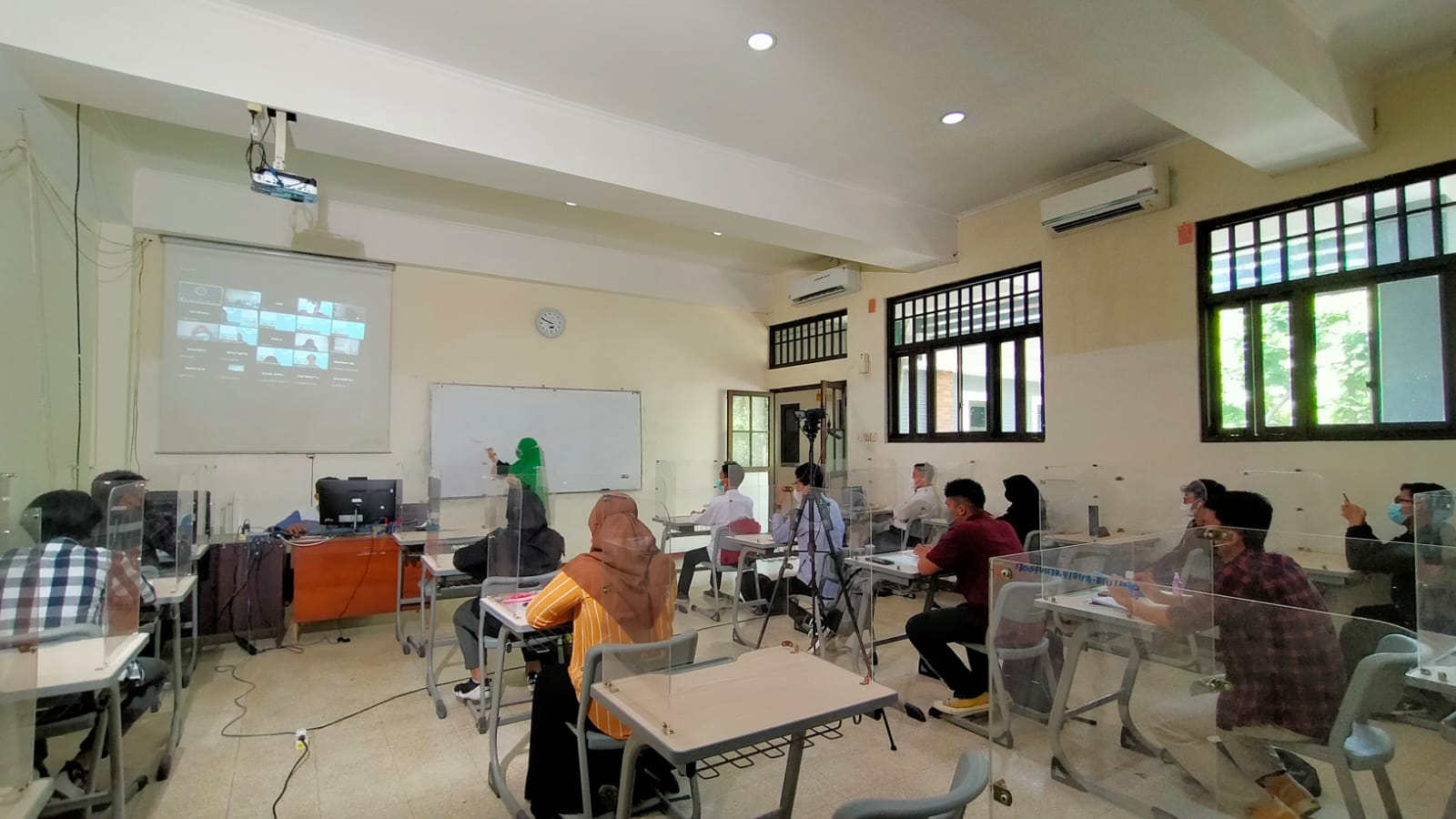
    A number of first semester students from the Management Study Program, Faculty of Economics and Business (FEB) Universitas Sebelas Maret (UNS) attended the Introduction to Macroeconomics lecture delivered by Prof. Dr. Izza Mafruhah, SE, M.Si., in Classroom 2.203 FEB UNS. At the same time, the rest of other students who enrolled to the course can follow the session through Zoom Cloud Meeting, Friday, September 3, 2021.

    This hybrid lecture, which combines two learning methods (online and direct learning), is an initial simulation carried out by FEB UNS to prepare Face-to-face Lectures (PTM) that will be implemented gradually by UNS. In the early stages, UNS will hold PTM for the first semester (class of 2021) students while prioritizing the residents of Solo Raya and vaccinated students to attend the PTM. Students are vibrant and enthusiastic about participating in the hybrid lecture simulation that will last for 2 hours.
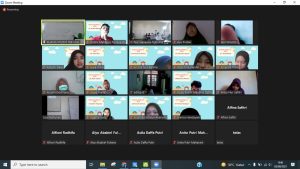
    “Students attending the face-to-face lectures are currently only from the Great Solo region, such as from Wonogiri, Sukoharjo, Klaten, and also Surakarta. With this method, lecturers can explain the material in more detail, especially for topics that require calculation, since Zoom Cloud Meeting still has limitations,” said Prof. Izza reveals after her lecture.

    According to her, equipment and technical officers’ preparation to support the implementation of this hybrid lecture are crucial to facilitate students, both joining the face-to-face lecture and virtual lecture, in understanding the material and allowing them to join class discussions can smoothly. Prof. Izza hopes that the university will immediately provide vaccination facilities for the new students; thus, students can safely join the face-to-face lecture.

    Meanwhile, Andreansyah Saputra, a student of the Management Study Program, said that this method is implemented perfectly. Students can clearly understand the material presented by the lecturer.

    “We, as students, feel comfortable attending lectures while maintaining health protocols on campus and in class,” he said briefly. (Humas FEB)

  • FEB UNS Management Study Program Invites Prof. Franco Fiordelisi in Workshop Recent Issues in Finance

    FEB UNS Management Study Program Invites Prof. Franco Fiordelisi in Workshop Recent Issues in Finance

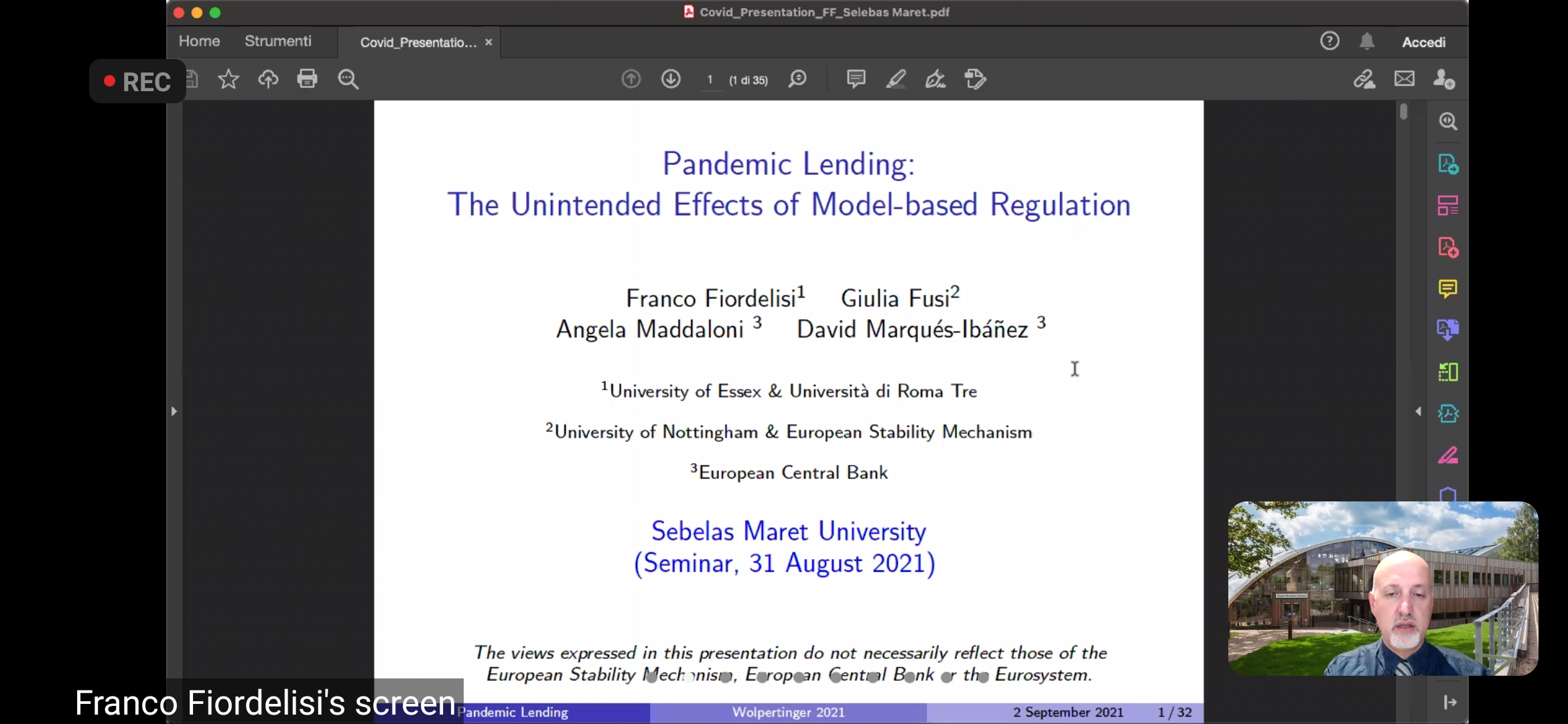
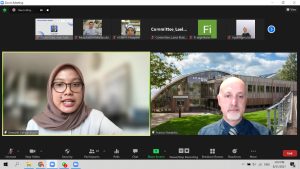
    The Bachelor in Management Study Program, Faculty of Economics and Business (FEB), Universitas Sebelas Maret (UNS) Surakarta invited Prof. Franco Fiordelisi to a workshop entitled “Recent Issues in Finance,” Tuesday (31/08/2021). The workshop is a part of the series of activities in the 2021 Program Kompetisi Kampus Merdeka (PKKM).
    Prof. Fiordelisi is a professor in finance and banking from the University of Rome III, Italy, and the University of Essex, UK. Prof. Fiordelisi also serves as President of the Financial Intermediation Network of European Studies (FINEST). Currently, Prof. Fiordelisi is an associate editor of the Journal of Financial Stability, European Journal of Finance, and Economic Modeling. In this workshop, Prof. Fiordelisi presented his article entitled Pandemic Lending: The Unintended Effects of Model-based Regulation.

    Prof. Fiordelisi and Moderator Dewanti Cahyaningsih

    In his research, Prof. Fioerdelisi tries to answer several questions related to the influence of model-based regulation in the ‘credit crunch’ during the Covid-19 pandemic. The research results show that IRB banks reduce the amount of funding more than SA banks.
    “The current crisis is different from the global financial crisis in 2008, which originated from the banking sector. The current pandemic crisis starts with consumers,” said Prof. Fiordelisi.
    Further, Prof. Fiordelisi revealed that based on the research result, credit reductions occurred in creditors affected by the pandemic. In general, there are several points of advice proposed by Prof. Fiordelisi related to research results among others are indication that the IRB model hinders lending during the crisis period where creditors are in dire need of financial assistance and that IRB banks channel less credit to the same creditors during the Covid-19 pandemic crisis.
    The interactive workshop was led by Dewanti Cahyaningsih, M.Rech., an alumna of the Management Study Program FEB UNS, and concluded with a group photo session.
    Reporter: Aulia
    Editor: Humas FEB

  • Prodi Manajemen FEB UNS Hadirkan Prof. Franco Fiordelisi dalam Workshop Recent Issues in Finance

    Prodi Manajemen FEB UNS Hadirkan Prof. Franco Fiordelisi dalam Workshop Recent Issues in Finance

    Program Studi (Prodi) S1 Manajemen, Fakultas Ekonomi dan Bisnis (FEB), Universitas Sebelas Maret (UNS) Surakarta menghadirkan Prof. Franco Fiordelisi dalam sebuah Workshop bertema “Recent Issues in Finance”, Selasa (31/08/2021). Workshop tersebut merupakan rangkaian kegiatan dalam Program Kompetisi Kampus Merdeka (PKKM) 2021.

    Prof. Fiordelisi adalah seorang profesor di bidang keuangan dan perbankan dari University or Rome III, Italia, dan University of Essex, Inggris. Prof. Fiordelisi juga menjabat sebagai President of the Financial Intermediation Network of European Studies (FINEST). Saat ini Prof. Fiordelisi adalah associate editor di Journal of Financial Stability, European Journal of Finance, and Economic Modelling. Dalam Workshop kali ini, Prof. Fiordelisi memaparkan artikelnya berjudul Pandemic Lending: The Unintended Effects of Model-based Regulation.

    Dewanti Cahyaningsih, moderator dan Fioerdelisi

    Dalam penelitiannya, Prof. Fioerdelisi mencoba menjawab beberapa pertanyaan terkait pengaruh model-based regulation dalam terjadinya ‘credit crunch’ selama krisis pandemi Covid-19. Hasil riset menunjukkan bahwa bank IRB mengurangi jumlah pendanaan lebih besar dibandingkan dengan bank SA.

    “Krisis saat ini berbeda dengan krisis keuangan global di tahun 2008 yang berasal dari sektor perbankan, krisis pandemi saat ini berawal dari konsumen,” ungkap Prof. Fiordelisi.

    Lebih lanjut Prof. Fiordelisi mengungkapkan bahwa berdasarkan riset yang dilakukan, pengurangan kredit terjadi pada kreditur yang terimbas pandemi. Secara garis besar terdapat beberapa poin saran yang disampaikan oleh Prof. Fiordelisi terkait hasil riset antara lain bahwa model IRB menghambat penyaluran kredit selama periode krisis dimana kreditur sangat membutuhkan bantuan finansial dan bahwa IRB bank menyalurkan lebih sedikit kredit ke kreditur yang sama selama krisis pandemi Covid-19.

    Workshop berlangsung interaktif dipandu oleh Dewanti Cahyaningsih, M.Rech yang merupakan alumni Prodi Manajemen FEB UNS, dan ditutup dengan sesi foto bersama.

    Reporter: Aulia

    Editor: Humas FEB

  • FEB UNS Adakan Simulasi Perkuliahan Hybrid

    FEB UNS Adakan Simulasi Perkuliahan Hybrid

    Sejumlah mahasiswa dari Program Studi S-1 Manajemen semester 1 Fakultas Ekonomi dan Bisnis (FEB) Universitas Sebelas Maret (UNS) mengikuti kuliah Pengantar Ekonomi Makro yang diampu oleh Prof. Dr. Izza Mafruhah, SE, M.Si secara luring di Ruang 2.203 Gedung 1  dan beberapa mahasiswa lainnya mengikuti secara daring di rumah masing-masing, Jumat 3 September 2021.

    Perkuliahan secara hybrid, menggabungkan dua metode pembelajaran luring dan daring itu merupakan simulasi awal yang dilakukan FEB untuk mempersiapkan Perkuliahan Tatap Muka (PTM) yang secara bertahap akan mulai dilakukan oleh UNS. Di tahap awal, UNS akan  menggelar PTM bagi mahasiswa semester 1 dan diutamakan bagi warga Solo Raya dan sudah mendapatkan vaksin.

    Mahasiswa terlihat semangat dan antusias mengikuti simulasi perkuliahan hybrid yang berlangsung selama 2 jam, baik yang berada di ruang kelas maupun yang mengikuti secara daring di rumah.

    “Mahasiswa yang mengikuti kuliah luring saat ini sementara baru dari Solo Raya, ada yang dari Wonogiri, Sukoharjo, Klaten dan juga Solo. Dengan seperti ini, ada nilai plusnya, dosen bisa menjelaskan secara detil apalagi untuk matakuliah yang ada hitung-hitungannya seperti yang saya ampu, kalau menggunakan zoom masih ada kesulitan” kata Prof. Izza usai mengajar.

    Menurutnya, memang perlu sekali dipersiapkan peralatan dan petugas teknis yang mendukung pelaksanaan perkuliahan hybrid ini sehingga peserta yang ada diruang kelas dan yang ada dirumah bisa terhubung, dapat jelas menerima apa yang disampaikan dosen pengampu, demikian juga diskusi kelas dapat berjalan dengan lancar.

    Prof. Izza berharap agar universitas segera memberikan fasilitas vaksin kepada mahasiswa baru agar mahasiswa yang mengikuti perkuliahan merasa aman.

    Sementara itu, Andreansyah Saputra, mahasiswa S1 Manajemen mengatakan, metode perkuliahan seperti ini sangat baik diterapkan. Mahasiswa dapat memahami dengan jelas materi yang disampaikan dosen.

    “Kami sebagai mahasiswa merasa nyaman mengikuti perkuliahan dengan tetap menjaga protokol kesehatan di kampus dan juga di dalam kelas” ungkapnya singkat. (Humas FEB)

  • FEB UNS Hosted AQAS Accreditation Dissemination and Preparation

    FEB UNS Hosted AQAS Accreditation Dissemination and Preparation

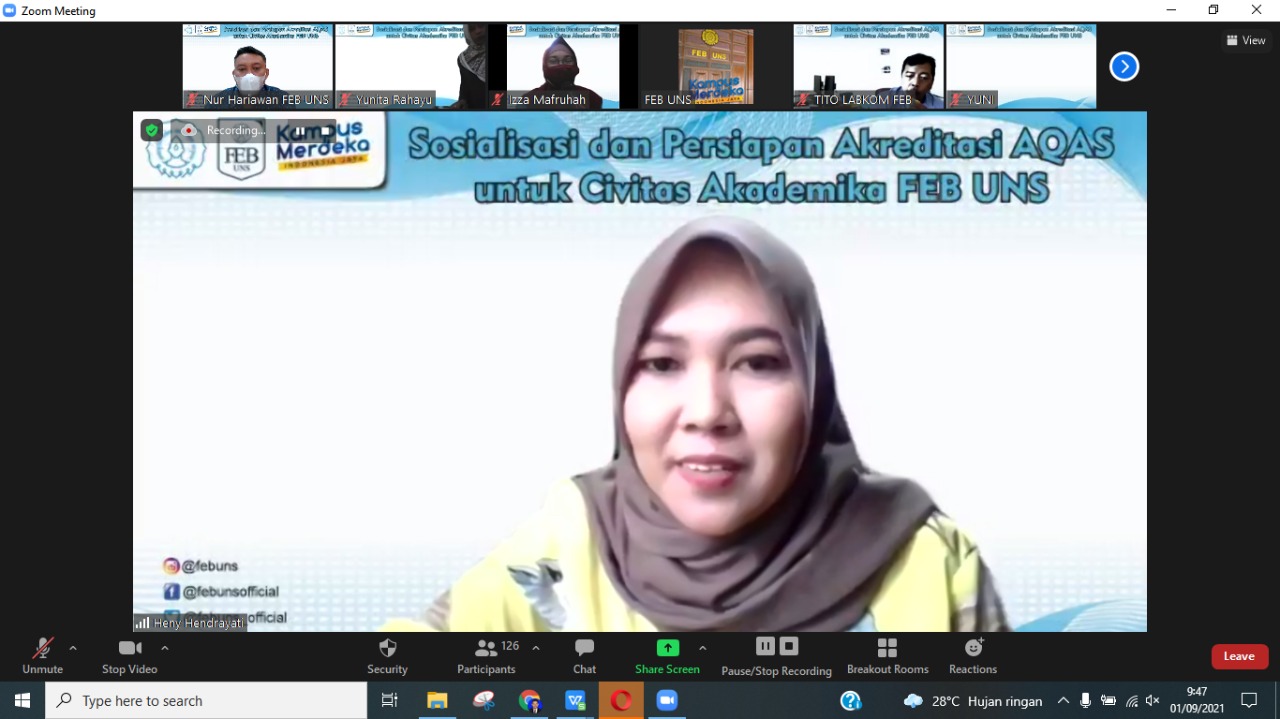
    Three study programs in the Faculty of Economics and Business (FEB) Universitas Sebelas Maret (UNS), the Accounting, Management, and Development Economics Study Program, are applying for the Agency for Quality Assurance by Accreditation of Study Programs (AQAS) International Accreditation this 2021. The study programs’ AQAS Self Evaluation Report (SER) was submitted in early August 2021 along with two other study programs in UNS. If the desk evaluation review returned a favorable result, the study programs would undergo a virtual site assessment in early November. In this regard, FEB UNS organized a hybrid AQAS Accreditation Dissemination and Preparation for the faculty members on Wednesday, September 1, 2021.

    The event, which was attended by all faculty members, academic support staff, and student organizations representatives, invited two speakers, Dr. Heni Hendrayati, SIP, MM., from the Indonesian Universitas Pendidikan Indonesia Bandung, and Irwan Trinugroho, SE, M.Sc. Ph.D., the Director of Partnership, Development, and Internationalization UNS, who is also a Lecturer at FEB UNS.

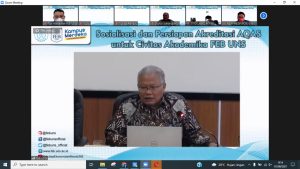
    The Dean of FEB UNS, Prof. Drs. Djoko Suhardjanto, M.Com Hons, Ph.D., Ak., in his speech, states that AQAS is one of the international accreditation institutions recognized by the Directorate General of Higher Education (Dikti). The accreditation was established in 2002 and is headquartered in Cologne, North Rhine-Westphalia, Germany.

    “Since UNS was determined as a State University with Legal Entity (PTNBH) starting of October 6, 2019, we have been given the mandate to be the top 500 global universities. This is an arduous assignment and has become our collective responsibility; therefore, an international accreditation is very much needed,” he said.

    Furthermore, the Ministry set a target for the Universitas Sebelas Maret to have 15 out of its 167 study programs accredited internationally. It is clear that for the FEB UNS, the target is to get all of its study programs accredited internationally.

    In fact, before UNS was designated as PTNBH, the study programs at FEB had been accredited and certified internationally. The Bachelor in Management and Development Economics Study Program has received AUN QA certification, while the Bachelor in Accounting Study Program received EPAS certification. As for the postgraduate study programs, the Masters in Accounting, Masters in Management, Masters in Accounting, and Doctoral Programs in Economics, have been certified by ABEST 21. However, all those previous accreditation institutions are currently not recognized by DIKTI. Hence, the Faculty need a slight amendment to find a recognized international accreditation agency.

    At the end of his remarks, the Dean wishes that the two speakers will enlighten the Faculty members on the focal point of AQAS Accreditation to assist the study programs at FEB UNS in earning the international certification. According to BAN-PT criteria, if a study program has received international accreditation, it will automatically be granted superior status. Hopefully, by the end of this year, all undergraduate study programs will be internationally accredited.

    The two invited speakers for the session explained in detail the preparation process, the site visit, and the description AQAS accreditation assessment. The invited speakers also explained the strategies needed to ensure the assessment process went smoothly.

    Dr. Irwan emphasized that the most crucial aspect of the assessment is the preparation of lecturers, students, and any other stakeholders invited to the interview session. The study program task force must discuss and communicate all assessment material and criteria to the invited stakeholder to establish a similar understanding according to the study program’s SER. Furthermore, the study programs must prepare and arrange all potential documents in a virtual drive to facilitate the ease of access. Additionally, the assessed study programs must follow the approved schedule and focus on the assessment process. (Humas FEB)