FEB

Blog

  • UNS Jadi Host untuk Midterm Evaluation and Workshop To Design New Modules

    UNS Jadi Host untuk Midterm Evaluation and Workshop To Design New Modules

    Universitas Sebelas Maret (UNS) sukses menjadi host dalam kegiatan OPTBANK Midterm Evaluation and Workshop to Design New Modules yang digelar pada akhir September 2019 di Hotel Royal Heritage Surakarta. UNS merupakan koordinator untuk universitas partner di Indonesia dalam program OPTBANK Erasmus+ Project,

    Peserta dari kegiatan ini adalah perwakilan dari universitas partner di Eropa (European Partner University) antara lain Universite de Limoges – Perancis, Universita Degli Studi Roma Tre – Italia, University of Bangor – UK (Inggris), dan Technical University of Crete – Yunani; partner universitas dari Indonesia yaitu Universitas Sebelas Maret (UNS), Institut Teknologi Bandung (ITB), UIN Syarif Hidayattullah Jakarta, Universitas Syiah Kuala (UNSYIAH), Universitas Sriwijaya (UNISRI), dan Universitas Tanjungpura (UNTAN).

    Selain itu, associate partner lain dari bank regulator seperti Bank Indonesia, Otoritas Jasa Keuangan (OJK) dan Lembaga Penjamin Simpanan (LPS) juga turut hadir dalam kegiatan tersebut.

    Dalam kegiatan Midterm Evaluation dilakukan evaluasi untuk segala kegiatan dari program OPTBANK yang telah berlangsung pada tahun sebelumnya.

    Koordinator Proyek (Project Coordinator), Prof. Amine Tarazi dari Universite de Limoges – Perancis, mengapresiasi segala usaha yang telah diberikan dalam pelaksanaan aktivitas OPTBANK sejak dimulai pada tahun 2018 hingga pertengahan 2019.

    Terdapat banyak hal perlu diperbaiki untuk program-program selanjutnya, seperti proses seleksi peserta dalam program exchange (pertukaran pelajar) dan training, proses diseminasi strategi untuk setiap aktivitas, alur pelaporan, dan kejelasan PIC (Person in Charge-Penanggungjawab) untuk program selanjutnya.

    Meskipun begitu Project Committees (Komite Project) optimis bahwa semua program yang akan datang dapat dilaksanakan dengan sukses, hingga akhir project pada tahun 2020.

    Setelah Midterm Evaluation, selanjutnya dibahas mengenai topik “How to Design New Modules for PhD in Banking and Finance. Terdapat 10 modul yang dipresentasikan oleh para ahli yang hadir termasuk 2 modul yang melibatkan 3 regulator di bidang perbankan din Indonesia yaitu BI, OJK, dan LPS.

    Modul-modul tersebut membahas mengenai berbagai area khusus di bidang keuangan dan perbankan seperti Perbankan Sharia (Islamic Banking), Institusi Perbankan dan Manajemen Risiko Perbankan (Banking Institution and Bank Risk Management), Regulasi Perbankan dan Stabilitas Keuangan (Banking Regulation and Financial Stability), Struktur dan Efisiensi di Industri Perbankan (Structure and Efficiency of Banking Markets), Literasi Keuangan, Inklusi Keuangan dan Financial Deepening (Financial Literacy, Financial Inclusion and Financial Deepening), Corporate Governance dan Institusi Keuangan (Corporate Governance of Financial Institutions), Keuangan Kuantitatif (Quantitative Finance), Operasional Riset dengan Teknik Berbasis AI dalam Keuangan dan Perbankan, serta modul yang secara khusus berhubungan dengan industri perbankan di Indonesia yang dipresentasikan oleh Dr. Inka Yusgiantoro dari Otoritas Jasa Keuangan (OJK), Dr. Yoga Affandi dari Bank Indonesia, dan Dr. Herman Saheruddin dari Lembaga Penjamin Simpanan (LPS).

    Modul-modul yang dibahas dalam pertemuan ini ditargetkan untuk diterapkan pada tahun 2020.

    Pilot project untuk modul-modul tersebut akan dilaksanakan di Universitas Sebelas Maret (UNS) dan Institut Teknologi Bandung (ITB).

    Keberhasilan dari pilot project akan membuka peluang bagi setiap universitas partner di Indonesia untuk menerapkan modul-modul tersebut.

    Sumber : Irwan Trinugroho, Ph.D.

  • Encouraging the Young Generation to be a Great Achievers in Their Field

    The Talk Show & National Seminar of “Capture the Moment for the Greatest Future”, Saturday October 12th, 2019, brought an exciting and inspiring atmosphere in UNS Auditorium. This event presents various excellent speakers such as dr. Andri Putranto, Abel Cantika, Ernest Prakasa, Aulion, and Amri Naufal. National Talk Show is a media for the young generation to meet inspiring speakers for knowledge, experience, and motivation sharing on business.

    Such event also provides a learning tool and entertainment for UNS students, and the wider community in general. Through various events like this, it is expected that student’s competency in the competitive and academic field would be improved. Moreover, it is expected to encourage students’ innovation to use their potential as an asset to achieve better economy.

  • To be an Entrepreneur in Creative Economics Era

    To be an Entrepreneur in Creative Economics Era

    The main differences between employee and entrepreneur is in term of time. For instance, employee will have to work for around 8-12 hours a day, their job is limited by time and has no rights to delegate task. Meanwhile, an entrepreneur can control their money and time. An employee earns a fixed payroll, if they do not work, they will not earn any salary, with a constraint on age. On the other hand, an entrepreneur can get greater earnings from their business with no age constraint. This matter is expressed by Endang Kurniawan, the alumni of the Faculty of Economics and Business (FEB) UNS, who shared about their success story on the event of Entrepreneur & Charity with Alumni “to be an Entrepreneur in Creative Economics Era”, in Saturday October 12th, 2019.

    In the front of a hundred of students who are member of the Entrepreneurial Community of FEB UNS, Endang encourage the students to be a tough entrepreneur and does not have a “block” mentality. He mentions that “block” mentality refers to restraints on one’s memory or thoughts. Having a “bad” feeling or misgiving that prevent someone to take an action. For examples having a presumption such as “what if it is rejected”, “what if they are busy”, “what if they think my product/goods is bad”, etc. Entrepreneur should focus on the advantages they have and should be able to differentiate between business and social. Should not mixed-up both aspects, thus management can be conducted orderly.

    The important point is an entrepreneur should build a customer base to gain insight on their customer, tracking individual behaviour, establish a basic individual and organizational competency, high-skilled and multi-skilled employee, as well as establish a new scheme from Customer to Customer relationship such as in cooperation and joint competence.

  • Many MSMEs do not have Sufficient Knowledge on Export Procedure

    To date, most of the Micro and Small Enterprises (MSEs) in Jogjakarta has not capable to export their product directly. This is not because of there is no demand on their product or craft internationally, but because they do not have sufficient knowledge on the procedure of export. Dr. Evi Gravitiani, a faculty member of the Faculty of Economics and Business (FEB) UNS, mentioned this problem during the release of a Workshop on Export Procedure for Handicraft Product, in CV Ragil Craft showroom, Gamplong Village, Moyudan, Sleman, Yogyakarta, on July 2019.

    The workshop was initiated by the Sustainable Development and Green Business Research Group of FEB UNS. The event was attended by 23 participants who are crafters of woven products that made from natural fibre and knitting yarn, from Sleman and Kulonprogo. Dr. Evi, as the team leader, assisted by Dr. AM Soesilo and Dr. Erni Ummi Hasanah delivers a briefing on the export procedure as well as product quality improvement.

    Further, it was mentioned that the workshop is embodied in the community service program under the Export Product Development Program that aims to improve the quality and quantity of MSEs products, thus it can be highly competitive for domestic and foreign markets. Moreover, as part of an active effort to maintain the sustainability of local cultural heritage. The community service program is funded by a multi-year grant started on 2018 to 2019, that intended for the MSEs partner. The partners are CV Ragil Craft, which located in Gamplong Village, Moyudan, Sleman, and Q’s Craft, which located in Banggan, Tuksono, Kulon Progo. Both MSE have similar input basis such as pandanus, agel fibres, water hyacinth, coconut sticks, mending, and fragrant root.

    All the natural materials are woven with Non-Machine Weaving Tools, as well as material from nylon thread. To help optimize production, the community service team donate a machine to the MSEs. For CV Ragil Jaya Craft a modified Non-Machine Weaving Tools with a dynamo was given. This tool will assist the weaver in creating a product, thus they do not need to manually operates the machine/tools. It is expected that the machine will improve the efficiency of natural fibres woven production.

  • Dr. Hunik Inaugurated as a Professor in Human Resource Management

    The Rector of Universitas Sebelas Maret (UNS), Surakarta, Prof. Jamal Wiwoho, inaugurates Dr. Hunik Sri Runing Sawitri, S.E., M.Si., as a Professor in Human Resource Management of the Faculty of Economics and Business (FEB) and Dr. dr. Yulia Lanti Retno Dewi, M. Si as a Professor in the Science of Nutrition for the Faculty of Medicine, on Tuesday, 15th October 2019.

    During the open senate congress of the Universitas Sebelas Maret in UNS Auditorium G. P. H

    Haryo Mataram, Prof. Dr. dr. Yulia Lanti Retno Dewi, M. Si delivers an inauguration speech entitled “Lack of Iodine within Ecological Perspective and Its Prevention”. The speech was the result of a research of Prof. Yulia under the Research Group of Iodine Deficiency Disorders (Gangguan Akibar Kekurangan Iodium-GAKI). In her opening speech, Prof. Yulia mentions that Iodine deficiency is a global problem and in Indonesia it is estimated that the population living in Iodine deprived area approximately 54 million and is scattered all around Indonesia.

    “The Minister of Health has decided that iodine deficiency is one of the major nutritional problem, because it meets the criteria such as many people suffer from the problem, spread-out through out Indonesia region, and has a negative impact on the quality of Indonesia citizen in a long-term,” Prof. Yulia explains.

    Meanwhile, Prof. Dr. Hunik Sri Runing Sawitri, S. E., M. Si, delivers an inauguration speech entitle “Organizational Commitment, Culture, and Employees’ Performance”, which highlight the relationship between commitment and employee’s performance. “Many assumed that an employee with a high commitment will have a high performance. However, empirical research offers different result regarding this matter,” Prof. Hunik mentions the topic at the opening of her speech. She explains that various research is conducted to examine the relationship between the two constructs. But the result shows a varied and unclear relationship between the two.

    “Therefore, when conducting research on the relationship between commitment and performance, the construct of commitment should be defined clearly beforehand, which organizational commitment is examined in the research,” Prof. Hunik explains.

    With the inauguration of Prof. Hunik and Prof. Yulia in UNS; the Rector of UNS Prof. Jamal Wiwoho expect that Prof. Hunik and Prof. Yulia can maintain and develop scientific and academic values, as well as contribute to the development of UNS.

  • Dorong Akselerasi Kenaikan Jabatan Akademik dan Guru Besar, FEB UNS Gelar Workshop

    Dorong Akselerasi Kenaikan Jabatan Akademik dan Guru Besar, FEB UNS Gelar Workshop

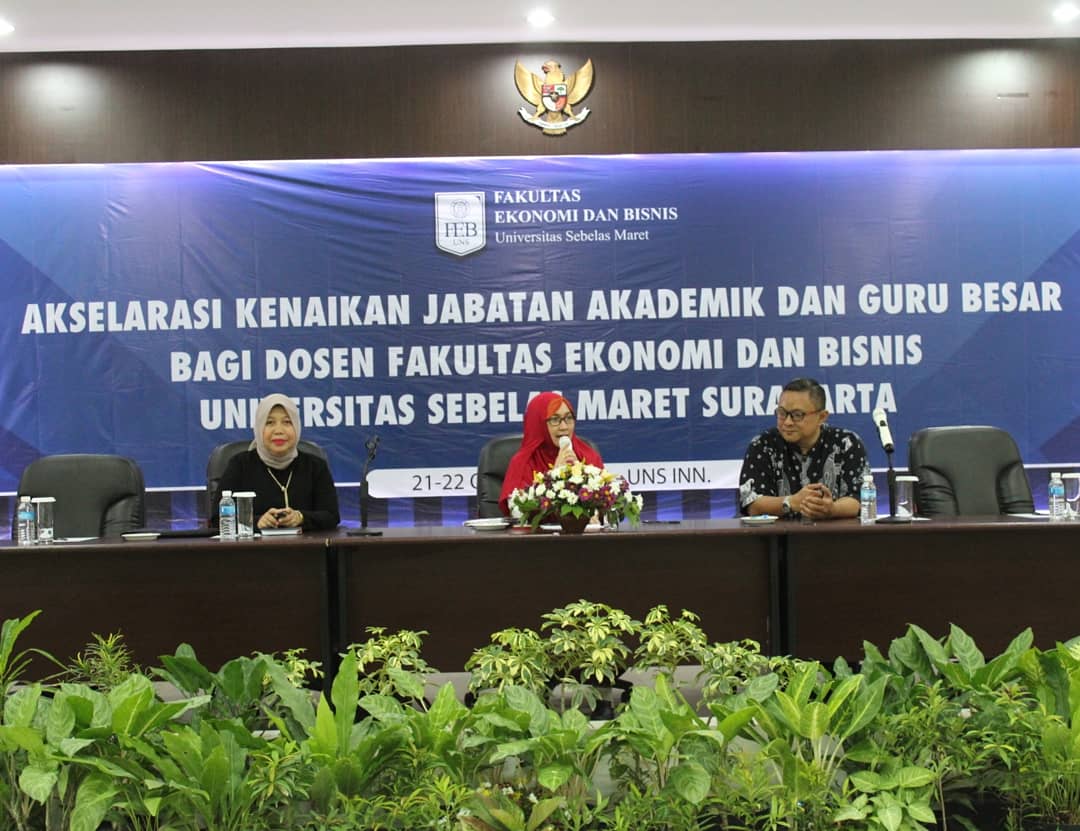
    Dorong Akselerasi Kenaikan Jabatan Akademik dan Guru Besar bagi para Dosen, Fakultas Ekonomi dan Bisnis (FEB) Universitas Sebelas Maret (UNS) Gelar Workshop, Senin,21 Oktober 2019, di UNS Inn.

    Acara yang dihadiri oleh seluruh dosen FEB UNS menghadirkan dua pembicara: Prof. Dr. Sucihatiningsih Dian Wisika Prajanti dan M.Si., Dr.Didit Purnomo, M.Si.

    Sebelum acara inti, Prof. Dr. Tulus Haryono,M.Ek., Dosen FEB UNS paparkan Potret Dosen FEB UNS Tahun 2019 dan Upaya Percepatan Kenaikan Pangkat.

    Profesor yang juga masuk dalam Tim PAK (Penilai Angka Kredit) UNS menyampaikan pengalamannya dalam mengurus kenaikan pangkat, yang hampir rata-rata diupayakannya dalam kurun waktu 2 tahun.

    “Perlu tekad yang kuat untuk bisa mempercepat kenaikan pangkat untuk bisa mencapai Lektor Kepala hingga meraih jabatan tertinggi akademik yaitu guru besar. Hidup harus ada target agar kita termotivasi” tegasnya menyemangati.

  • Encouraging the Academic Rank Increment, FEB UNS Organizes a Workshop

    Encouraging the Academic Rank Increment, FEB UNS Organizes a Workshop

    To encourage the increment in academic rank as well as Professor promotion for the Faculty member of the Faculty of Economics and Business, Universitas Sebelas Maret (FEB UNS), the faculty organizes a Workshop on October 21, 2019. The event was attended by all of FEB UNS faculty member, with two main speakers Prof. Dr. Sucihatiningsih Dian Wisika Prajanti and M.Si., Dr.Didit Purnomo, M.Si.

    During the opening remark, Prof. Dr. Tulus Haryono,M.Ek., provides a brief description of the current condition of FEB UNS faculty member and the effort taken to accelerate the academic rank increment. The speakers who is also part of Credit Score Assessor Team tell the participant about their experience on the management of rank promotion, which usually takes 2 years. “A strong determination is needed to speed-up the increment process to reach Senior Lecturer rank, and greater effort to earn full Professor. We need a target in life to keep ourselves motivated,” they explained.

  • Entrepreneur Talk Show

    Entrepreneur Talk Show

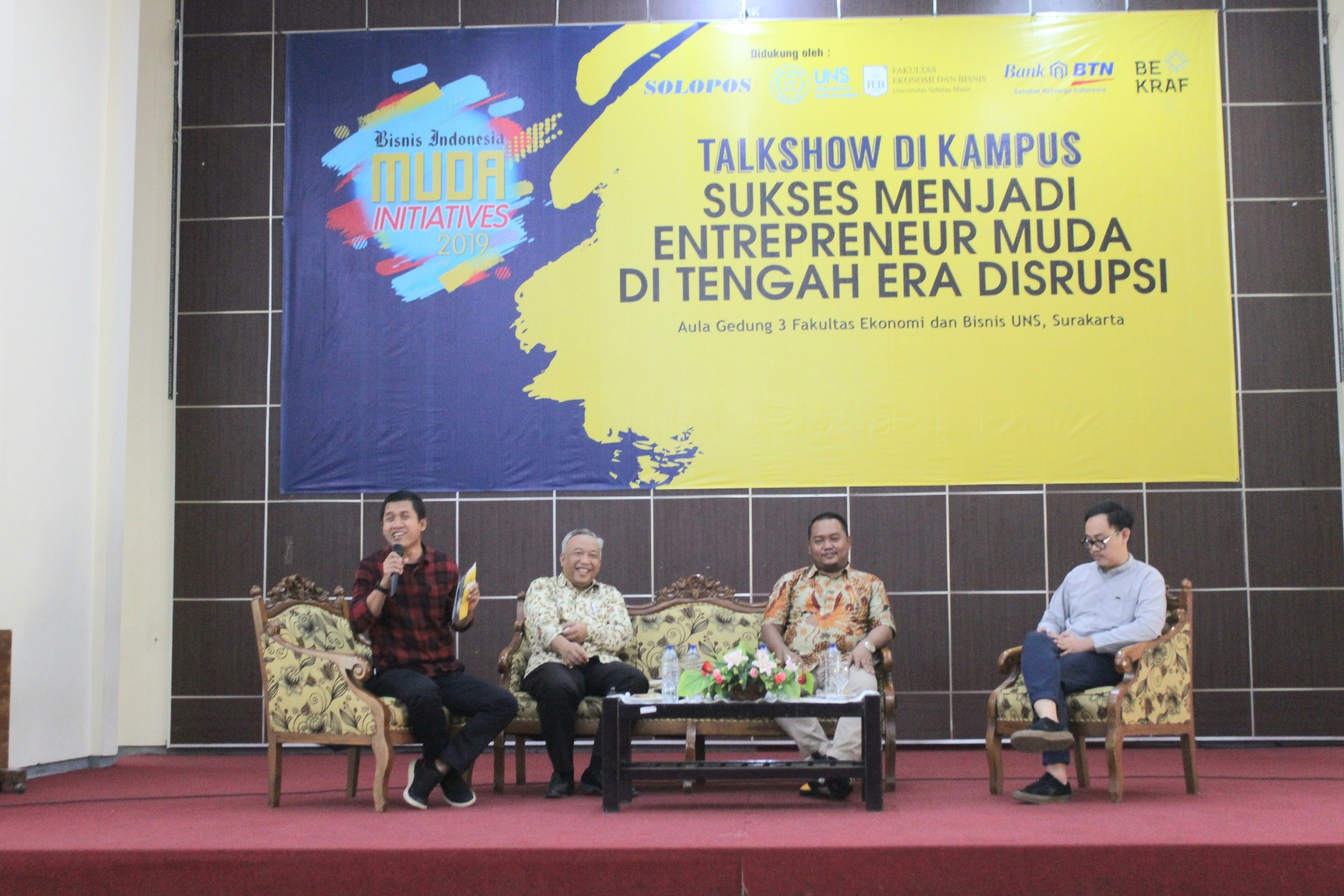
    The Faculty of Economics and Business Universitas Sebelas Maret (FEB UNS) Surakarta in collaboration with the Harian Bisnis Indonesia, hosted a Talk Show in Campus: Successfully Become a Young Entrepreneur in Disruptive Era. This talk show is held in the FEB UNS Hall (3rd Building), on Tuesday, 10th October 2019. The event was opened by the Rector of UNS, Prof. Dr. Jamal Wiwoho. The speakers invited for the event are the Director of Strategic Human Capital of BTN: Yossi Istanto, Owner of Regarsport: Jumariyanto, INDEF Economist: Bhima Yudhistira, and Rector Staff Expert in Academics Affairs and Business Development UNS: Dr. Sutanto S.Si. DEA.

    In his opening remarks, the Rector of UNS, Prof.Dr. Jamal Wiwoho mentions that industrial revolution 4.0 that is happening in all countries, encourage a disruption on various fields. This can give an opportunity as well as challenge for the young generation, which also known as millennial generation. The millennial generation is quite dominant in the digital era and are expected to have an important role in dealing with the industrial revolution 4.0, which related with demographic bonus for Indonesia in 2030.

    “We are aware and admit that the technological change currently happened rapidly due to disruption. The trend on technological change has shifted, thus the digital technology has led the world ecosystem and economics. Other challenges we face are related with the availability of employment that shrink due to technology advancement,” Prof. Jamal explains. He added that approximately there are 5 million people who will lose their job due to automatization. A huge change in industrial world will have a direct impact on millennial generation existence. Because even though the generation have a high entrepreneurial spirit, the execution remains weak.

    On this digital era, it is convenient to be an entrepreneur because of technology advancement. However, the success rate of millennial business is low due to their consumptive lifestyle. Therefore, a paradigm or millennial point of view should be changed, not only working in efficient and productive manner, but also to be tough in winning competition, have a great innovation, creativity, and entrepreneurship. Currently there are 130 million people in productive age who can take on new opportunities to develop business in the digital era. For instance, Gojek, Tokopedia, Bukalapak, and the most current one Ruang Guru, which predicted to be a Unicorn in Indonesia.

    With the vast development of digital business, the Indonesia government is targeting the creation of 1,000 technopreneur in 2020. “For that, I and UNS should encourage the millennial generation especially the one present here and across Indonesia, to grab the opportunity and take an active role in digital industry era,” Prof. Jamal says.

    Prof. Jamal adds that UNS should empower human talents it has to face the industrial revolution 4.0 and VUCA (Volatile, Uncertain, Complexity, Ambiguous) era. The main key is competitive and innovative human resource. “To prove that UNS capable to innovate, we currently have a start-up as research result from junior lecturer from Engineering Faculty, namely Lithium Battery and Natural Colouring Batik (Ecody), which will be the Teaching Factory of UNS.”

    Meanwhile, the Editor in Chief of Harian Bisnis Indonesia, Hery Trianto explains that this event is not only conducted in UNS, but also in other campus. “We hope that when the students are graduated, they will not only focus on finding a job. Because they can establish a new business and employment,” Hery explain.

  • Platform Logistik Memerlukan Otomatisasi

    Platform Logistik Memerlukan Otomatisasi

    Tren pasar logistik di Indonesia perlu mendapatkan perhatian lebih terutama karena biaya logistik yang selalu mengalami peningkatan dari tahun ke tahun.

    Tren logistik di era ekonomi 4.0 memerlukan kontribusi dari dunia pendidikan seperti yang ada di universitas. Hal ini dikarenakan pendidikan merupakan salah satu dari empat hal yang penting untuk diperhatikan jika ingin mengembangkan dunia logistik, yakni: deregulasi yang lebih tepat untuk logistik di Indonesia, harmonisasi regulasi pemerintah pusat dan daerah, pembangunan infrastruktur fisik dan informasi teknologi dan Pendidikan.

    Pentingnya logistik di Indonesia terutama karena melihat fakta bahwa potensi di Indonesia belum termaksimalisasi. Saat ini, Indonesia merupakan kawasan berkembang tetapi menempati posisi ke-3 secara kekuatan ekonomi ASEAN. Indonesia juga menempati peringkat nomor 6 dalam pertumbuhan ekonomi ASEAN.

    Solo khususnya, sebenarnya juga memiliki potensi yang dapat dikembangkan karena Solo punya banyak keunggulan terutama adanya perusahaan tekstil terbesar di ASEAN.

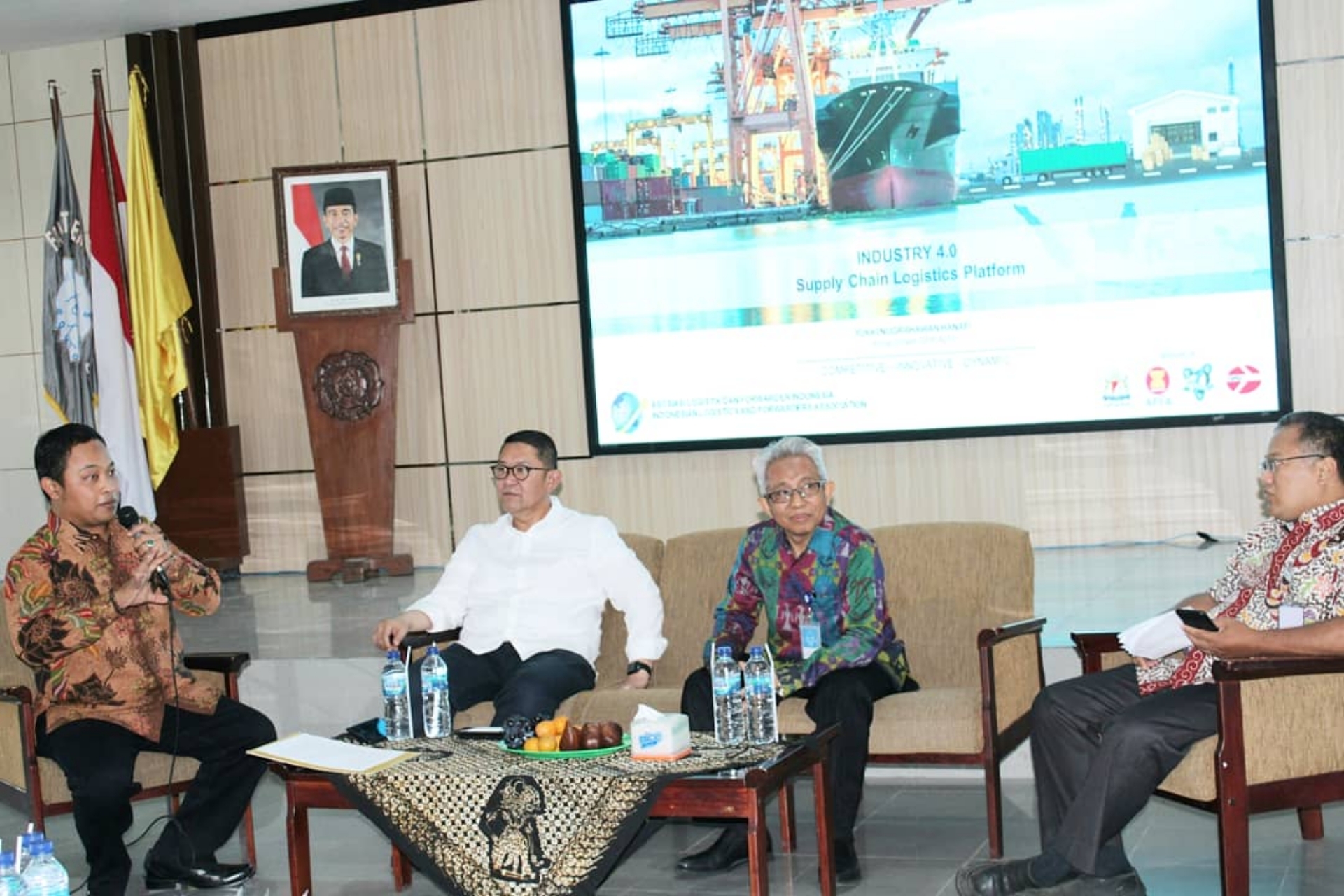
    Pernyataan itu disampaikan Yukki Nugrahawan Hanafi, Ketua Asosiasi Logistik dan Forwarder Indonesia (ALFI) ALFI dalam Seminar Nasional The Role of Accounting in Logistic Industry, Jum’at 18 Oktober 2019 di Aula Gedung V FEB UNS.

    Menurutnya, sekarang kita telah berada di digital era sehingga diperlukan pembaharuan terkait model bisnis baru yang dapat merangkul era digital dengan internet sebagai nafas utamanya sebagai tools untuk mempermudah dunia perlogistikan.

    “Perlu dilakukan pengembangan sistem yang mumpuni untuk menyatukan dan mengkolaborasikan keempat komponen yang perlu diperhatikan dalam dunia perlogistikan tadi” katanya

    Kedepan, infrastruktur dan area fisik (physical logistic) tidak lagi menjadi komponen penting dalam dunia logistik sehingga kita perlu berubah dan berkembang mengikuti area. Platform logistik memerlukan otomatisasi sehingga dapat mempermudah kolaborasi dan efisiensi informasi dengan global network.

    Sementara itu, Prof. Drs. Hassan Fauzi, M.Ba., Ph.D., Ak, Dosen Akuntansi FEB UNS menyatakaan , selain tools untuk melakukan proses supply chain management, stakeholder di dalam entitas juga menjadi hal yang perlu diperhatikan.

    Hal ini terkait dengan sumber daya manusia yang menjadi kunci pertama pelaksanaan supply chain management yang efektif.

    Proses supply chain management tidak lagi berorientasi pada mencari laba, akan tetapi juga perlu memperhatikan kepentingan sosial dan lingkungan sebagai bentuk pertanggung jawaban sosial perusahaan.

    Narasumber lain di acara yang digelar atas kerjasama ALFI dan FEB UNS adalah Arif Prabowo, CEO PT. Pelindo III Regional Jawa Tengah.

    Di kegiatan itu, juga dilakukan Penandatangan MoU atau kerjasama antara ALFI dan FEB UNS.

    Diolah dari: Prodi Akuntansi

  • Pengaruh Power Pemilik Hotel bagi Perkembangan Bisnis Hotel

    Pengaruh Power Pemilik Hotel bagi Perkembangan Bisnis Hotel

    Power pemilik hotel yang tinggi akan menghambat terciptanya partisipasi peran akuntan dan menghambat penggunaan akuntansi manajemen strategis. Sebaliknya, power pemilik hotel yang rendah akan mendorong peningkatan partisipasi peran akuntan dan peningkatan penggunaan akuntansi manajemen strategis perusahaan.

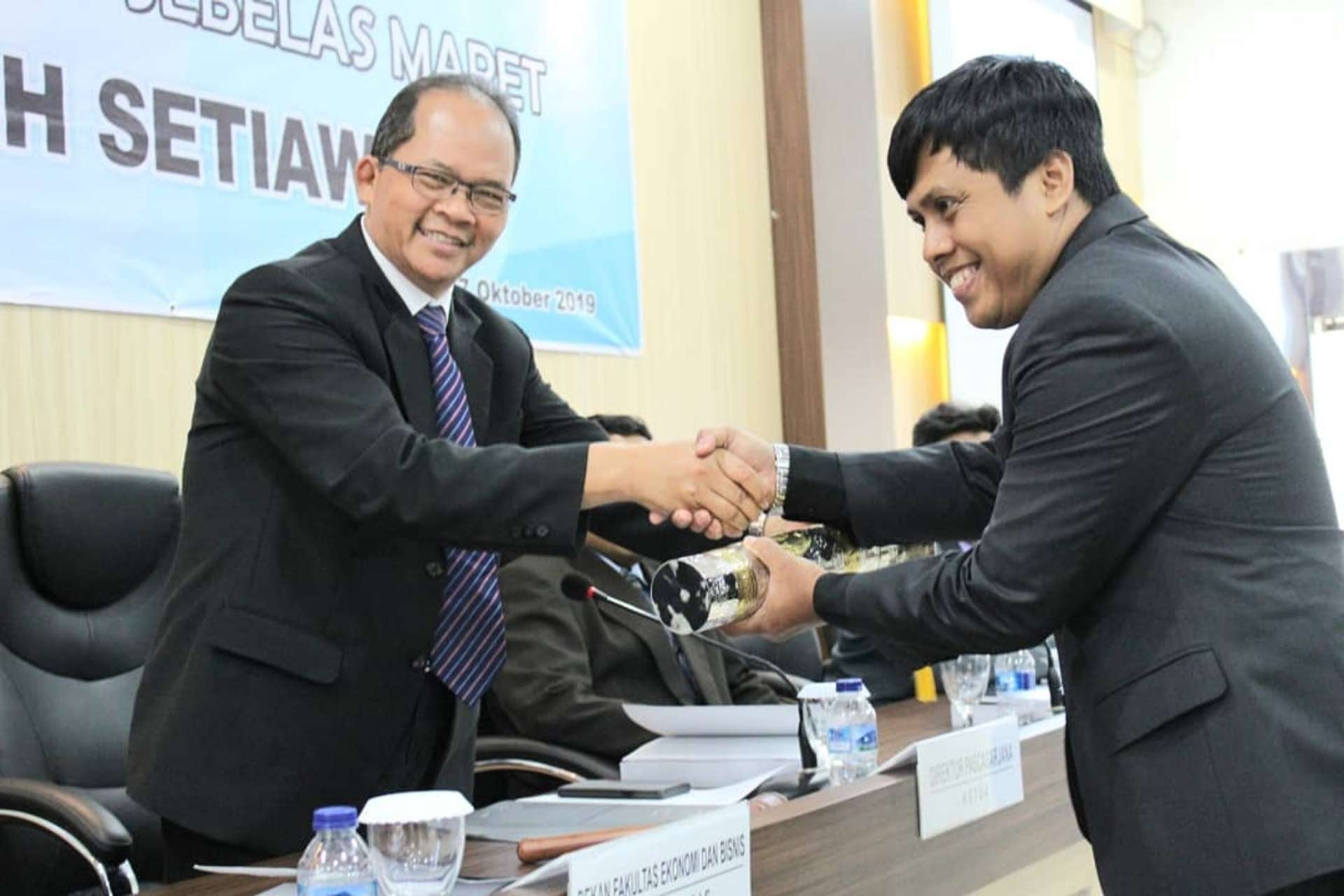
    Pernyataan itu disampaikan Antonius Singgih Setiawan dalam presentasi disertasinya di Ujian Terbuka Promosi Doktor pada Program Doktor Ilmu Ekonomi (PDIE) Fakultas Ekonomi dan Bisnis UNS, Kamis, 17/10/2019.

    “Peran akuntan dan penggunaan akuntansi manajemen strategis akan lebih tinggi saat perusahaan menerapkan strategi yang berorientasi prospector daripada perusahaan yang menerapkan strategi defender. Semakin tinggi peran akuntan dalam membuat keputusan strategis akan mendorong peningkatan penggunaan sistem akuntansi manajemen strategis pada hotel” jelasnya

    Disisi lain, kinerja terintegrasi sangat dipengaruhi oleh pemanfaatan dan penggunaan akuntansi manajemen strategis secara optimal. Pilihan strategi kompetitif juga menjadi faktor untuk diterapkan.

    “Pemilik hotel harus berani mendelegasikan power pengelolaan pada operator/manajemen yang ditunjuk agar operator mempunyai peluang untuk mengimplementasikan kreativitas mereka sehingga mereka mempunyai tanggung jawab yangebih untuk memberikan kinerja terbaik bagi perusahaan” papar Dosen Universitas Katolik Musi Charitas Palembang.

    Disertasi yang berjudul Anteseden-Konsekuensi Akuntansi Manajemen Strategis: Peran Power Pemilik (Studi pada Industri Hotel di Wilayah Sumatera) dipertahankan di hadapan delapan penguji dengan Promotor: Prof. Dr. Rahmawati, M.Si.,Ak. Ko-Promotor: Dr. Djuminah, M.Si,Ak dan Ari Kuncara Widagdo,SE,