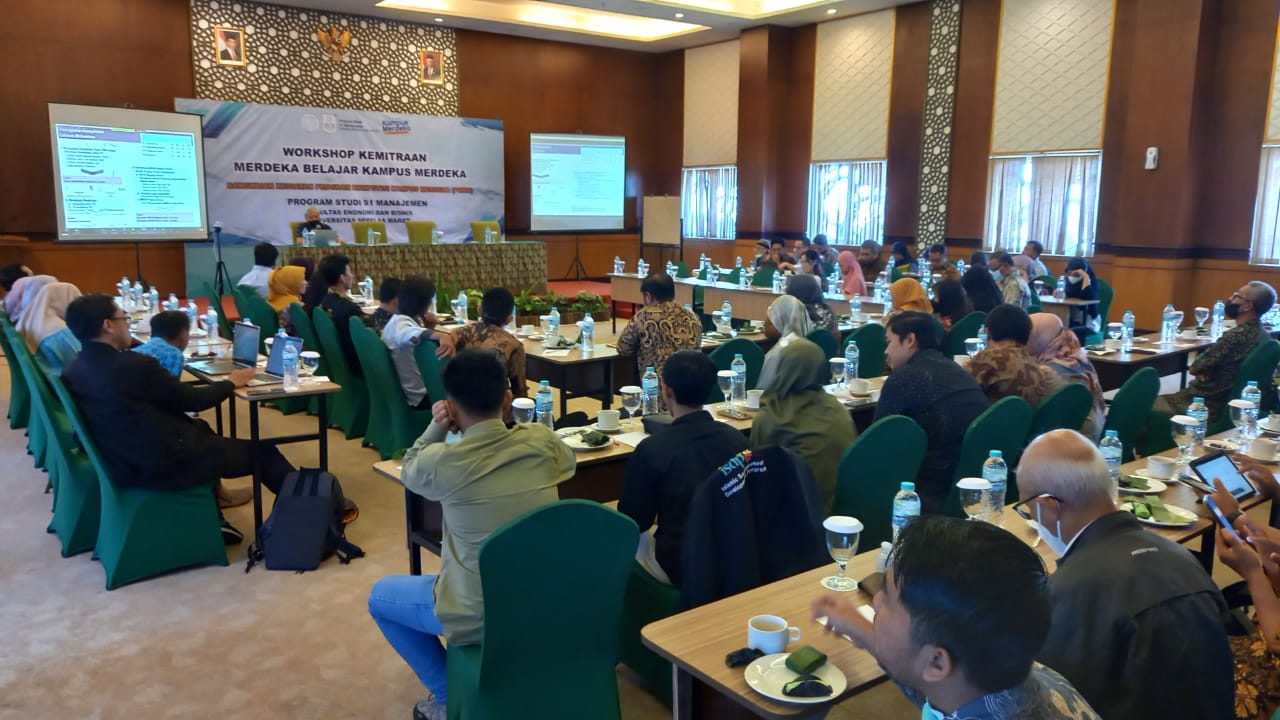
The Management Study Program, Faculty of Economics and Business (FEB), Universitas Sebelas Maret (UNS) hosted Merdeka Belajar Kampus Merdeka (MBKM) Partnership Workshop in Syariah Hotel Solo, Saturday, January 7th, 2023. The workshop was attended by all Management Study Program Partners, the Indonesian Chamber of Commerce and Industry (Kadin) for Surakarta Office, MSMEs partners, Lecturers, and students.
I n his remarks, Dr. Atmaji, MM, as the Head of the Management Study Program FEB UNS, states that the study program welcomed the MBKM program, initiated by the Ministry of Education, Culture, Research, and Technology (Kemendikbud Ristek), by preparing various supporting programs. Responding to the MBKM program, the Management Study Program has designed supporting programs for the students interested in participating in MBKM.
“Alhamdulillah, when MBKM was initiated, our Study Program reacted swiftly, thus, when the Minister of Education finally launched MBKM, Management Study Program could directly participate, even though only in one program, the student exchange program. For the following semester, however, our students participated in eight MBKM programs,” he reveals.
The eight programs are student exchange, internship, teaching assistance at education institutions, research, humanities project, entrepreneurship, independent project or study, and village development program or thematic student community program (KKNT). Students participating in the MBKM program will receive 20 credits for the one-semester MBKM program.
Not only studying theories, in the MBKM program, students can get involved in field activities and interact with the community according to their selected MBKM program. Students can learn about how the community interacts and how to get involved in business interaction and networking.
Higher Education Institutions cannot implement the MBKM program independently because it needs a partnership with various parties. Considering this, Dr. Atmaji also thanked all parties supporting MBKM implementation in the Study Program, particularly to Surakarta Kadin Office, for providing the opportunity for the industrial internship in the Solo Great Sale last year. He also thanked 16 MSMEs for supervising the students during the MBKM program, especially for business consulting for the last two months.
This workshop also marked the end of the MBKM business consulting and industrial internship program at the Surakarta Kadin Office.
The Head of the Kompetisi Kampus Merdeka Program (PKKM) for Management Study Program, Dr. Joko Suyono, M.Si., reported the implementation of PSM PKKM. The report states that the MBKM Program was strengthened through the PKKM programs. “The Study Program has entered its second year. In the first year, the Study Program developed the existing supporting laboratory and Project Based Learning program. While in this second year, the program will develop a virtual laboratory for data science,” he states.
Further, Dr. Joko Suyono explains that the main objective of MBKM is to improve the graduates’ competency, lecturers’ competency, and curriculum design for the Study Program. There are five programs proposed by the Management Study Program, including the development of a student learning platform, digital finance innovation development, graduates’ competency improvement, student entrepreneurship activity, and development of the study program reputation.
The workshop continued with testimonials from the partners’ representatives regarding the implementation of the MBKM program, followed by an award session for the best team in SGS 2022, as well as a Memorandum of Understanding signatory for the next MBKM Program.

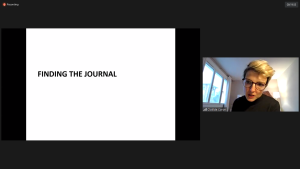 The recent workshop hosted by the Study Program invited Associate Professor Clotilde Coron, Ph.D., from IAE Paris Sorbonne Business School, France. Prof. Coron previously delivered numerous topics in the earlier sessions of this Visiting Professor Program. In this session, Prof. Coron shared the steps of the Human Resource Management (HRM) research article publication.
 For around one hour, Prof. Coron also explained the six stages of preparing a research article, such as planning, finding a suitable publishing outlet, understanding the article structure according to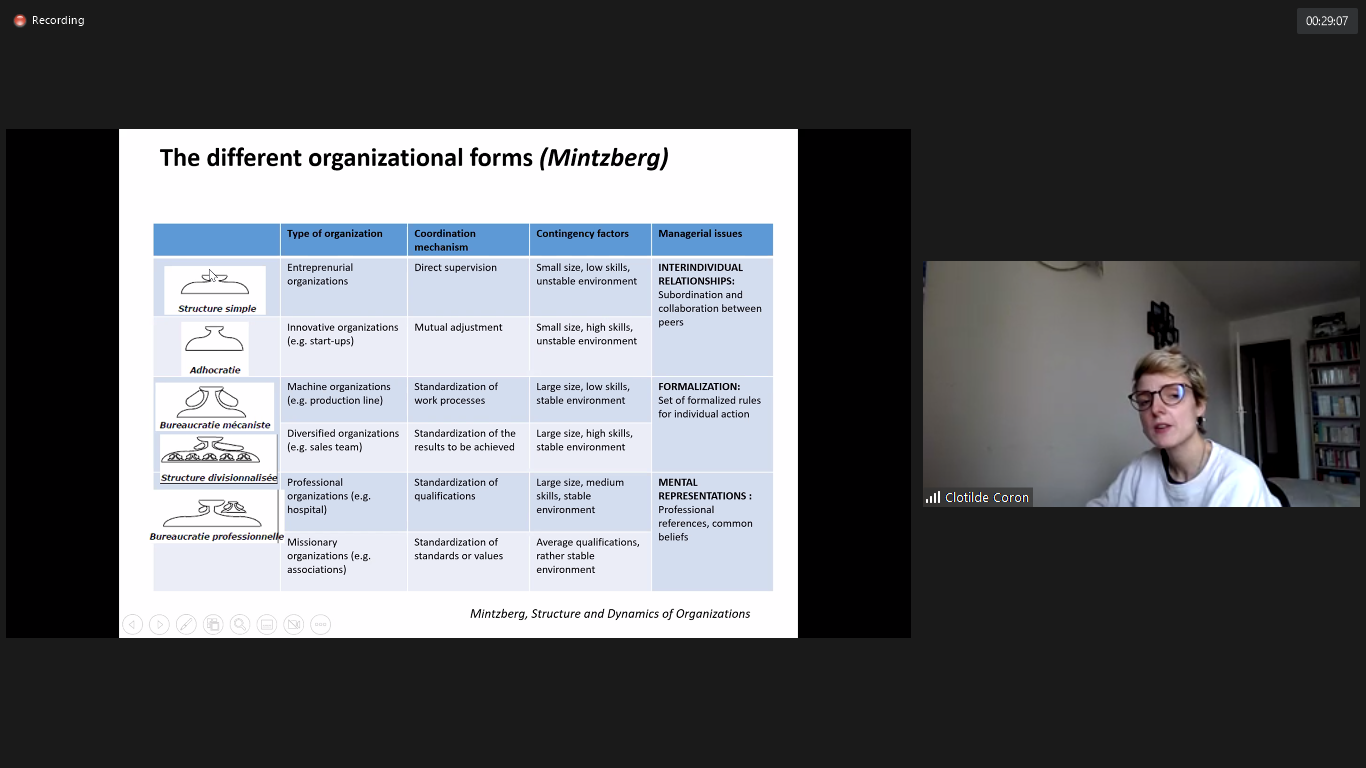
 The material presentation started with the organization configuration approach proposed by Mintzberg regarding the five internal actors in an organization, namely, the strategic plan officer (executive), middle management, center operation, technostructure, and supporting staff. “In the organizational configuration approach, each part of the five categories has a different role,” said Prof. Coron.
 The discussion about organization management is followed by the advantage of systems in human resource management and the significance of workplace flexibility. According to Prof. Coron, this flexibility is crucial in this VUCA environment, where transformation can happen quickly. For an organization, flexibility can be defined as the capacity to execute an initiative quickly and the capability to adjust organizational processes and structure.

 Further, she explains the digital technology applied in the human resource management sector and the existing challenges, which include disruption, economic platforms, collaboration, and automatization. On the other hand, she also mentioned the advantages of digital technology adoption in human resource management, including productivity improvement, enhanced focus on high-added-value assignments, and data usage for human resource performance improvement.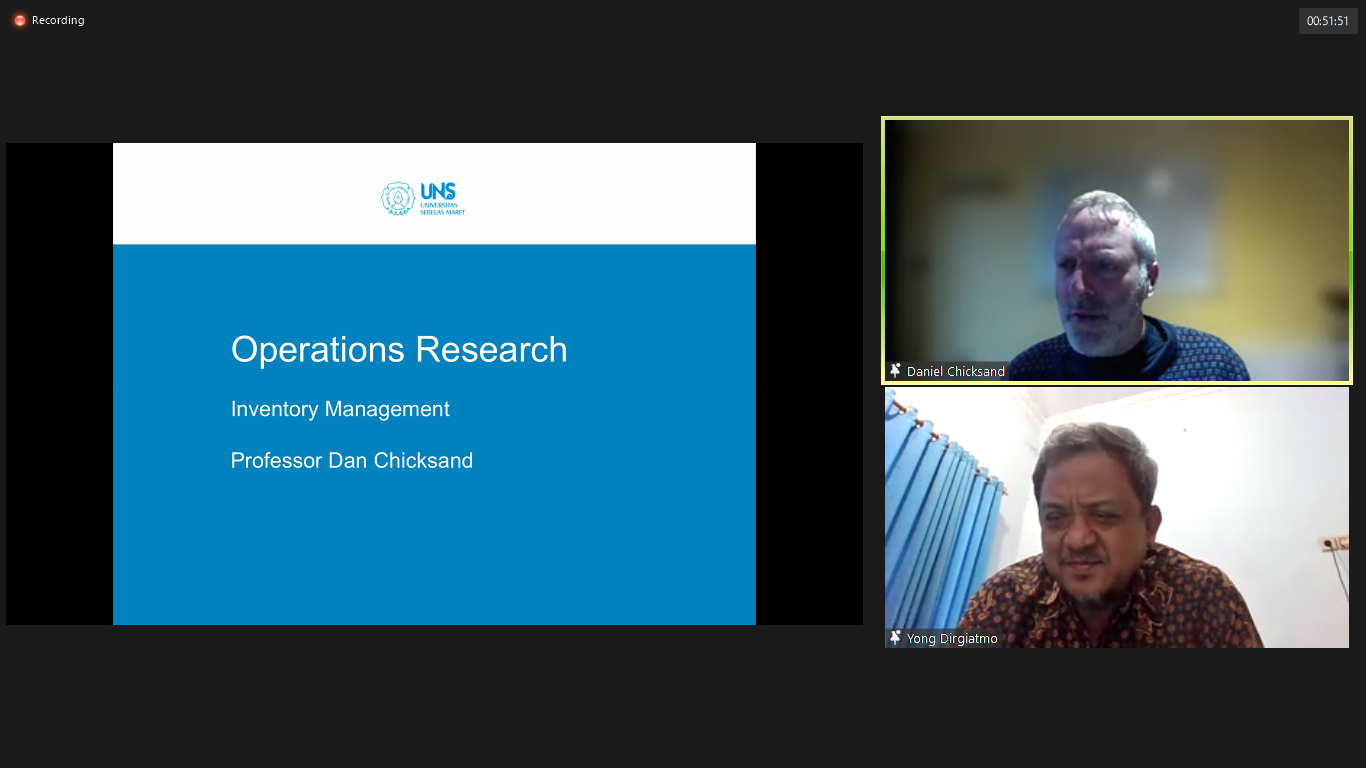
 The guest lecture entitled ‘Guest Lecture Operation Research: Inventory Management’ was conducted on Thursday, December 1st, 2022, through the Zoom Cloud Meeting and was led by Dr. Yong Digiatmo as Moderator.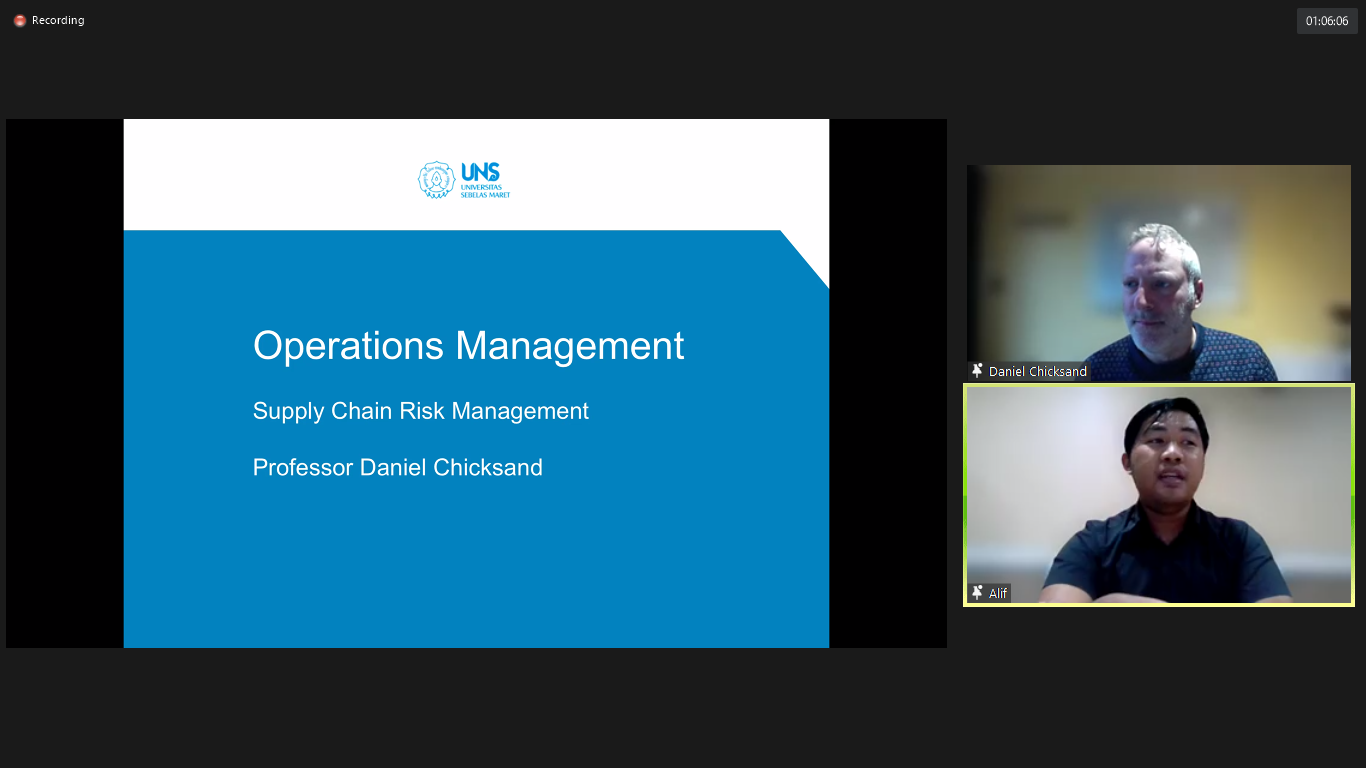
 The guest lecture conducted on Wednesday, November 30th, 2022, was attended by more than 100 participants consisting of FEB UNS students and lecturers.
 Following the extensive introduction to risk, Prof. Chicksand further explains risk management in the supply chain sector. Regarding mitigation according to the type of risk and probability, Prof. Chicksand mentioned four options available, among others, reduce, avoid, retain, and transfer.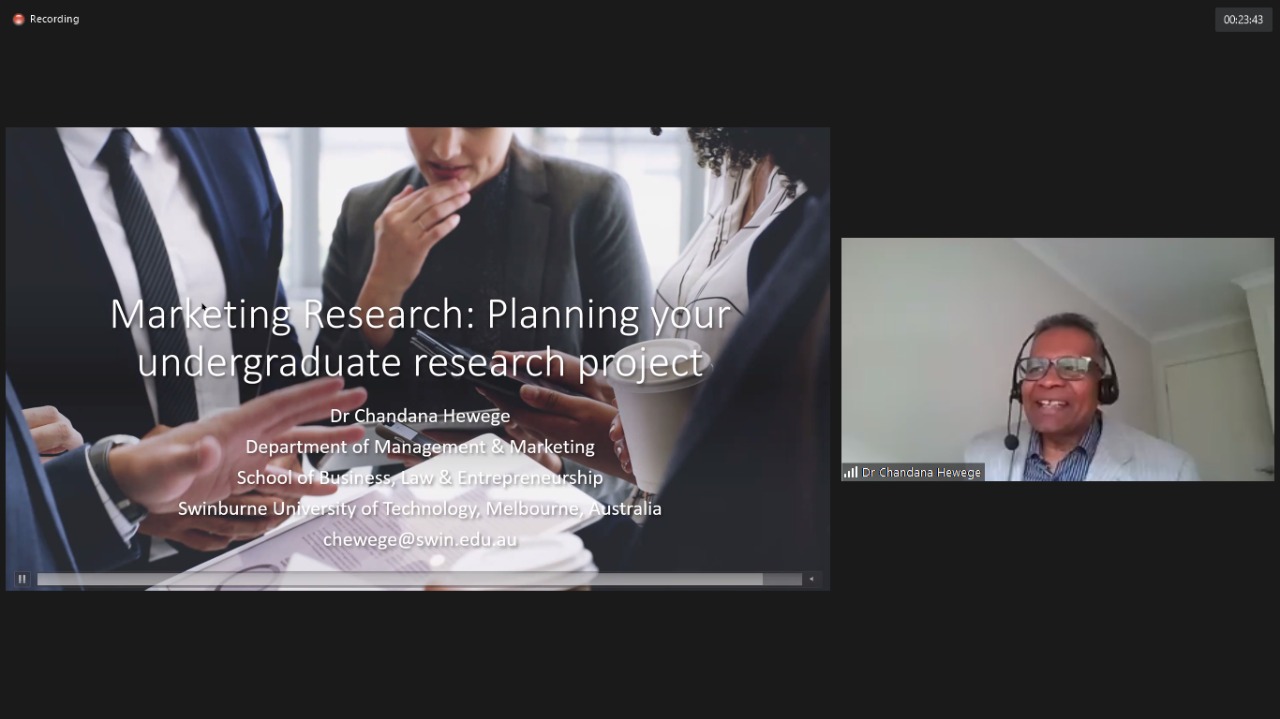
 Starting the material presentation, Dr. Hewege shortly explains the definition of research as a form of systematic investigation, which involves a systematic process to uncover new facts, theories, or practices. Further, he explains that the reason for a corporation to invest in research and development is motivated by the significance of market data in determining the global market and decision-making process. “Good research will help a company to formulate accurate decisions and policy, which means a good decision is supported with qualified data and adequate research,” explains Dr. Hewege.
 Afterward, Dr. Hewege continued delivering more in-depth material related to the research approach. This approach must be considered by the students before conducting research or when preparing thesis research. Meanwhile, regarding global marketing research, Dr. Hewege specifies six research stages to be conducted by students, namely, formulating the research problem, developing the research design, determining the source of information, data collection, data analysis and interpretation, and lastly, research report.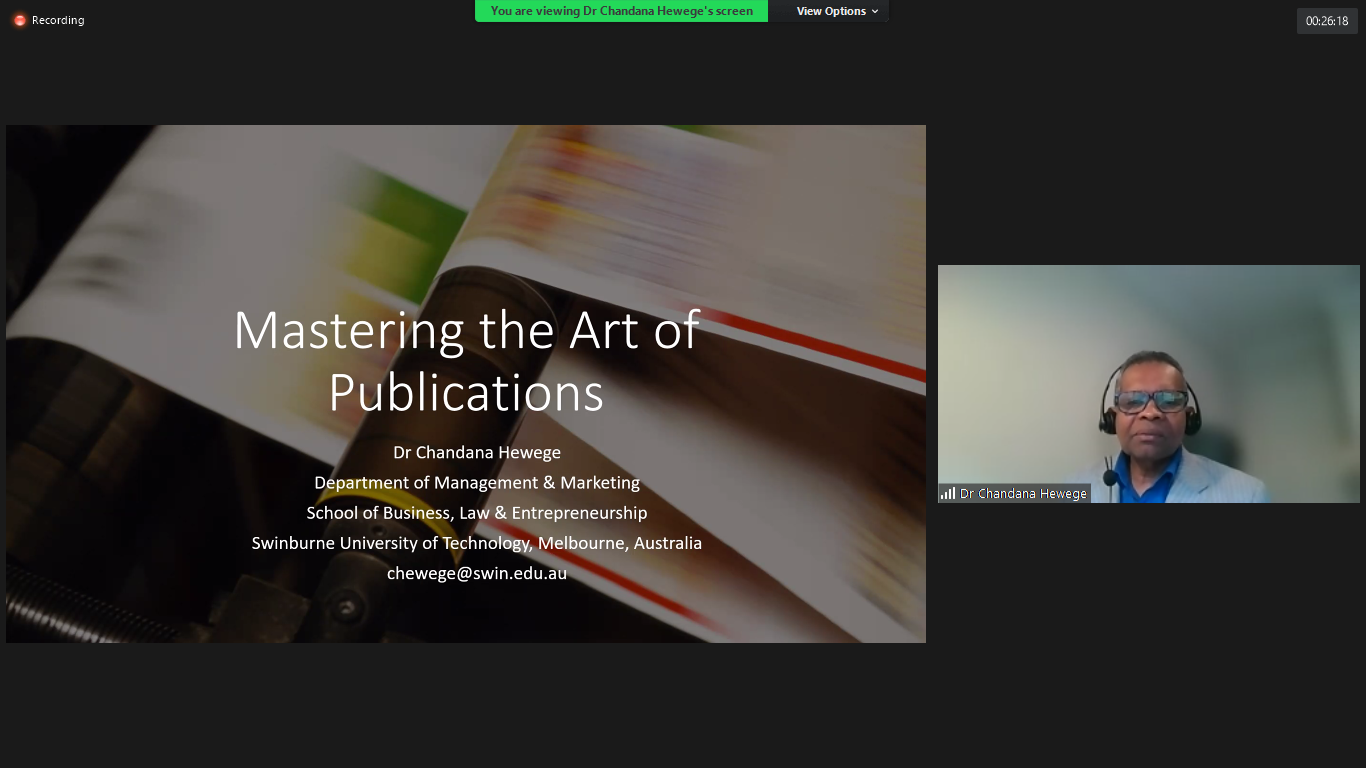
 Research, according to Dr. Hewege, is an interesting activity, but of course, there are academic members who are less interested in conducting research activities. However, to develop an excellent academic career, an academician must be involved in a balanced activity. “On this occasion, the material I am about to share is based on my experiences on various processes of publications. Hopefully, the material and the discussion can be a motivation for all the participants,” hopes Dr. Hewege.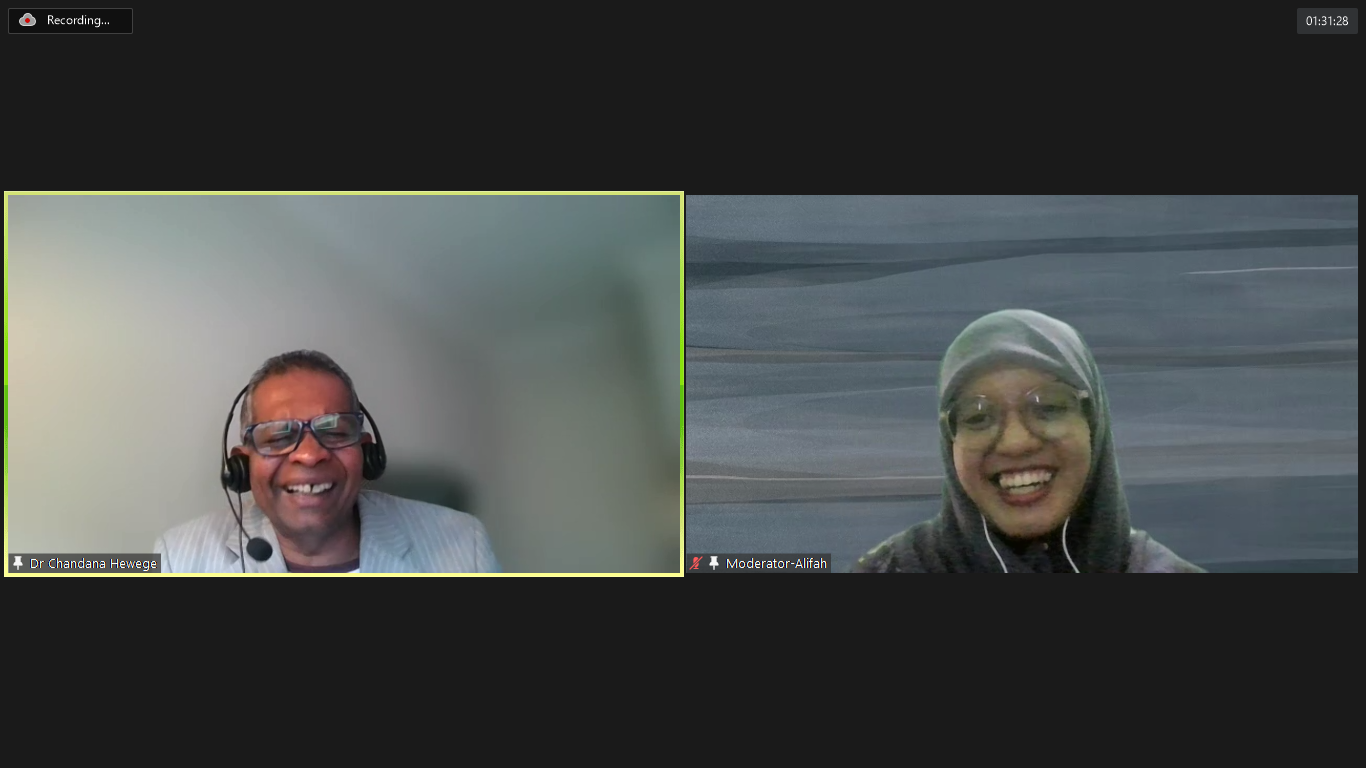
 Further, he explains that the biggest challenge faced by marketing experts recently is the need to manage both physical and virtual stores harmoniously. Therefore, both services and products offered virtually can be delivered and received by customers. This condition is in line with the consumer demand that is now more focused on experiences, which will encourage producers to transform their business from multichannel to omnichannel, where a company needs to integrate all available marketing channels. “Customers now are more powerful than before. Especially with the existence of social media as a global catalyst, companies need to build an online community and must be present in every online discussion to maintain product image. It is no longer enough to own social media account, but they must be involved in the ongoing discussion,” he explained.