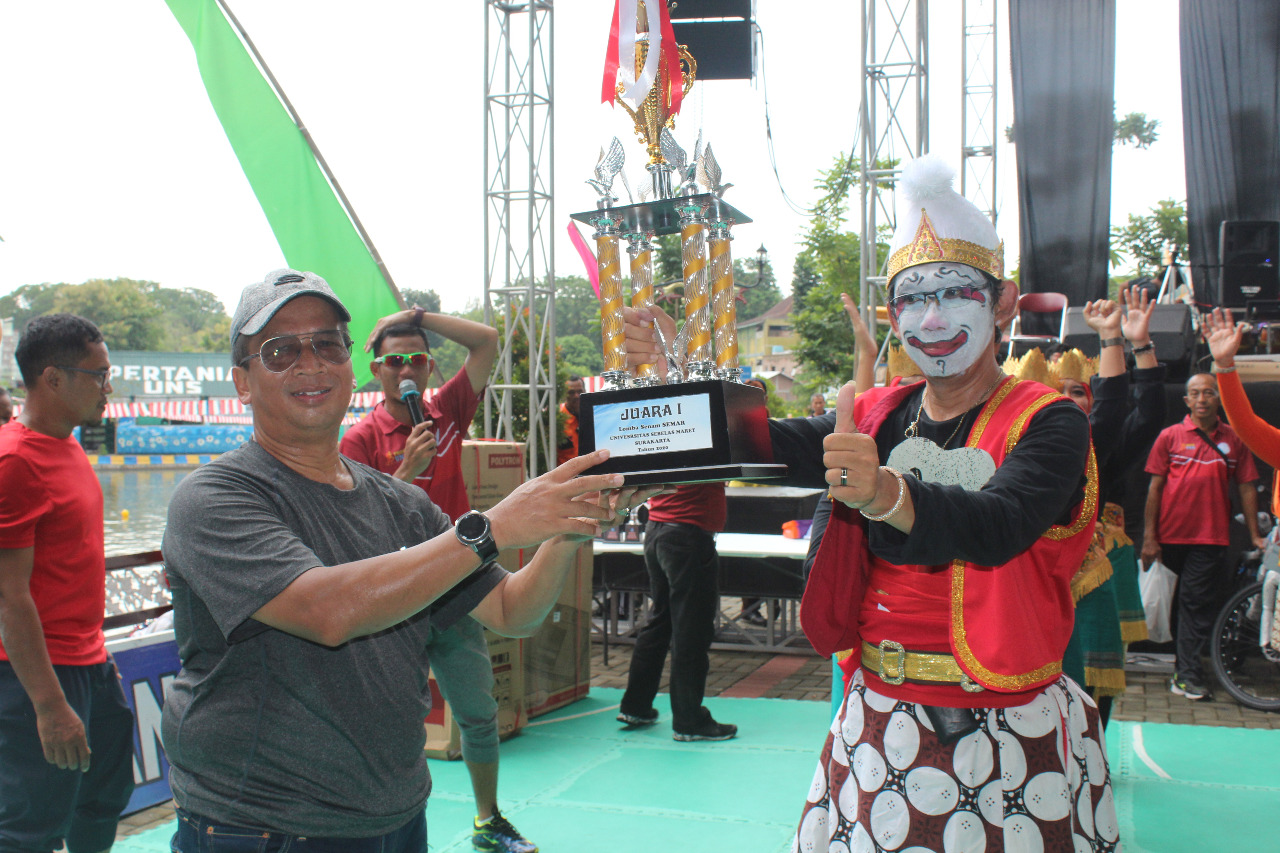
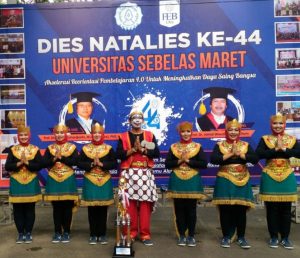
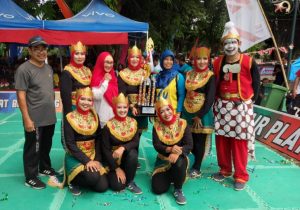
The cheers from the supporters of the Faculty of Economics and Business, Universitas Sebelas Maret (FEB UNS) sounds boisterous when the Rector of UNS announces the winner of Semar Gymnastic Competition, which held at Danau UNS on Friday (6/3/2020). The FEB Gymnastic Team has successfully performed amazingly surpassing its biggest competitor from the Faculty of Social and Political Study (FISIP) with only 10 points difference, at 1338, while FISIP earns 1328 points.
Besides the gymnastic moves, performance, and teamwork, the Rector of UNS, Prof. Jamal Wiwoho, while announcing the winner, mentioned that in Semar Gymnastic there is a philosophy that cannot be changed. In the FISIP team, there are two Semar figures, while in the FEB team there is only one Semar, which is the correct one. Overall points from the jury, FEB is superior.
“FIB team is good, FISIP is great, and FEB is excellent,” Prof. Jamal commented when watching the performance of the finalist.
Dr. Izza Mafruhah, M.Si, the Vice Dean of Academic Affairs FEB, representing the Dean of FEB appreciates the FEB Gymnastic Team who did their all during the final. “Really amazing, this event is incredible, not only teamwork, but the cheers from the FEB UNS supporters boost the team spirit to win the championship,” said Dr. Izza Mafruhah showing her happiness.
Furthermore, it was mentioned that their main objective is only to participate in the celebration of the UNS 44th Anniversary. They do not mind get the first champion, second, or third, but thankfully FEB UNS team won the first champion.
Meanwhile, Hendri Prayitno, S.Sos., the leader of the FEB UNS Gymnastics team is proud of this achievement and thanking the FEB UNS Leaders who have supported the team and the FEB UNS Faculty member who also give many supports since the beginning of the championship. The team realizes that their main competitor FISIP is quite difficult and they only have one day to prepare a new strategy to win the championship.
“Alhamdulillah, our hard work to train is not in vain, even though the time is limited to prepare for the final competition. We prepare a new strategy, the costume is changed, make-up, and formation is also changed from the previous formation,” said Hendri.
Self-confidence is their main key to stay optimistic on winning the competition. (Humas)
The current Indonesia’s economics is facing a continuous test. Following the decline in the percentage of Indonesia economics in the 4th quarter of 2019 to 4.97 percent, at the beginning of 2020, Indonesia’s economics has to face another hard condition with the coronavirus outbreak and Omnibus law implementation.
the participants, lecturers, and postgraduate students
Through the public lecture entitled ‘Global and Indonesia Economic Outlook 2020’, that held in Konimex Hall, 4th Building of the Faculty of Economics and Business (FEB) Universitas Sebelas Maret (UNS) Surakarta, on Saturday (15/2/2020), the Chairman of the Board of Commissioner, the Financial Service Authority (OJK), Prof. Wimboh Santoso, Ph.D., reviews in detail the role of government, especially OJK, in overcoming the economic impact that will be faced by Indonesia in 2020.
“The weakening of Rupiah can not be separated from the phenomena in our environment that affect the economy. Indonesian economics can not be isolated from the factors that highly dependent on the economic condition of other countries. Even though currently there is no coronavirus case in Indonesia, economically we are also affected. Corona became a subject that blamed by many people,” explains Prof. Wimboh starting the lecture.
In front of the UNS students who attended the public lecture, Prof. Wimboh Santoso mentioned that coronavirus outbreak in several countries will have a significant impact on countries with high export figures. He predicts that for the first quartal in 2020, China’s economy will decline by more than 1 percent.
“The unrest due to the coronavirus epidemic lead to a risk-off and pushing down the stock market and oil prices. Countries with high export figures will be affected by the outbreak. Luckily, Indonesia’s export is not that high, thus the effect is not significant. Global economic growth is minus 0.5 in the first quarter of 2020 due to corona. While China faces a 1.5 percent decline,” Prof. Wimboh continues.
Not only mentioning the decline of China’s economy, but Prof. Wimboh also mentioning the growth of credit at the end of 2019 that reach 6.08 percent. He considers the anomaly in the financial sector that happened in 2019 as the attitude of businesspeople in Indonesia who wait for the implementation of Omnibus law, which will bring a huge incentive.
The Omnibus law that currently is discussed by the government has become the topic of national conversation and polemic. Later, through the new stances, the government will submit two Drafts Law (RUU), namely the RUU on Employment and RUU on Taxation to the Dewan Perwakilan Rakyat (House of Representative-DPR).
“In the financial sector, there was some anomaly at the end of 2019, with very surprising figures, because credit only grew 6.08 and the Gross Domestic Product (GDP) 5.02 percent. Why the credits decline dramatically, there are several hypotheses. We at the OJK are researching on the factors. This is because of the announcement of the Omnibus law, everyone is waiting because the incentive is enormous. Because of the waiting, the effect is significant, thus if after the Omnibus law is implemented there is no boost, then our GDP will be below 5 percent not to mention the corona outbreak.”
As the Chairman of OJK, Prof. Wimboh also helped to rectify the polemic on omnibus law which become the subject of criticism from academics and workers. He mentions that the Omnibus law that was announced by President Joko Widodo since 2019 aims to boost the investment in Indonesia. Prof. Wimboh added that the Omnibus las will help to accelerate the revision/improvement of the Regulations in Indonesia, which will take a longer time to get revised individually.
On the occasion, Prof. Wimboh shares a number of moves taken by the government in stimulating new sources of economic growth. This including 10 priorities for new tourism destinations and processing the natural resources in Indonesia to promote employment.
“We made 10 priorities for new tourism destinations to create new sources of economic growth, for instance, PT. Freeport should process their product in Indonesia. As much as possible we should process our resources in Indonesia in order to absorb human resources. The new economy source is needed to absorb human resources and export orientation. The objective is how to provide a funding scheme for large payments, MSME, and consumers. We have a master plan for financial service 2020-2024, which covers the efforts to make the financial sector competitive in Indonesia and regionally,” Prof. Wimboh concludes.
Through the general lecture, the Vice Dean of General and Finance, the FEB UNS, Dr. Djuminah, M.Si., Ak., hopes that the visitation of Prof. Wimboh can add knowledge and become subject to deepens study material for the students of FEB UNS. Forward, Dr. Djuminah mentioned that FEB will follow up on OJK’s offer to hold a seminar on the Omnibus law in collaboration with the Faculty of Law (FH) UNS. Humas UNS/ Yefta
33 students from MAN 2 Surakarta follow the simulation in FEB UNS Laboratory
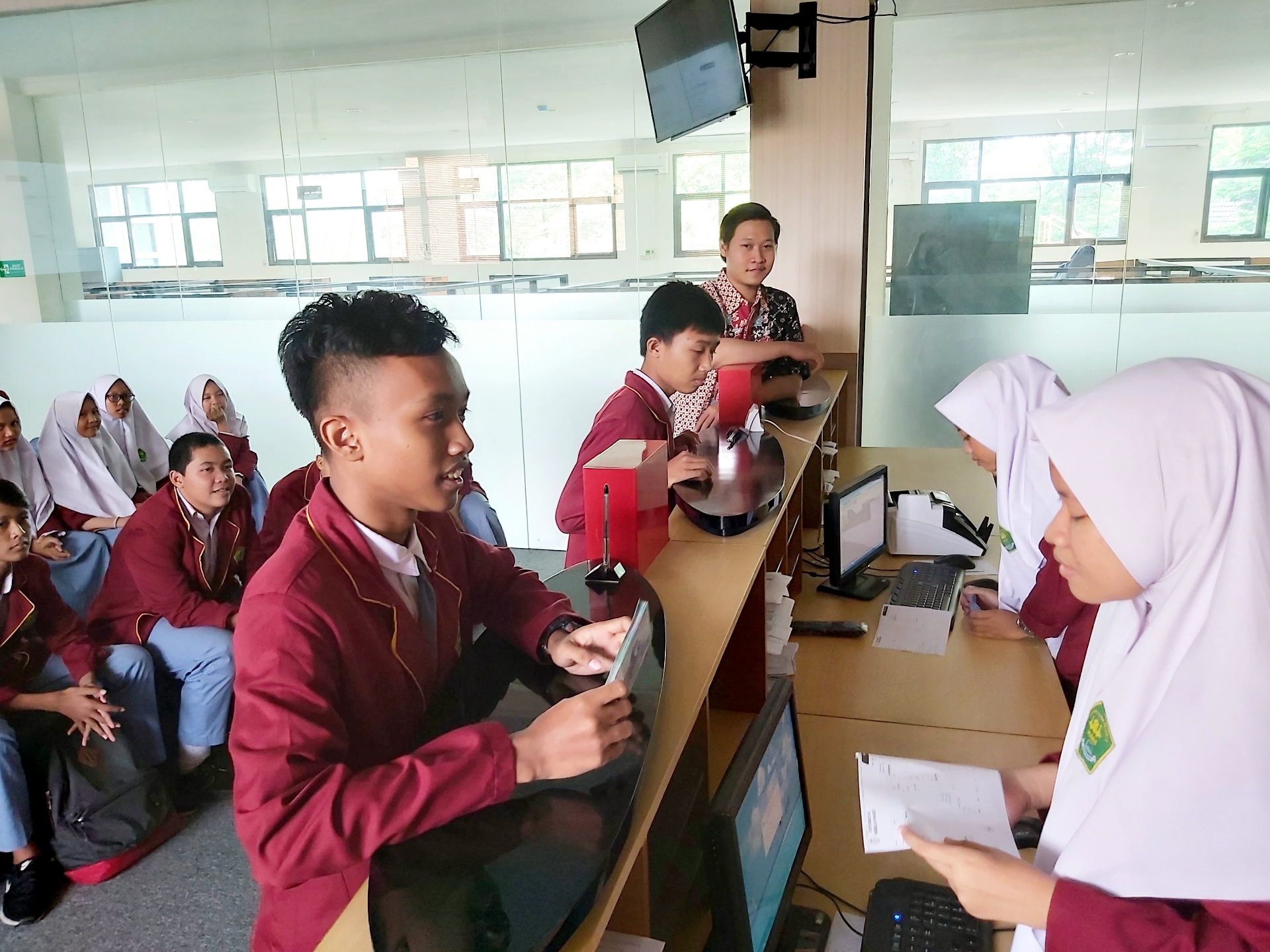
A total of 33 students from Madrasah Aliyah Negeri (MAN) 2 Surakarta held a simulation in the three of the Faculty of Economics and Business, Universitas Sebelas Maret (FEB UNS) laboratories namely Accounting Labs, Export and Import Laboratory, and Banking Simulation Laboratory, in Tuesday, February 11th, 2020.
In the laboratory, the students were given an explanation of the function and the mechanism of the laboratory by the Head of each Laboratory. For at least 2 hours, the students and teachers are taking roles interchangeably during the simulation. At the beginning of the simulation, the students seemed awkward to do the simulation, but after continuous instruction, they started to enjoy and excited to follow the simulation.
Before directed to the laboratory the contingent, that was led by Sita Kurniasari, S.Pd, M.Si, as a supervisor from MAN 2 Surakarta, was welcomed by the Vice Dean of General and Financial Affairs, Dr. Djuminah. M.Si. Ak., in Ruang Sidang 1 FEB UNS.
Dr. Djuminah motivates the students to choose FEB UNS
Dr. Djuminah welcomes the visit and coveys her gratitude to the MAN 2 Surakarta for their trust and visit to FEB UNS. “We hope that by knowing FEB UNS better, especially after observing and following the simulation in the labs, the students will be more interested to choose UNS and FEB as their main option to continue their study,” she said followed with “amiiin…” remarks from the students and teachers.
Meanwhile, Sita Kurniasari, S.Pd, M.Si, said that this visit to FEB UNS is their second visit and be will be routinely carried out also for the following year. The objective of this visit is to introduce the environment of the campus to the students. “The students will know that laboratory is not only owned by the faculties in natural science, but FEB UNS as one of the faculty in social science also owns a laboratory,” she explained.
It is expected that after the visit, the students will be encouraged to achieve their dreams, where most of them are interested to choose UNS, especially FEB UNS as their main option in continuing their study.
The Faculty of Economics and Business, Universitas Sebelas Maret (FEB UNS) collaborates with the Indonesia Association of Logistics and Forwarder (ALFI) Institute to organize an In-house Training in Export, Import, Logistics, and Freight Forwarder, on Monday to Thursday, 10-13 February 2020 in Student Lounge room, 4th Building FEB UNS.
The training was attended by 16 FEB UNS Faculty members and is opened directly by the Dean of FEB UNS, Prof. Drs. Djoko Suhardjanto, M.Com.(Hons)., Ph.D., Ak.
the Dean of FEB UNS (middle) deliver the opening remarks
In his opening remarks, Prof. Djoko conveys that this training is a response to the idea initiated by the Minister of Education and Culture (Mendikbud) of the Republic of Indonesia, Nadiem Anwar Makarim regarding “Kampus Merdeka”.
One of the Mendikbud ideas that need a quick response is the 5-3 learning formula, where the students follow lectures in the campus for 5 semesters and the following 3 semesters the students can join the lectures outside the faculty (to the other faculty), other universities, or taking an internship in the industries.
“For the outside the campus lecture, I would agree that the students take courses in the industry,” he stressed. This training is also an effort to bring the campus closer to the real world. The students are expected to stay grounded and starting to understand the issues that are happening in their environment.
Moreover, the new accreditation standard, requires that 80% of the graduates are absorbed by the industry or are capable to establish employment; otherwise, the accreditation score would be lower. The idea initiated by the Mendikbud should be responded to in order for FEB UNS to survive at the national and international levels.
Two trainers from ALFI Institute on the first training day
It is expected that after following this training, the Faculty members can share the knowledge to the students. At the end of his remarks, the Dean mentioned that the collaboration with industry sector needs to be improved. The laboratory in FEB UNS can be used as a training spot by inviting participants from various institutions and other higher education.
The training that was held for 4 days was led by 6 trainers from ALFI Institute. The material delivered were Freight Forwarding Services and Multimode Transport, Packaging and Document for Export-Import, Sales Contract and Documentary Credit, Other International Payment, Customs in Export and Import, and Trade Facilitation and SKA International Goods Classification.
The Dean of the Faculty of Economics and Business, Universitas Sebelas Maret (FEB UNS), Prof. Drs. Djoko Suhardjanto, M.Com.(Hons)., Ph.D., Ak., appreciates the FEB UNS alumni from the class of 1995, that not only organizing a reunion but also conducting a series of social activities. Moreover, the program was including all of the components of the civitas academics.
“The alumni of the class of 1995 are extraordinary, they are not only held a reunion, but they can organize a reunion that can promote the Faculty development and have a social impact. Even more, they can bring the
The Dean of FEB UNS Appreciates Alumni
senior lecturers, both that remain active and those already retired, to attend the event, as well as the support staff. Hopefully, this will be an inspiration to the other alumni,” he stressed during the opening remarks of “Alumni Talk”, on Saturday (1/2/2020).
Further, Prof. Djoko explained that the collaboration of all civitas academics, lecturers, support staff, students, and alumni will help the acceleration of FEB UNS development to be excel, not only at national but also international level. Currently, higher education institutions are required to follow accreditation with 9 standards, which regulate that 80% of the alumni should be absorbed by industry or creating employment. Therefore, the curriculum should be designed in collaboration among the faculty members, industry sector, and alumni.
The role of the alumni is important to motivate the students through knowledge and experience sharing, such as the Alumni Talk, that was held since morning in FEB UNS Hall. At the end of his remarks, the Dean delivers his gratitude to the main sponsor of the event among others are PT. Wijaya Karya, PT. Perkebunan Nusantara XIV, Wika Gedung, PT. Yogya Power and Pukis Badran, as well as the donation from the FEB UNS Alumni form 1995 class.
“Alumni Talk is one of the events from the series of activities organized by the Alumni from the class of 1995.
The alumni collaborates with FEB UNS civitas academics
There are four alumni who serve as the speakers for the event namely Danang Pamungkas, the Regional Territory Manager of PT HM Sampurna, Tbk, Haryanto, Commercial Director of PTPN XIV, Lenny Mardhiyati, Chief of Accounting and Reporting Section I of DJPK-Kemenkeu, and Renata Zoraifi, the Owner of Pukis Badran.
Through the event that was celebrated with a culinary festival, the alumni deliver an appreciation to the lecturers and academic support staff, as well as a scholarship for the students.
Other activities that were part of the series were medical check-up and social service in the form of 50 packages of groceries distributed to the cleaning service officer, security officer, driver, office boy, and the academic support staff. These activities were held on Friday (31/01/2020), after the morning gymnastics.
The alumni also deliver a ‘gebyok’ (a traditional door or room divider in Javanese culture), extra amenities for the praying room, canteen renovation, restroom, porch renovation, and provision of organic and non-organic waste bins.
Starting from January 14 to 16, 2020, for about three days, the Master in Economics and Development Study, Faculty of Economics and Business, Universitas Sebelas Maret (MESP FEB UNS), Surakarta, organized orientation for the new students of the study program. The event was conducted in FEB UNS 4th Building, Meeting Room 2. Nine students participated in the he-registration and student orientation.
Student orientation is a routine event, organized by the MESP FEB UNS to refresh the new student, on the topics related to their undergraduate study through small discussion. This activity is expected to give the new students a similar start-point in their study in MESP as well as to give them an illustration of the study in MESP for the following 2 semesters.
Dr. Evi Gravitiani, SE, M.Si, the Head of MESP, in her remarks mentioned that she wishes the students to follow the lecture and can get graduated on time. Previously, the average graduate time for MESP students is 2 years and two months. “We hope the students can graduate on time, not more than 2 years,” she specifically emphasized to encourage the new students who, especially this semester, were all fresh graduates from the Undergraduate program in Development Economics FEB UNS.
The hardest part for the master students is the final year because aside from thesis writing, the students are also required to do a publication for their research article with special requirement and they also must present their research in a national and international conference. During the three days orientation, the students are invited to discuss basic materials such as Mathematics for Economy, Micro Economics, and Macro Economics, which were presented by three MESP lecturers namely Aulia Hapsari Juwita, SE., M.E, Danur Condro Guritno, S.E., M.E., and Vita Kartika Sari, S.E., M.Sc. A pre-test was conducted before the material discussion, and a post-test also conducted to test the students’ readiness.
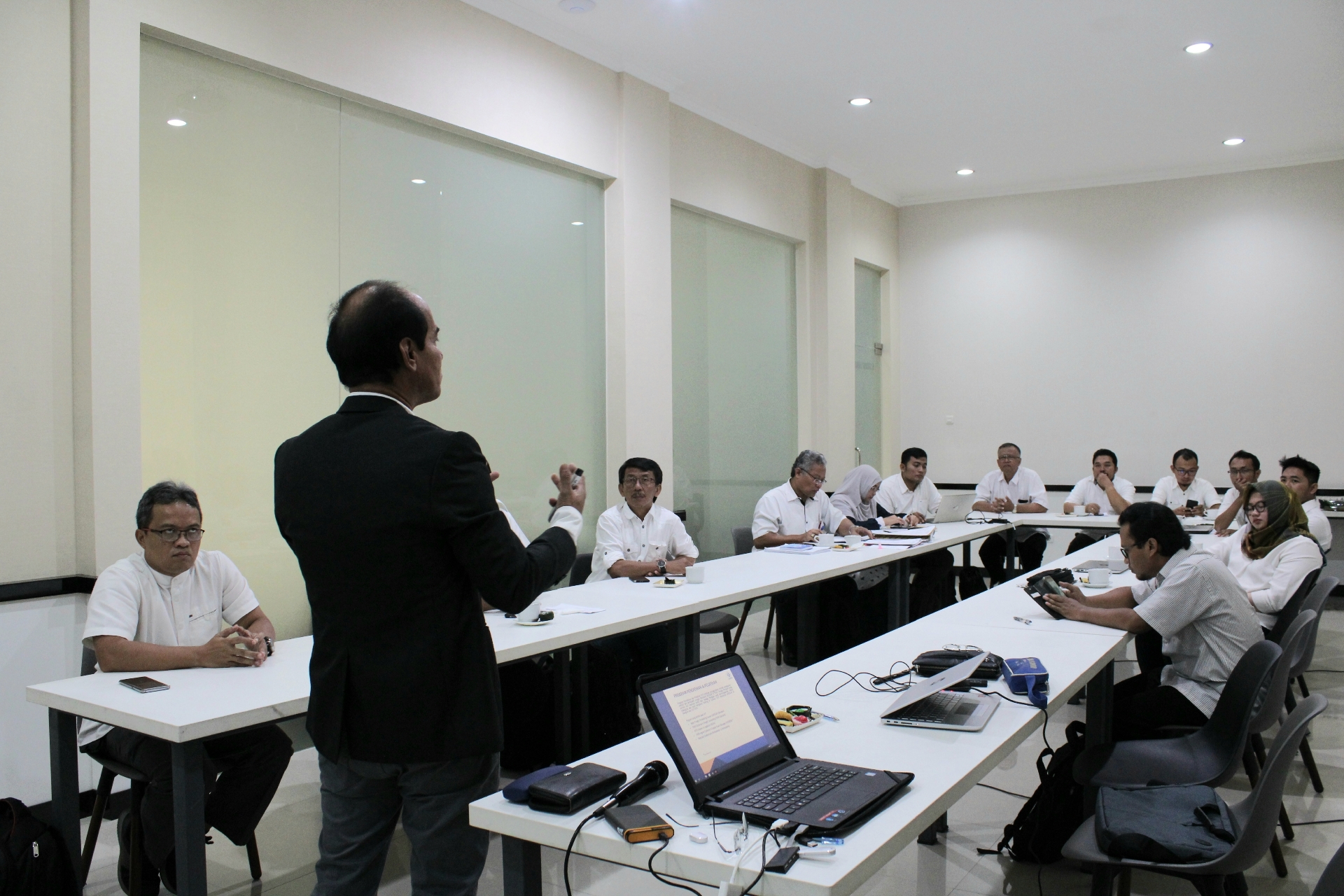
The Study Program of Master in Management (MM), the Faculty of Economics and Business, Universitas Sebelas Maret (FEB UNS) organized a Workshop on Research Proposal Writing on Saturday, January 11, 2020, in
Konimex Hall FEB UNS. The activity was attended by 90 students from the MM FEB UNS and Master in Accounting Study Program, with main speaker Dr. Nuryakin from Muhammadiyah University, Yogyakarta, and Retno Tanding Suryandari, Ph.D., the Head of MM FEB UNS.
In her presentation, Dr. Retno Tanding explained that a research proposal is formal writing that explains the topic and research plan, to ensure that the researcher has a relevant, focused, and interesting research idea and the research is feasible. The research proposal covers three aspects: research idea, research objective, research interest, the motivation of study, research plan and design.
Meanwhile, when choosing for research idea there are several aspects to consider such as interesting for the researcher, important, reasonable (access to data is available, supervisor availability, access to literature), feasible (cost, time, technique), and has a practical contribution. “Choose an interesting topic for you, at first do not choose a topic that interesting for others. If you are not interested in the topic, how are you going to convince the reader that your topic is interesting? Afterward, make sure that the research is feasible because there is a possibility that the research is not feasible to do,” Dr. Retno Tanding said.
Further, she explained the elements that should be included in research proposal are title (no need to be written at the beginning, can be decided later-on), introduction that covers the idea of research and research problems, literature review that covers the formulation of research objective, methodology, and research work plan that includes budget, time, and funding.
In line with Dr. Retno, Dr. Nuryakin also explained that the foundation in beginning a research is research idea, avoid topic that has limited theoretical background or with limited previous research, find supporting reference, determine research framework, use software to manage your reference (endnote, zootero, Mendeley), and access the information published in reputable journal. After the presentation from the two speakers, the participants are allowed to ask some questions regarding the material.
Dr. Mugi Harsono, the Vice Dean of Student and Alumni Affairs FEB UNS, delivers an opening remark
An internship program is a learning process for the students to get experience in the working world. This program also serves as a means to sharpen students’ soft skills and to learn about the alternative solution in problem-solving by applying their knowledge. In order to introduce internship program, the Internship and Career Development of the Faculty of Economics and Business, Universitas Sebelas Maret (ICD FEB UNS) Surakarta, organize a Socialization and Briefing for undergraduate and Diploma students who will take Internship program, Thursday, January 9-10, 2020, in FEB UNS Auditorium.
The Vice Dean of Alumni and Students Affairs FEB UNS, Dr. Mugi Harsono, mentioned the importance of an internship program to the students. “Internship program is conducted because the classical coursework is considered not sufficient to prepare the students to enter the job market. Students are not ready because they were not involved in real work within an organization or company. There is a big difference between education (campus) life with working place,” Dr. Mugi explained.
During the internship program, there will be many things to learn such as ethics, standard and procedure, how to handle dissent at the workplace, conflict management, and how to negotiate. On this occasion, a practitioner from the Human Resources Department of Novotel and IBIS Hotel Solo, Praliyana Megasari, delivered a presentation to prepare the students in entering working life. Opening her speech, Praliyana who is an alumna of FEB UNS from Management Study Program, explaining about the necessary preparation for joining the internship program.
“Internship is the first opportunity for the students to enter the working world, it is time to enrich your knowledge, skill, network, connection, and knowing new things in real work life,” Praliyana said.
Further, Praliyana advised that students should mind their behavior when entering the working world because it represents someone’s identity. Several aspects that employers considered when recruiting fresh graduate are communication skill, their loyalty, endurance, teamwork, performance, and sensitivity. At the end of the session, one of the ICD administrators, Juliati, M.Si, explains to the students about the internship program guidelines such as internship place, internship supervisor, the obligations of participants and interns, internship procedures, as well as evaluation and internship assessment aspect.
The Faculty of Economics and Business, Universitas Sebelas Maret (FEB UNS) Surakarta, organized a Character Coaching and Workshop for the Faculty academic support staff, on Saturday, January 11, 2020 in Magelang. The activity was attended by 80 support staff in FEB UNS as well as the Deanery and the Head of Study Programs and Units in FEB UNS. The activity was started with rafting along the Elo river, which was supported with a clear weather that day.
After the rafting, the academic support staff held a Workshop in Kampung Ulu Resort meeting room. Prof. Djoko Suhardjanto, the Dean of FEB UNS in his remarks mentioned that this activity aims to refresh the spirit of all support staff after working and busy with various activities at the office. “This activity is also a means to disciplining ourselves, to work hard, and work together to maintain compactness. Be happy under any circumstances even under a high pressure to achieve the target set,” the Dean said. Further, he also mentioned that this activity is useful to train the staff to be a good event organizer, how to plan an event to be successfully implemented, and providing excellent service.
Meanwhile, the Vice Dean of Academic Affairs, Dr. Izza Mafruhah, tells a story about “Learning from a Butterfly”. A kid who watch a cocoon felt sorry for the butterfly that struggling to getting out from its cocoon. The kid took initiative to help the butterfly and cut a wide hole on the cocoon to help the butterfly, but the butterfly is to weak to fly. The struggle taken by a butterfly to get out from its cocoon helps the butterfly to strengthen its wings, thus when it finally out, the butterfly has a strong wing. Learning from this, the difficulties in life actually bring wisdom to us become stronger and wiser. Work hard and struggling is part of life.
Dr. Izza also reminds the staff that FEB is a family, if one person is sick, then the other will be affected. Likewise, if one is happy, then the other will feel happy too. “Wherever, the position is, either in academic or student affairs or other unit, we should work together to support FEB UNS,” she said.
During the testimonial session, Lucida Rectavia represent the other 4 support staff who are transferred to other unit, to deliver a speech.
Starting on January 1, 2020, there are 5 support staff from FEB UNS who were transferred to other faculty in UNS. They are Edi Kusnadi transferred to the Faculty of Sport; Mohammad Taufiqurrahman, A.Md transferred to Faculty of Mathematics and Natural Science (MIPA); Sutopo, S.Kom transferred to the Vocational School; Hermawanti transferred to the Legal and Administrative and Cooperation Division; and Lucida Rectavia, SP transferred to Interest, Talent, Reasoning, and Student Information Section.
The end year meeting of the FEB UNS is attended by the Deanery of FEB UNS and all of the Faculty support staff. The meeting, which was conducted modestly, is organized on December 27, 2019, in FEB UNS 2nd Meeting Room. This aims to establish a positive synergy among the Deanery and FEB UNS support staff.
The Vice Dean of Academic Affairs, Dr. Mugi Harsono, starting the meeting with an introspection toward oneself mistake, both in action and thought in the daily life. In general, he mentions that all people should introspect their worship to the Allah, as all a person did should goes along with God regulation. Meanwhile, in social interaction he reminds the support staff about the good moral to fellow human beings. Dr. Mugi also provides example on how to introspect someone life, such as finding comparison to someone better or reviewing one’s weakness, and understand that God always keep an eye on our life.
Meanwhile, the Vice Dean of General and Finance Affairs, Dr. Djuminah, wishes that FEB UNS will be a ecosystem that provide usefulness and convenience for all stakeholders both internal and external parties. She also mentions that all Faculty member should have a sense of belonging in their workplace, which leads to responsibility and better performance. Further, she informs that in 2020 the structural official of echelon 3 and 4 will be abolished. Therefore, all the Head of Unit in UNS will retain their position but their rank will changed into functional position.
Moreover, in the beginning of 2020 there will be a rearrangement of support staff to refresh the staff performance. This mean several FEB UNS support staff will be transferred to other Faculty or to another unit within the FEB UNS. This, however, is a normal transfer.
At the end of meeting, Dr. Izza Mafruhah, mentioned to the support staff that in conducting their job in FEB UNS all Faculty members are establishing a collaboration, not working together. Where in collaboration there is an interrelated bond. A job conducted by academic unit can be forwarded by student service and/or other units. Therefore, all organization unit is important and no unit is more prominent than other. In an interconnected bond, if one part is loose then all other part will likely to crumble.
 Besides the gymnastic moves, performance, and teamwork, the Rector of UNS, Prof. Jamal Wiwoho, while announcing the winner, mentioned that in Semar Gymnastic there is a philosophy that cannot be changed. In the FISIP team, there are two Semar figures, while in the FEB team there is only one Semar, which is the correct one. Overall points from the jury, FEB is superior.
 ment and thanking the FEB UNS Leaders who have supported the team and the FEB UNS Faculty member who also give many supports since the beginning of the championship. The team realizes that their main competitor FISIP is quite difficult and they only have one day to prepare a new strategy to win the championship.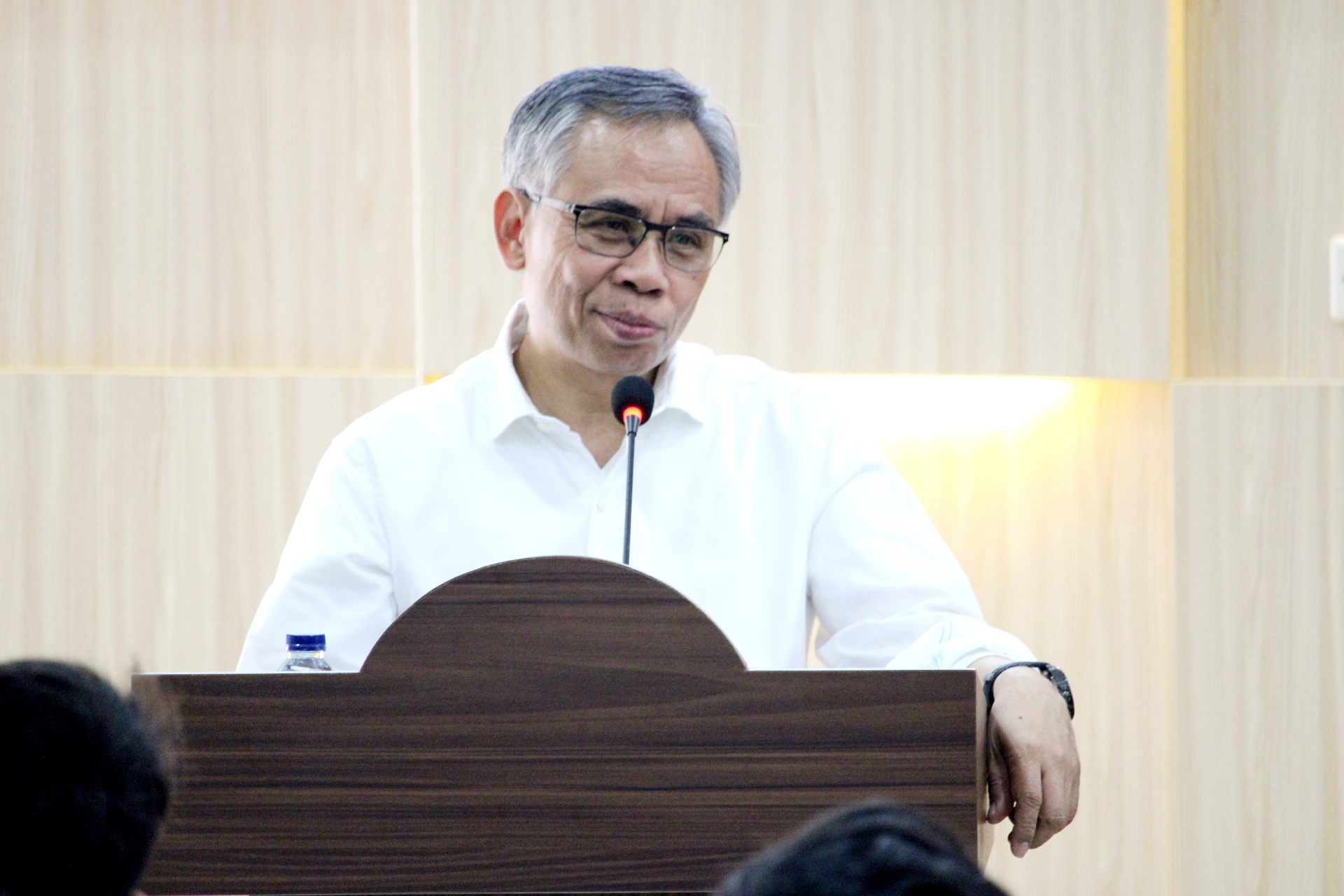






 Student orientation is a routine event, organized by the MESP FEB UNS to refresh the new student, on the topics related to their undergraduate study through small discussion. This activity is expected to give the new students a similar start-point in their study in MESP as well as to give them an illustration of the study in MESP for the following 2 semesters.
 FEB UNS.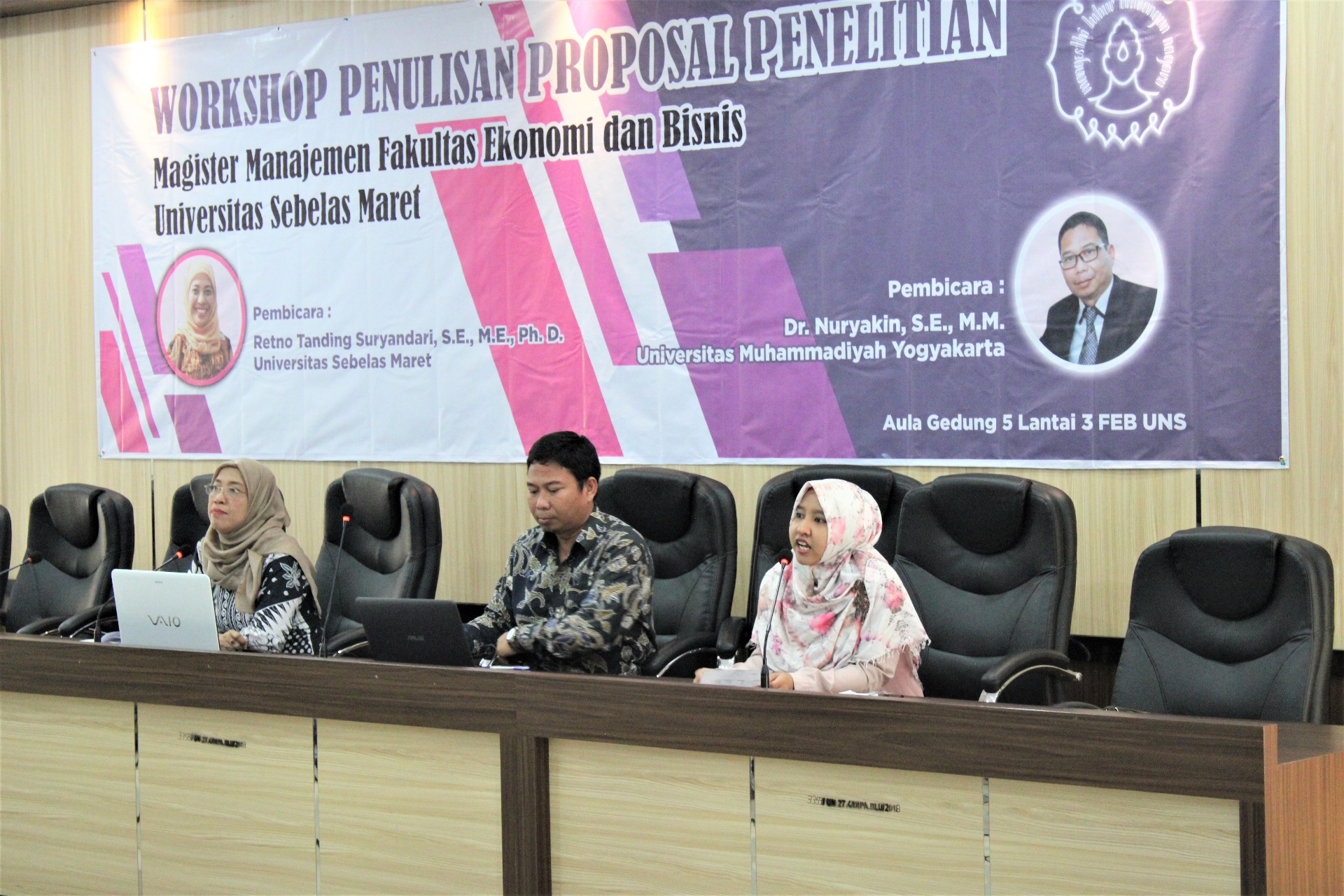

 Further, she explained the elements that should be included in research proposal are title (no need to be written at the beginning, can be decided later-on), introduction that covers the idea of research and research problems, literature review that covers the formulation of research objective, methodology, and research work plan that includes budget, time, and funding.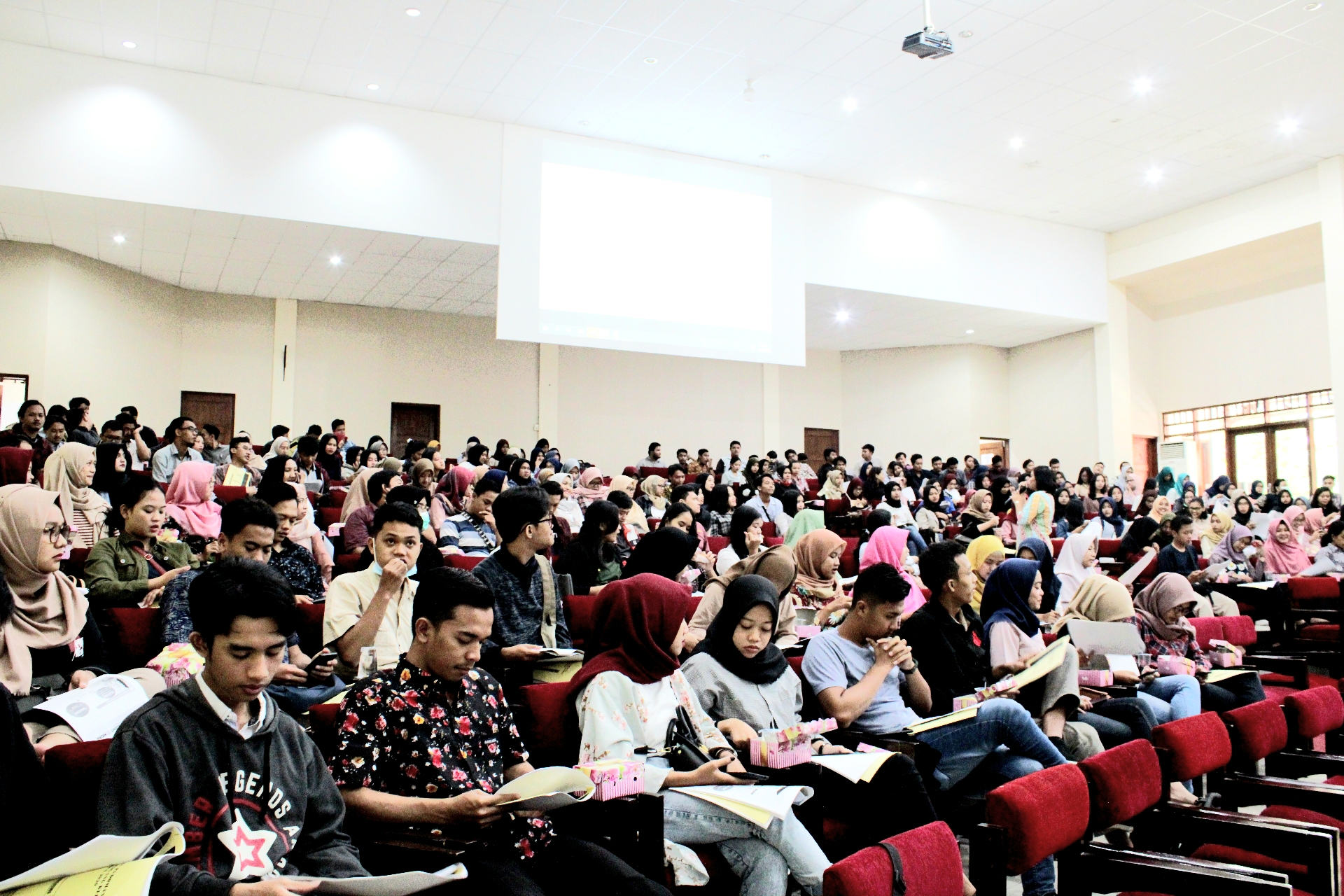


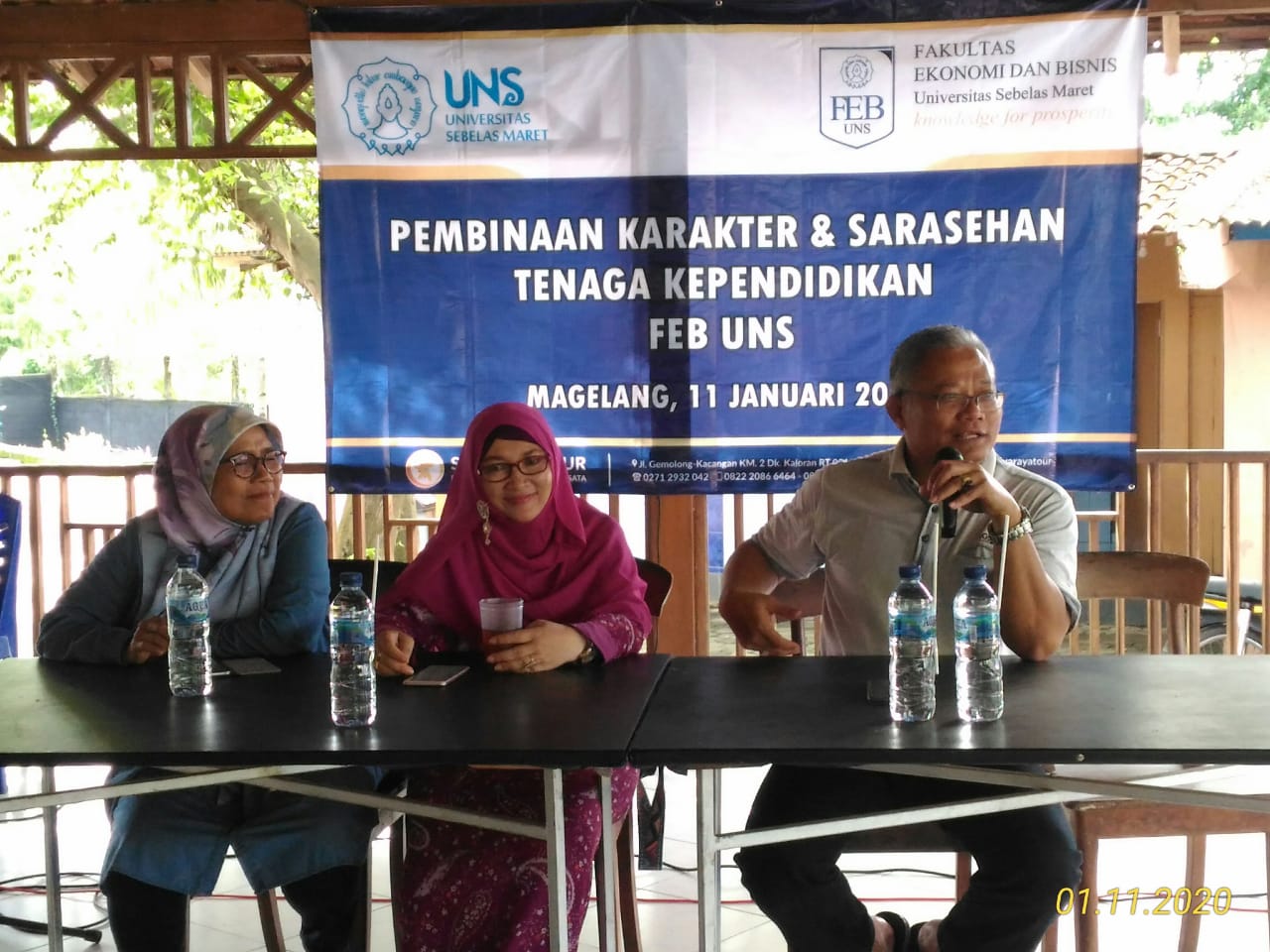
 After the rafting, the academic support staff held a Workshop in Kampung Ulu Resort meeting room. Prof. Djoko Suhardjanto, the Dean of FEB UNS in his remarks mentioned that this activity aims to refresh the spirit of all support staff after working and busy with various activities at the office. “This activity is also a means to disciplining ourselves, to work hard, and work together to maintain compactness. Be happy under any circumstances even under a high pressure to achieve the target set,” the Dean said. Further, he also mentioned that this activity is useful to train the staff to be a good event organizer, how to plan an event to be successfully implemented, and providing excellent service.
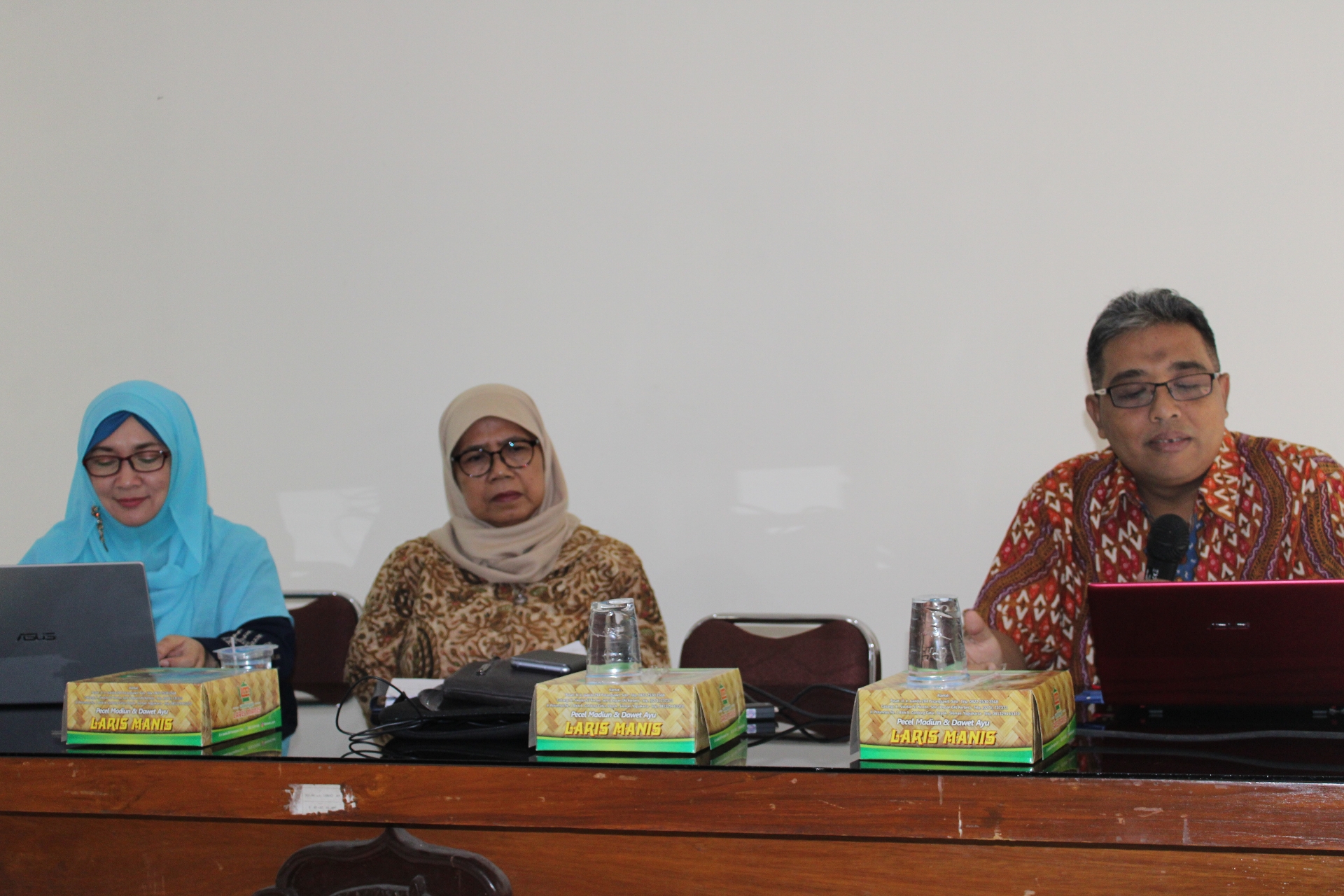
 The Vice Dean of Academic Affairs, Dr. Mugi Harsono, starting the meeting with an introspection toward oneself mistake, both in action and thought in the daily life. In general, he mentions that all people should introspect their worship to the Allah, as all a person did should goes along with God regulation. Meanwhile, in social interaction he reminds the support staff about the good moral to fellow human beings. Dr. Mugi also provides example on how to introspect someone life, such as finding comparison to someone better or reviewing one’s weakness, and understand that God always keep an eye on our life.
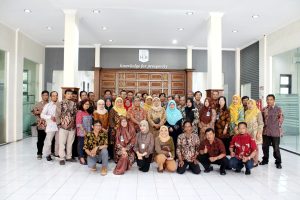 Moreover, in the beginning of 2020 there will be a rearrangement of support staff to refresh the staff performance. This mean several FEB UNS support staff will be transferred to other Faculty or to another unit within the FEB UNS. This, however, is a normal transfer.