Peraturan jam kerja pegawai selama Bulan Ramadhan 1444 Hijriah Tahun 2023 di Lingkungan Universitas Sebelas Maret dapat dilihat pada link berikut Edaran-Jam-Kerja-Ramadhan-1444-H-Th-2023.pdf
Peraturan jam kerja pegawai selama Bulan Ramadhan 1444 Hijriah Tahun 2023 di Lingkungan Universitas Sebelas Maret dapat dilihat pada link berikut Edaran-Jam-Kerja-Ramadhan-1444-H-Th-2023.pdf
The rapid development of the creative industry and the tourism sector has its own appeal to encourage regional economic growth. The development of the creative economy in Indonesia is currently focused on 16 sub-sectors, in accordance with Presidential Regulation Number 6 of 2015 concerning the Creative Economy Agency, namely culinary, architecture, product design, interior design, graphic design, film, animation and video, music, fashion, performing arts, games and applications, crafts, radio and television, fine arts, advertising, photography, and publishing.
 Seeing the condition and uniqueness of each region opens a vast opportunity to develop this creative industry and tourism economic sector as a potential “niche market” commonly called Niche Market Destination. The function of the market niche itself is to classify the economic sector, in this discussion is the creative industry and tourism. For example, Surakarta City is well-known for its culture and batik production industry. This aspect is known as the market niche of each region, which has its own characteristics as a potential economic resource for the region.
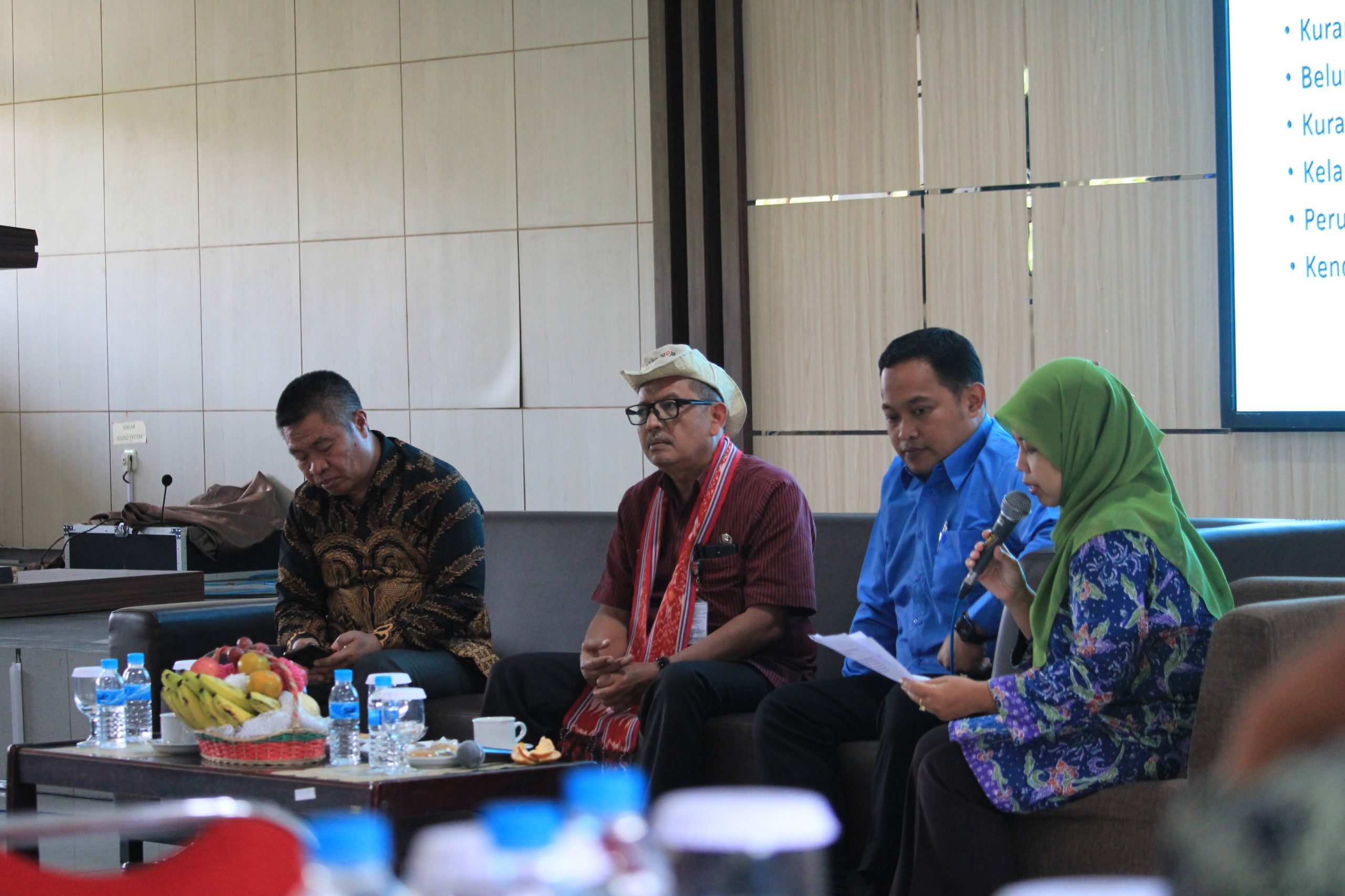
In response to this situation, the Business Management Agency (BPU) of the Faculty of Economics and Business (FEB), Universitas Sebelas Maret (UNS) held a Focus Group Discussion (FGD) Business Gathering with Regulators and Industry, Tuesday, March 21, 2023, at the Soedarah Soepono Building Hall FEB UNS.
The FGD entitled “Acceleration of Tourism Industry and Creative Economy Development in Central Java” presented three speakers, Purwanto, SH., M.Par, Plt. (Acting Officer) Head of the Central Java Youth, Sports, and Tourism Office; Parmin Sastro Wijono, Vice Chairman of the Indonesian Tourism Industry Association (GIPI); Prof. Agung Nur Probohudono, SE, M.Si., Ph.D., Ak., CA., FEB UNS Academician.
Purwanto, SH., M.Par., in his presentation conveyed the priorities of regional development in Central Java in 2023, namely through increasing community-based eco-socio-tourism and the environment through improving tourism destination facilities, increasing tourism promotion, increasing accessibility, and optimizing the role of private and community in the tourism industry.
The support programs and activities carried out by the government include the construction of a Toll Road for the Solo-Jogja track, Bawen-Jogja track, Ahmad Yani Airport, and Adi Sumarmo track, improving roads and trans-Jateng transportation, intermodal intelligent platforms for train stations and terminals.
In terms of attractions, the government has hosted various events such as Sports Tourism Tour De Borobudur, the Borobudur Marathon, World Wayang Way, Supermoon Festival, Music, Socio-Cultural Events, Edutainment Tourism, performances in 20 tourist villages, and many others. The local government has also coordinated the arrangement of the area, the management of homestays, the arrangement of parking areas and traders (Pasar Kujon), and the construction of the grand mosque.
Purwanto further explained the potential of the creative economy in Central Java. The leading sub-sectors of the creative economy in Central Java are Fashion (40.40%), Culinary (30.01%), and Crafts (15.00%). Meanwhile, the highest growth was in the Television and Radio, Film, Animation, Video, Performing Arts, and Visual Communication Design sub-sectors.
 Meanwhile, Prof. Agung Nur Probohudono said that the development of the tourism sector is very important because it can create jobs, increase income, and encourage local governments to build and maintain infrastructure so that the quality of life of the local community also increases. Central Java has 1,130 tourist attractions with 418 natural attractions, 175 cultural tourism, 365 artificial tourism, 76 special interest tourism, and 96 other tourist attractions.
“Good governance is needed, thus, all tourist attractions in Central Java can grow and be sustainable. Good governance includes 5 principles of Good Corporate Governance, namely transparency, fairness, independence, and accountability,” he said.
Furthermore, universities hold an important and strategic role in developing and advancing the tourism sector and creative economy growth, especially in enhancing human resources contribution through learning, research, and community service activities. Meanwhile, the Vice Chairman of the Indonesian Tourism Industry Association explained the key factors for the success of the tourism industry including product, customer care, location, environment, realistic cost, and strategic marketing.
This agenda also marks a partnership signatory ceremony between FEB UNS and Lawu Park. The partnership was signed by the Vice Dean of Planning, Business Partnership, and Information FEB UNS, Dr. Mugi Harsono, SE, MSi., and Parmin Sastro Wijono from Lawu Park.
Pesatnya perkembangan industri kreatif dan sektor pariwisata memiliki daya tarik tersendiri untuk mendorong pertumbuhan ekonomi daerah.
Pengembangan ekonomi kreatif di Indonesia saat ini difokuskan pada 16 subsektor, sesuai dengan Peraturan Presiden Nomor 6 Tahun 2015 Tentang Badan Ekonomi Kreatif yaitu kuliner, arsitektur, disain produk, disain interior, disain grafis, film, animasi dan video, musik, fesyen, seni pertunjukan, games dan aplikasi, kriya,radio dan televisi, seni rupa, periklanan, fotografi, serta penerbitan.
Melihat kondisi dan keunikan setiap daerah sangat memungkinkan mengembangkan sektor ekonomi industri kreatif dan pariwisata ini sebagai “ceruk pasar” yang potensial atau yang biasa di namakan dengan Niche Market Destination.
Fungsi dari ceruk pasar itu sendiri adalah untuk mengklasifikasikan sektor ekonomi dalam pembahasan ini adalah industri kreatif dan pariwisata. Sebagai contoh Kota Surakarta identik dengan kebudayaannya dan industri pembuatan batik, hal ini yang disebut ceruk pasar setiap daerah memiliki ciri khasnya sendiri untuk dijadikan potensi sumber ekonomi bagi daerah.
Dilatarbelakangi hal tersebut, Badan Pengelola Usaha (BPU) Fakultas Ekonomi dan Bisnis (FEB) Universitas Sebelas Maret (UNS) kembali menggelar Focus Group Discussion (FGD) Business Gathering Bersama Regulator dan Industri, Selasa, 21 Maret 2023, di Aula Gedung Soedarah Soepono FEB UNS.
FGD yang bertemakan “Akselerasi Pengembangan Industri Pariwisata dan Ekonomi Kreatif Jawa Tengah menghadirkan tiga narasumber, Purwanto, SH., M.Par, PLT. Kepala Dinas Kepemudaan, Olahraga dan Pariwisata Jawa Tengah, Parmin Sastro Wijono, Wakil Ketua Umum Gabungan Industri Pariwisata Indonesia (GIPI), Prof. Agung Nur Probohudono, S.E., M.Si., Ph.D., Ak., CA, Akademisi FEB UNS.
Purwanto, SH., M.Par dalam paparannya menyampaikan prioritas pembangunan daerah di Jawa Tengah pada tahun 2023 yakni melalui peningkatan eco socio tourism berbasis masyarakat dan lingkungan hidup melalui perbaikan sarana destinasi pariwisata, peningkatan promosi pariwisata, peningkatan aksesibilitas serta optimalisasi peran swasta dan masyarakat dalam industri pariwisata.
Dukungan program dan kegiatan yang dilakukan pemerintah tersebut diantaranya dengan pembangunan Jalan Tol Solo Jogja, Bawen Jogja, Bandara Ahmad Yani Dan Adi Sumarmo, peningkatan jalan dan transportasi trans Jateng, anjungan cerdas intermoda stasiun KA dan terminal.
Dalam hal atraksi dengan menggelar Sport Tourism Tour De Borobudur, Borobudur Marathon, World Wayang Way, Supermoon Festival, Music, Socio Cultural Events, Edutainment Tourism, pertunjukan di 20 desa wisata, dan sebagainya.
Pemerintah daerah juga telah mengkoordinasikan penataan kawasan, pengelolaan home stay, penataan area parkir dan pedagang (Pasar Kujon) serta pembangunan masjid agung.
Lebih lanjut Purwanto menjelaskan potensi ekonomi kreatif di Jawa Tengah. Untuk sub sektor unggulan ekonomi kreatif di Jawa Tengah yaitu : Fesyen (40,40%), Kuliner 30,01%, dan Kriya (15,00%). Sedangkan pertumbuhan tertinggi yaitu pada sub sektor Televisi dan Radio, Film, Animasi, dan Video, Seni Pertunjukan dan Desain Komunikasi Visual.
Sementara itu, Prof. Agung Nur Probohudono menyampaikan pembangunan sektor pariwisata sangat penting karena dapat menciptakan lapangan kerja, meningkatkan pendapatan, serta dapat mendorong pemerintah daerah membangun dan memelihara infrastruktur sehingga kualitas hidup masyarakat setempat juga meningkat.
Jawa Tengah memiliki daya tarik wisata sebanyak 1.130 dengan rincian 418 wisata alam, 175 wisata budaya, 365 wisata buatan, 76 wisata minat khusus dan 96 daya tarik wisata lainnya.
“Diperlukan tata kelola yang baik agar seluruh obyek wisata di Jawa Tengah bisa berkembang dan sustain. Tata kelola yang baik meliputi 5 prinsip Good Corporate Governance yaitu adanya transparansi, keadilan, kemandirian, akuntabilitas dan pertanggung jawaban” ungkapnya.
Lebih lanjut dikatakan peran perguruan tinggi penting dan strategis dalam mengembangkan dan memajukan dunia pariwisata dan pertumbuhan ekonomi kreatif, khususnya dalam memberi kontribusi sumber daya manusia melalui kegiatan pembelajaran, penelitian dan pengabdian kepada masyarakat.
Sedangkan Wakil Ketua Umum Gabungan Industri Pariwisata Indonesia menjelaskan faktor-faktor kunci untuk kesuksesan industri pariwisata meliputi product, customer care, location, environment, realistic cost dan marketing strategic.
Di kegiatan tersebut juga dilakukan penandatanganan perjanjian kerja sama antara FEB UNS dengan Lawu Park. Perjanjian kerja sama ditandatangani oleh Wakil Dekan Perencanaan Kerjasama Bisnis dan Informasi FEB UNS, Dr. Mugi Harsono, SE, MSi dan Parmin Sastro Wijono dari Lawu Park.
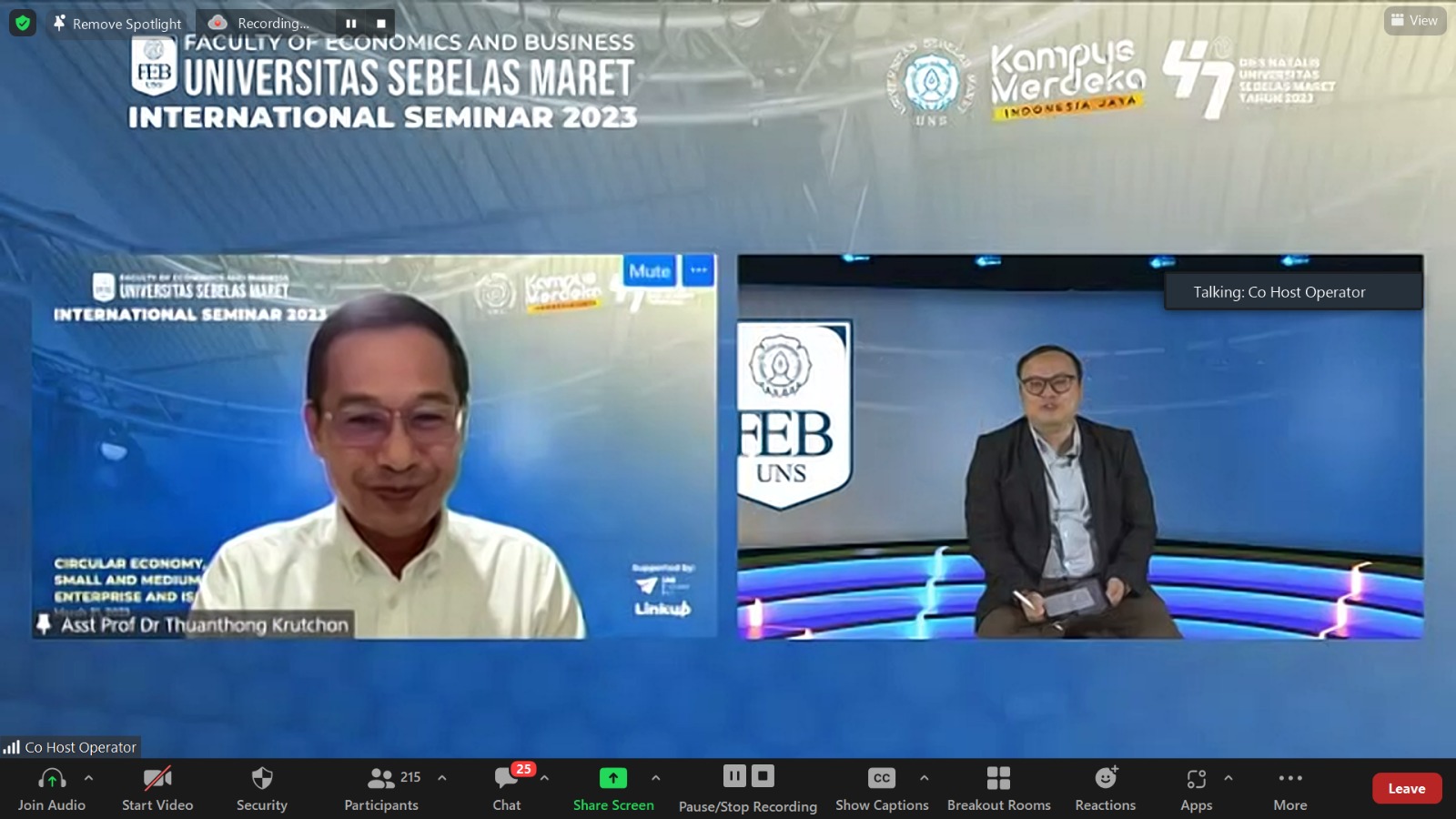
Fakultas Ekonomi dan Bisnis (FEB) Universitas Sebelas Maret (UNS) Surakarta hadirkan lima akademisi internasional dalam gelaran International Seminar 2023: A Lecture on Circular Economy, Small and Medium-Sized Enterprise and Islam.
Agenda yang dilaksanakan dalam rangka perayaan Dies Natalis ke 47 UNS tersebut berlangsung secara daring pada Selasa (21/03/2023). Agenda yang didukung oleh UNS Innovation Hub dan LinkUp! tersebut dihadiri oleh lebih dari 250 peserta yang terdiri dari dosen, mahasiswa, dan peserta umum.
Membuka jalannya seminar, Prof. Djoko Suhardjanto, Dekan FEB UNS, mengungkapkan rasa terima kasih kepada seluruh pembicara yang telah bersedia hadir dan menyampaikan materi pada Seminar Internasional FEB UNS 2023.
“Saya merasa sangat bahagia karena kesempatan ini dapat menghadirkan kesempatan bagi kita untuk belajar dari satu sama lain terkait ide-ide serta best practice di sektor circular economy dan islam. Saya berharap peserta yang hadir dapat terlibat secara aktif dalam diskusi hari ini,” ungkap Prof. Djoko.
Prof. Djoko juga berharap agar agenda pada hari ini akan menghasilkan kolaborasi yang bermakna.
Pembicara kunci pertama yang menyampaikan materi pada agenda kali ini adalah Prof. Khaleed Soufani dari University of Cambridge, Inggris, yang menyampaikan topik terkait hubungan antara sustainability, circular economy, impact investing, dan Islam.
Menurutnya saat ini kondisi dipenuhi dengan disrupsi baik di bidang teknologi, sosial, dan lingkungan.
“Kita saat ini berada pada posisi over-consumption, over-producing, dan over-trading, tiga kondisi ini menyebabkan jumlah sampah yang besar dan berakibat negatif bada kondisi lingkungan,” jelas Prof. Khaleed.
Pemateri kunci kedua hadir secara daring dari Universitas Islam Negeri Syarif Hidayatullah, yaitu Prof. Abdul Mu’ti.
Dalam paparannya, Prof. Mu’ti mengungkapkan bahwa Islam adalah sebuah agama yang lengkap yang mengajarkan dan mengatur banyak hal dalam kehidupan manusia.
“Ekonomi dalam ajaran Islam mengajarkan kepada kita akan pentingnya kepemilikan material sebagai bagian dalam kekayaan dan kemakmuran umat muslim. Perlindungan kekayaan tetap bagian dari ajaran Islam, meskipun Islam juga melarang akumulasi kekayaan pada satu orang atau kelompok kecil yang kemudian mengesampingkan permasalahan yang timbul di masyarakat,” jelas Prof. Mu’ti.
Pada sesi kedua seminar, tiga akademisi menyampaikan materi secara berurutan dalam sesi plenary yang dipimpin oleh Dr. Putra Pamungkas dari FEB UNS. Ketiga pembicara yang hadir pada sesi ini adalah Assoc. Prof. Dr. Thuanthong Krutchon dari Thaksin University Thailand, Dr. Rudi Natamiharja dari Universitas Lampung, dan Dr. Tastaftiyan Risfandy dari FEB UNS.
Selama kurang lebih tigapuluh menit, Assoc. Prof. Dr. Thuanthong membagikan pengalaman dalam penerapan circular ekonomi di Thailand, yang mencakup tiga aspek yaitu Bioeconomy, Circular Economy, dan Green Economy (BCG). Penerapan BCG ini juga terkoneksi pada target pembangunan nasional.
Menyambung paparan dari Dr. Thuanthong, Dr. Rudi, menjelaskan topik terkait perlindungan hukum untuk UMKM di Indonesia.
Dalam paparannya bertemakan ‘Indonesian Legal Guarantee on the Welfare of MSMEs,’ tersebut, Dr. Rudi membahas secara detail tentang peraturan yang menjadi dasar perlindungan hukum bagi UMKM baik di tingkat internasional, nasional, serta perlindungan hukum bagi hak UMKM dalam menjalankan aktifitas ekonomi di Indonesia.
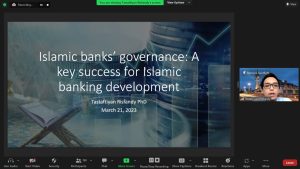
Pembicara terakhir, Dr. Tastafiyan menyampaikan materi berjudul “Islamic Banks’ Governance: A key success for Islamic banking development”.
Membuka paparannya, Dr. Tastaftiyan menyatakan bahwa, “Bank syariah dibentuk untuk mengurangi jarak antara masyarakat miskin dan kaya. Selain itu, peran dari bank syariah adalah juga untuk menyediakan kredit bagi UMKM. Dalam hal perkembangan bank syariah, terdapat banyak aspek yang perlu diperbaiki,” ungkap Dr. Tastafiyan.
Dalam paparan tersebut, Dr. Tastaftiyan juga membagikan hasil risetnya yang bertajuk ‘Excess remuneration, governance, and risk-taking in Islamic banks,’ yang berkolaborasi dengan Prof. M. Kabir Hassan.
Dikatakan bahwa motivasi dari penelitian tersebut adalah karena adanya tingkat remunerasi yang tinggi bagi company executive.
“Implikasi dari hasil riset ini adalah bahwa aktivitas monitoring yang baik, yang dilakukan oleh Board of Director dan Sharia Board dapat mengurangi insentif risk-taking yang kemudian mendorong kemajuan bank syariah. Untuk karenanya, pembuat kebijakan perlu menetapkan skema remunasi yang baik, khususnya untuk anggota BoD dan SSB.” paparnya.
Seminar yang berjalan sekitar tiga jam tersebut berlangsung dengan lancar. Peserta sangat antusias mengikuti jalannya seminar terlihat dari diskusi aktif peserta dengan seluruh narasumber.
Faculty of Economics and Business (FEB) Universitas Sebelas Maret (UNS) Surakarta, presented five international academics in the International Seminar 2023: A Lecture on Circular Economy, Small and Medium-Sized Enterprise and Islam.
The agenda organized as part of the 47th UNS Anniversary celebration, was conducted virtually on Tuesday (03/21/2023). The agenda supported by the UNS Innovation Hub and LinkUp! was attended by more than 250 participants consisting of lecturers, students, and general participants.
Opening the seminar, Prof. Djoko Suhardjanto, the Dean of FEB UNS, expressed his gratitude to all speakers who have been willing to attend and deliver materials at the FEB UNS 2023 International Seminar. “I am thrilled because the current occasion can present an opportunity for us to learn from each other regarding ideas and best practices in the circular economy and Islam. I hope the participants can be actively involved in today’s discussion,” said Prof. Djoko. Prof. Djoko also hopes that today’s agenda will result in meaningful collaboration.
The first keynote speaker who delivered the material at this seminar was Prof. Khaleed Soufani from the University of Cambridge, UK, presenting topics related to the relationship between sustainability, circular economy, impact investing, and Islam. According to him, the current world conditions are filled with disruptions in the field of technology, social, and the environment.
“We are currently in the position of over-consumption, over-producing, and over-trading, these three conditions cause large amounts of waste and negatively affect environmental conditions,” explained Prof. Khaleed.
The second keynote speaker who attended the event virtually was from Syarif Hidayatullah State Islamic University, namely Prof. Abdul Mu’ti. In his presentation, Prof. Mu’ti revealed that Islam is a complete religion that teaches and regulates many things in human life.
“The Islamic economy teaches us the importance of material property as part of the wealth and prosperity of Muslims. The protection of wealth remains part of Islamic teachings, although Islam also prohibits the accumulation of wealth in one person or small group, which then ignores the problems that arise in society,” explained Prof. Mu’ti.
In the second session of the seminar, three academics delivered different materials in sequence in a plenary session led by Dr. Putra Pamungkas from FEB UNS. The three speakers invited for this session were Assoc. Prof. Dr. Thuanthong Krutchon from Thaksin University Thailand, Dr. Rudi Natamiharja from the University of Lampung, and Dr. Tastaftiyan Risfandy from FEB UNS.
For about thirty minutes, Assoc. Prof. Dr. Thuanthong shared his experience in implementing circular economy in Thailand, covering three aspects namely Bioeconomy, Circular Economy, and Green Economy (BCG). The implementation of BCG is also connected to national development targets.
Following material from Dr. Thuanthong, Dr. Rudi explained the topic related to legal protection for MSMEs in Indonesia. In his presentation entitled ‘Indonesian Legal Guarantee on the Welfare of MSMEs,’ Dr. Rudi discussed in detail the regulations that form the basis of legal protection for MSMEs both at the international, national, and legal protection for MSME rights in carrying out economic activities in Indonesia.
The last speaker, Dr. Tastafiyan presented the material entitled “Islamic Banks’ Governance: A key success for Islamic banking development.”
Starting the presentation, Dr. Tastaftiyan stated that, “Islamic banks were formed to reduce the distance between the poor and the rich. Moreover, Islamic banks also serves the role to provide credit for MSMEs. In terms of the development of Islamic banks, there are many aspects that need to be improved,” said Dr. Tastafiyan.
In this presentation, Dr. Tastaftiyan also shared the results of his research entitled ‘Excess remuneration, governance, and risk-taking in Islamic banks,’ in collaboration with Prof. M. Kabir Hassan. He revealed that the motivation for the study is due to the high level of remuneration for company executives.
“The implication of the results of this research is that good monitoring activities carried out by the Board of Directors and the Sharia Board can reduce risk-taking incentives, which then encourage the progress of Islamic banks. For this reason, policymakers need to establish a good remuneration scheme, especially for BoD and SSB members.”
The seminar, which lasted about three hours, went seamlessly. Participants are very enthusiastic about following the course of the seminar proven by the active discussion between participants with all the speakers
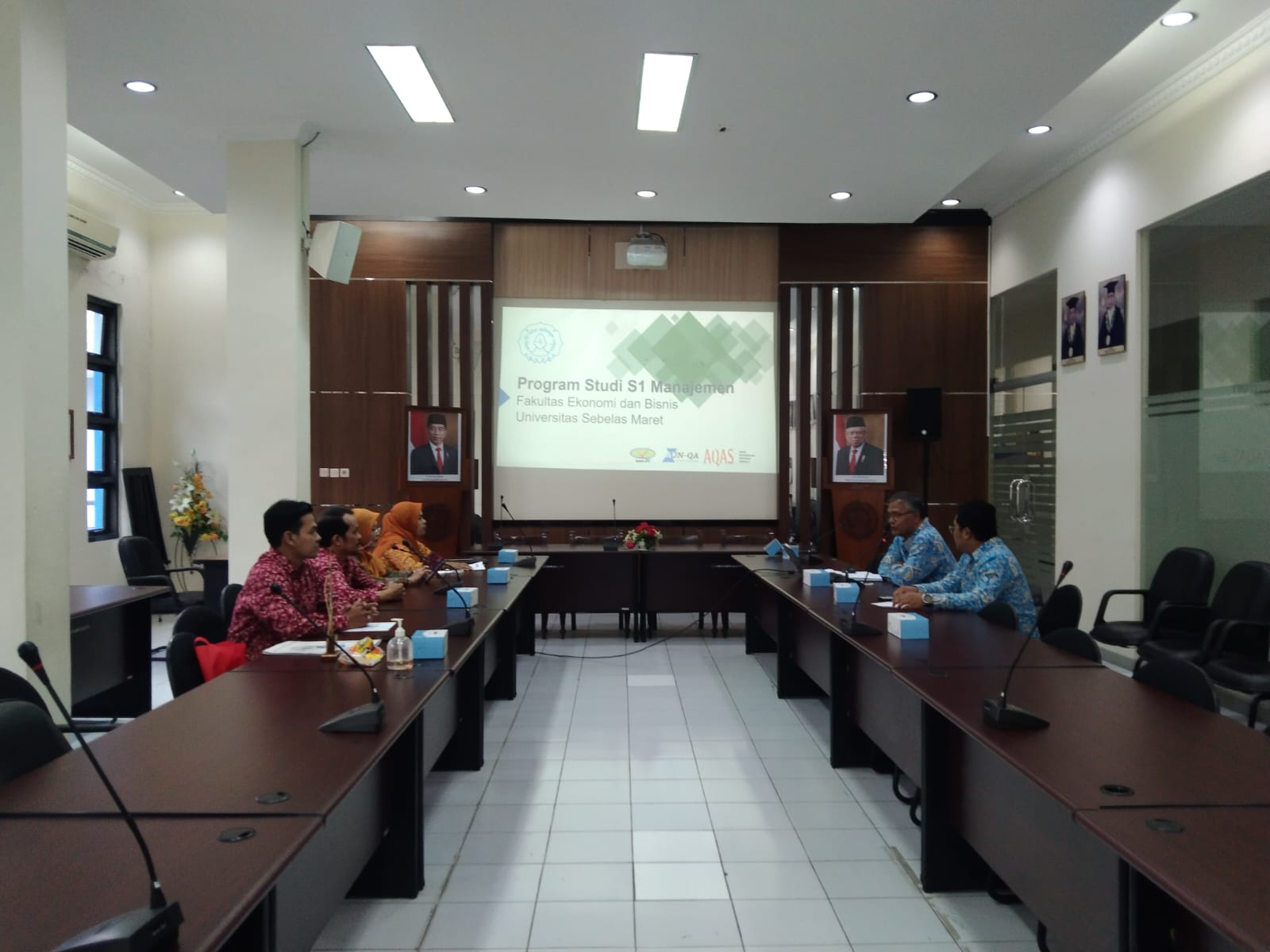
Faculty of Economics and Business (FEB), Universitas Sebelas Maret (UNS) received a visit from the Head of FEB Universitas Muhammadiyah Malang, Monday 20 March 2023 in Assembly Room 1 of Soeharno TS Building FEB UNS. The team led by Dr. Marsudi, MM., Head of the Management Study Program, FEB Universitas Muhammadiyah Malang was welcomed by a number of FEB UNS leaders and lecturers.
 The Vice Dean of Planning, Business Partnership, and Information FEB UNS, Dr. Mugi Harsono, SE, M.Sc., representing the Dean of FEB UNS, welcomed the visit of the leadership ranks from the FEB Universitas Muhammadiyah Malang.
After introducing the leaders and lecturers of FEB UNS who are attending the session, Dr. Mugi Harsono presented a short profile of FEB UNS. Initially Universitas Sebelas Maret was named Universitas Negeri Surakarta Sebelas Maret, which was officially established on March 11, 1976.
In its development, in 1982 the name and abbreviation of Universitas Negeri Surakarta Sebelas Maret Surakarta (UNS Sebelas Maret), was determined to be Universitas Sebelas Maret, which is abbreviated as UNS. This name and abbreviation transformation was approved through the Presidential Decree of the Republic of Indonesia No. 55 of 1982.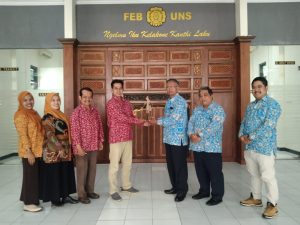
Furthermore, as mentioned by Dr. Mugi, the Bachelor in Management Study Program has an incessant Merdeka Belajar Kampus Merdeka (MBKM) program implementation and has received an MBKM grant. The Management Study Program provides many opportunities for students to take part in MBKM Program and the types of MBKM offered in the study program are more exhaustive. This excellent management leads to commendable student achievement, both at the faculty, university, and study program levels.
Dr. Mugi gave the leadership of FEB Universitas Muhammadiyah Malang the opportunity to discuss further with the Head of the Management Study Program, Dr. Atmaji MM., along with the Taskforce Team. The discussion, which lasted approximately 2 hours, went seamlessly. Hopefully, this visit will provide many benefits, both for FEB University of Muhammadiyah Malang and for FEB UNS.
Fakultas Ekonomi dan Bisnis (FEB) Universitas Sebelas Maret (UNS) menerima Kunjungan Pimpinan FEB Universitas Muhammadiyah Malang, Senin 20 Maret 2023 di Ruang Sidang 1 Gedung Soeharno TS.
Tim yang dipimpin oleh Dr. Marsudi, MM, Kepala Program Studi Manajemen FEB Universitas Muhammadiyah Malang disambut oleh sejumlah pimpinan dan dosen FEB UNS.
Wakil Dekan Perencanaan Kerjasama Bisnis dan Informasi FEB UNS Dr. Mugi Harsono, SE, M.Si., mewakili Dekan FEB mengucapkan selamat datang atas kunjungan pimpinan FEB Universitas Muhammadiyah Malang.
Usai memperkenalkan pimpinan dan dosen yang hadir, Dr. Mugi Harsono memaparkan profil FEB UNS.
Pada awalnya Universitas Sebelas Maret bernama Universitas Negeri Surakarta Sebelas Maret yang resmi berdiri pada 11 Maret 1976. Dalam perkembangannya, pada tahun 1982 nama dan singkatan Universitas Negeri Surakarta Sebelas Maret Surakarta (UNS Sebelas Maret), ditetapkan menjadi Universitas Sebelas Maret yang disingkat UNS. Perubahan nama dan singkatan ini diresmikan dengan Keputusan Presiden RI No. 55 Tahun 1982.
Lebih lanjut disampaikan Program Studi S1 Manajemen merupakan Prodi yang sangat gencar dalam menjalankan Merdeka Belajar Kampus Merdeka (MBKM) dan telah mendapatkan hibah MBKM. Prodi S1 Manajemen banyak memberikan peluang kepada mahasiswa untuk mengikuti MBKM dan jenis MBKM yang diikuti juga lebih komplit. Hal ini menyebabkan, prestasi mahasiswa kita naik cukup tinggi, baik pada level fakultas, universitas maupun prodi.
Dr. Mugi memberi kesempatan kepada pimpinan FEB Universitas Muhammadiyah Malang untuk berdiskusi lebih lanjut dengan Kaprodi Manajemen, Dr. Atmaji MM dan juga tim taskforcenya.
Diskusi yang berlangsung kurang lebih 2 jam tersebut berjalan dengan lancar, harapannya banyak memberikan manfaat, baik bagi FEB Universitas Muhammadiyah Malang, demikian juga sebaliknya untuk FEB UNS.
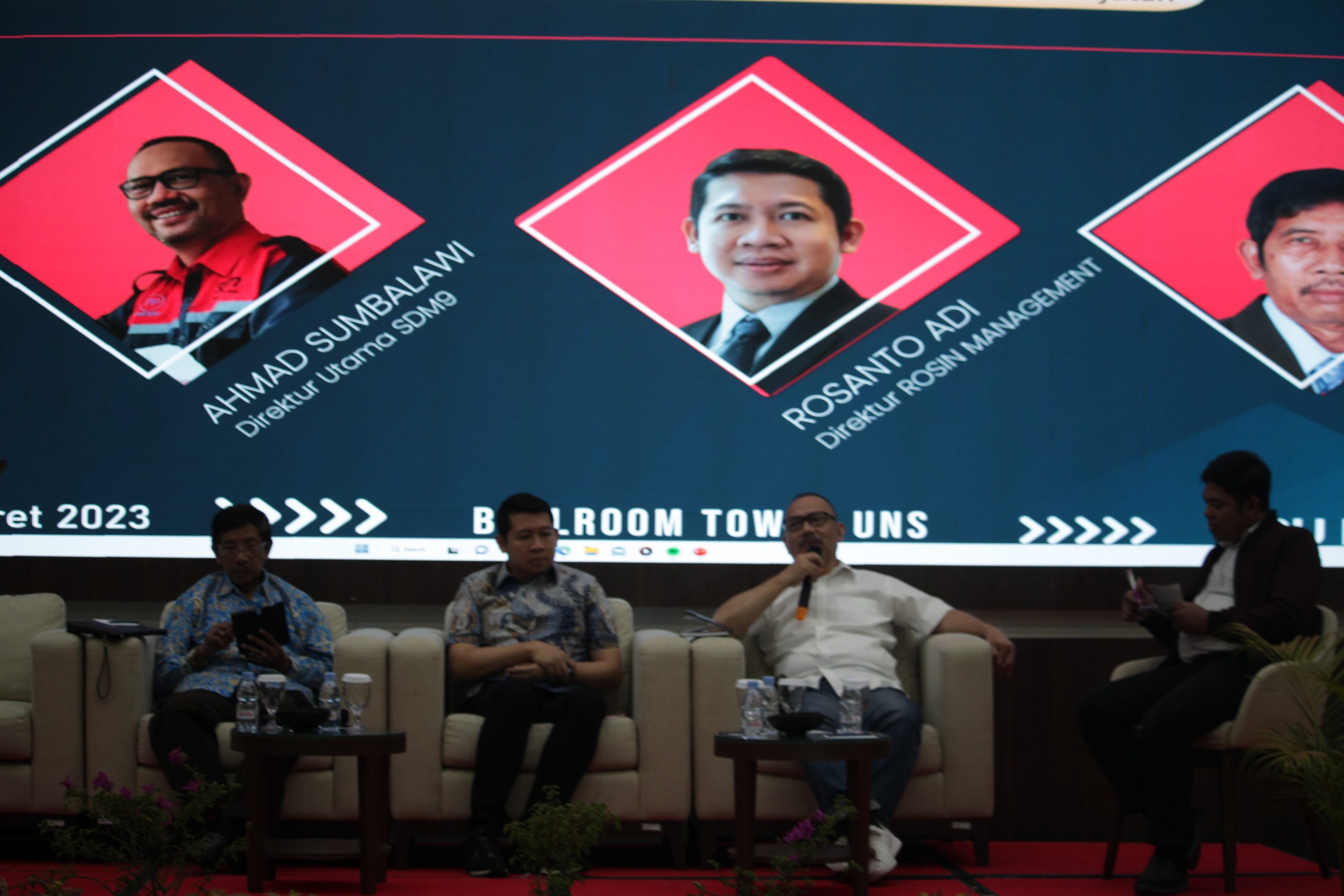
The Business Management Agency (BPU) of the Faculty of Economics and Business (FEB), Universitas Sebelas Maret (UNS), held a Focus Group Discussion (FGD) – Business Gathering with Regulators and Industry entitled “Agile Performance Management to Achieve Optimum Return,” Monday, March 20, 2023, at the Ki Hajar Dewantara Building Ballroom (UNS Tower).
 In the FGD, BPU presented three speakers, Ahmad Sumbalawi (Director of Human Resources 9) with material on Industrial Job Opportunities and Preparing Human Resources that Support the Company’s Sustainable Competitive Advantage; Rosanto Adi (Director of Rosalia) with material on Implementation of Higher Education Partner Internship System that Adds Value to Industrial Productivity; and Prof. Dr. Tulus Haryono M.Ek., (FEB UNS Lecturer) with the material of Higher Education Strategy to Improve the Quality of MBKM Program (Merdeka Belajar and Kampus Merdeka) in Supporting the Synergy in Human Resources Quality Growth.
The Vice Dean of Planning, Business Partnership, and Information FEB UNS, Dr. Mugi Harsono, SE, M.Sc., in his speech, said that since information technology is unstoppable and changes can occur at any time, the approach implemented in the education sector must also be adjusted.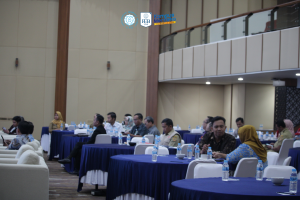
“Agile performance management is one of the solutions for companies that are in a turbulent situation to get optimal results. Proof of agile process is the presence of a comparison process between owner, management, and employee, where all of the stakeholders can make decisions, because maybe in every line, whether employees, management, or owner have information or experiences that are used to formulate company strategies. It is on this basis that we sit together in this FGD to get experiences from speakers, Mr. Ahmad Sumbalawi and Mr. Rosanto Adi and philosophically strengthened by Prof. Tulus,” he explained.
 Furthermore, it is impossible to solve problems alone in the face of these conditions, there needs to be a mutual awareness to hold hands or collaborate between academics, business, and government, requiring a close hand-to-hand struggle to reach agreements. Before the discussion session started, the event was marked by the signing of a partnership between FEB and various agencies invited to the agenda. The goal is to take and give to each other. This partnership will lead to Merdeka Belajar Kampus Merdeka (MBKM).
In MBKM, there was a revolution in the learning process, students had the opportunity to understand the real world. Students may be allowed to take courses for 3 or 4 semesters outside their study program, for one full semester they may take an internship program at the company of their selection, or to serve in the community, thus, students can gain hands-on experience when they graduate. On the other hand, MBKM also provides opportunities for practitioners to become lecturers on campus.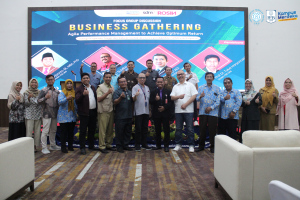
At the end of his remarks, Dr. Mugi hoped that this FGD activity would provide many benefits, thus, Universities will not become ivory towers whose buildings are towering but do not take root downwards or on the contrary, the government needs academic studies, thus, the policies made can have a philosophy, as well as from business experts, academics need experience and conceptual additions.
The FGD led by Sarjiyanto, SE, MBA, Ph.D., FEB UNS academics, went interactively with responses and questions from discussion participants who consisted of partner agencies for the students’ internship programs.
Badan Pengelola Usaha (BPU) Fakultas Ekonomi dan Bisnis (FEB) Universitas Sebelas Maret (UNS) menggelar Focus Group Discussion (FGD) – Business Gathering Bersama Regulator dan Industri bertajuk “Agile Performance Management To Achieve Optimum Return” Senin, 20 Maret 2023, di Ballroom Gedung Ki Hajar Dewantara (UNS Tower)
Di FGD tersebut, BPU menghadirkan tiga narasumber, Ahmad Sumbalawi (Direktur Utama SDM9) dengan materi Peluang kerja Industri dan Menyiapkan SDM yang Mendukung Keunggulan Bersaing Berkelanjutan Perusahaan; Rosanto Adi (Direktur Rosalia) dengan materi Implementasi Sistem Magang Kerja Mitra Perguruan tinggi yang Bernilai Tambah pada Produktifitas Industri dan Prof Dr. Tulus Haryono.M.Ek (Dosen FEB UNS) dengan materi Strategi Perguruan Tinggi Meningkatkan Kualitas Progam MBKM (Merdeka Belajar dan Kampus Merdeka) dalam Mendukung Sinergi Pertumbuhan Kualitas SDM.
Wakil Dekan Perencanaan Kerjasama Bisnis dan Informasi FEB UNS, Dr. Mugi Harsono, SE, M.Si. dalam sambutannya menyampaikan ketika teknologi informasi tidak terbendung dan perubahan itu kapanpun bisa terjadi maka pendekatan yang kita pakai juga harus disesuaikan.
“Agile performance manajement merupakan salah satu solusi bagaimana agar perusahaan yang berada pada situasi yang penuh gejolak bisa mendapatkan hasil yang optimum. Agile itu salah satunya dibuktikan adanya proses persandingan antara owner, management dengan employe yang mereka sama-sama mengambil keputusan, karena mungkin di setiap lini, apakah karyawan, management, owner mempunyai informasi-informasi atau pengalaman-pengalaman yang dipakai untuk menyusun strategi perusahaan. Atas dasar itulah kita duduk bersama dalam FGD ini untuk mendapatkan pengalaman dari narasumber, Bapak Ahmad Sumbalawi dan Bapak Rosanto Adi dan secara filosofi dikuatkan oleh Prof Tulus” paparnya.
Lebih lanjut dikatakan, dalam mengadapi kondisi seperti ini memang tidak mungkin menyelesaikan masalah sendirian, perlu ada kesadaran bersama untuk saling bergandengan atau kolaborasi antara akademisi, bisnis dan government, memerlukan sebuah pergelayatun tangan yang akrab sehingga menghasilkan kesepakatan.
Sebelum proses diskusi akan ditandai dengan adanya penandatanganan kerja sama antara FEB dengan berbagai instansi yang telah diundang. Tujuannya adalah untuk saling take and give, akan mengarah kepada Merdeka Belajar Kampus Merdeka (MBKM).
Dalam MBKM, terjadi revolusi pemikiran pembelajaran, mahasiswa memiliki kesempatan untuk mengenali dunia yang sebenernya. Mahasiswa boleh selama 3 atau 4 semester di luar prodinya, selama satu semester penuh boleh magang di perusahaan dan mengabdi di masyarakat sehingga mahasiswa memiliki pengalaman ketika lulus.
Sebaliknya MBKM juga memberi kesempatan kepada para praktisi untuk menjadi dosen praktisi di kampus.
Diakhir sambutannya, Dr. Mugi berharap kegiatan FGD ini memberikan banyak kemanfaatan, perguruan tinggi tidak menjadi menara gading yang gedungnya menjulang tinggi tapi tidak mengakar ke bawah atau sebaliknya government membutuhkan telaah akademisi agar kebijakan tidak kering dan ada filosofinya, serta dari pakar bisnis, akademisi perlu pengalaman dan penambahan koseptual.
FGD yang dipandu oleh Sarjiyanto, SE, MBA, Ph.D. Akademisi FEB UNS berjalan sangat interaktif dengan tanggapan dan pertanyaan dari peserta diskusi yang merupakan instansi mitra magang mahasiswa.
Materi FGD: https://bit.ly/FGDBUSINESSGATHERINGFEBUNS
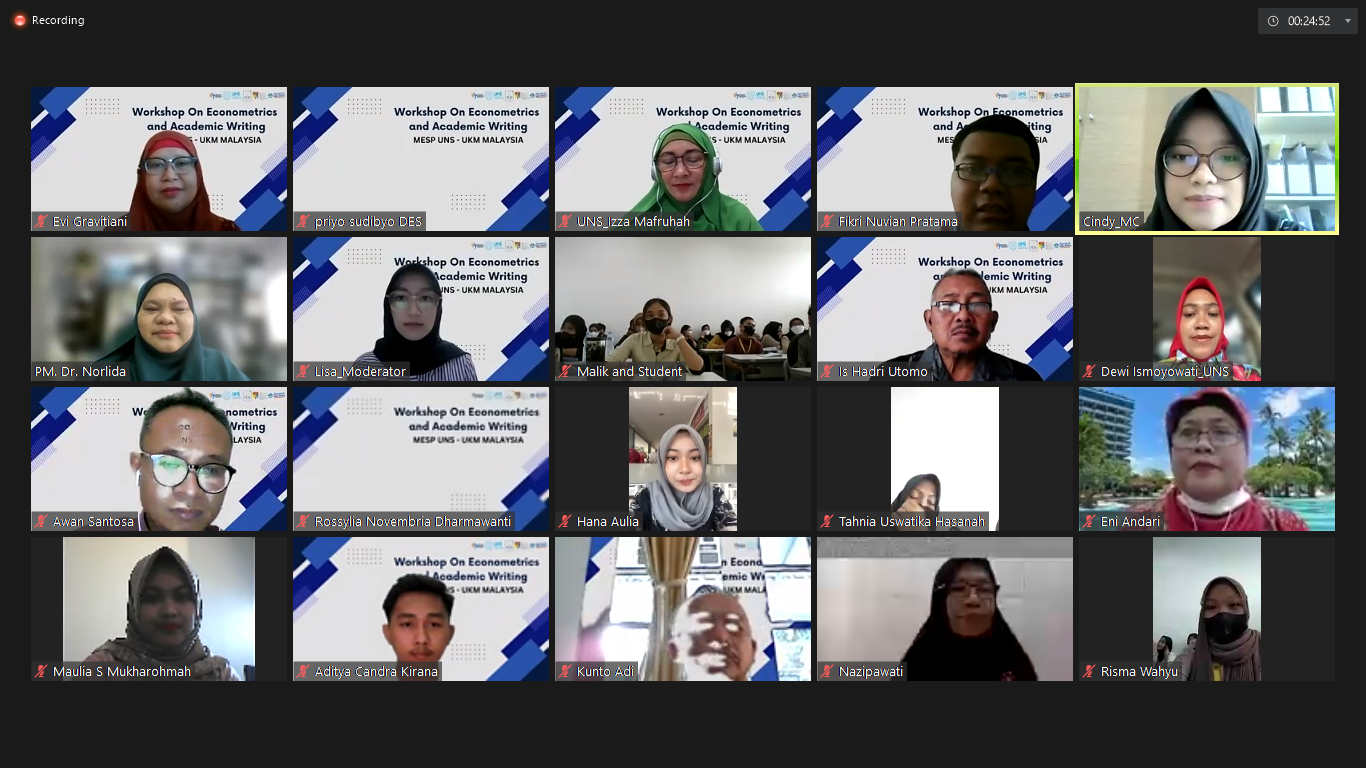
Master of Economics and Development Studies Program (MESP), Faculty of Economics and Business (FEB), Universitas Sebelas Maret (UNS) hosted a virtual Workshop on Econometrics and Academic Writing, on Thursday, March 9, 2023.
The workshop attended by students from the undergraduate, graduate, and postgraduate programs of FEB UNS, invited Prof. Dr. Tamat Sarmidi and Assoc. Prof. Dr. Norlida Hanim Mohd Salleh from the Universiti Kebangsaan Malaysia.

Opening the workshop, Prof. Dr. Izza Mafruhah, S.E, M.Sc., Vice Dean of Academic, Research, and Student Affairs FEB UNS expressed her gratitude to Prof. Tamat and Prof. Norlida for their willingness to attend the virtual event and shared their knowledge with FEB UNS students.
“Thanks to Dr. Evi Gravitiani and also all the students who have taken the time and are willing to attend today’s workshop. The workshop was hosted as part of the 47th UNS Anniversary Celebration. We need quantitative and qualitative training to help students in the preparation of the thesis,” explained Prof. Izza in her opening remark.
Further, Prof. Izza also revealed that previously MESP had carried out several other statistical training such as a data mining workshop using Orange in February 2023. While in this workshop, the two speakers will discuss online surveys and limited dependent variables.
“Hopefully, today’s event will give us some useful knowledge. If the student has a question to ask, they can ask it immediately. Thank you to the Professors who have been willing to share knowledge with the participants. I wish you the best of luck with the workshop,” she said.
The first speaker, Assoc. Prof. Norlida, explains the role of theory in academic writing. According to her, academic writing must follow specific grammar. Theory needs to be included in both the thesis and the scientific article to be published.

“One aspect of academic writing is the theoretical framework, this section explains or describes the theory that underlies the emergence of a problem, which then becomes the focus of research. How to determine the theory in research? Authors need to read a lot of literature. Especially for the Doctoral study (S3) level, it is necessary to find a research gap, which will be the benefit of research,” explained Prof. Assoc. Prof. Norlida.
In the second session, Prof. Tamat Sarmidi delivered material on statistical analysis for the limited dependent variable (binary dependent variable). In his material, Prof. Sarmidi explains four statistical tests that can be used where the dependent variable used is a binary variable (dummy). The four tests are probit, logit, multinomial logit, and ordered probit model.
At the end of the presentation, Prof. Tamat also demonstrates the procedures for using all four statistical tests using Stata.