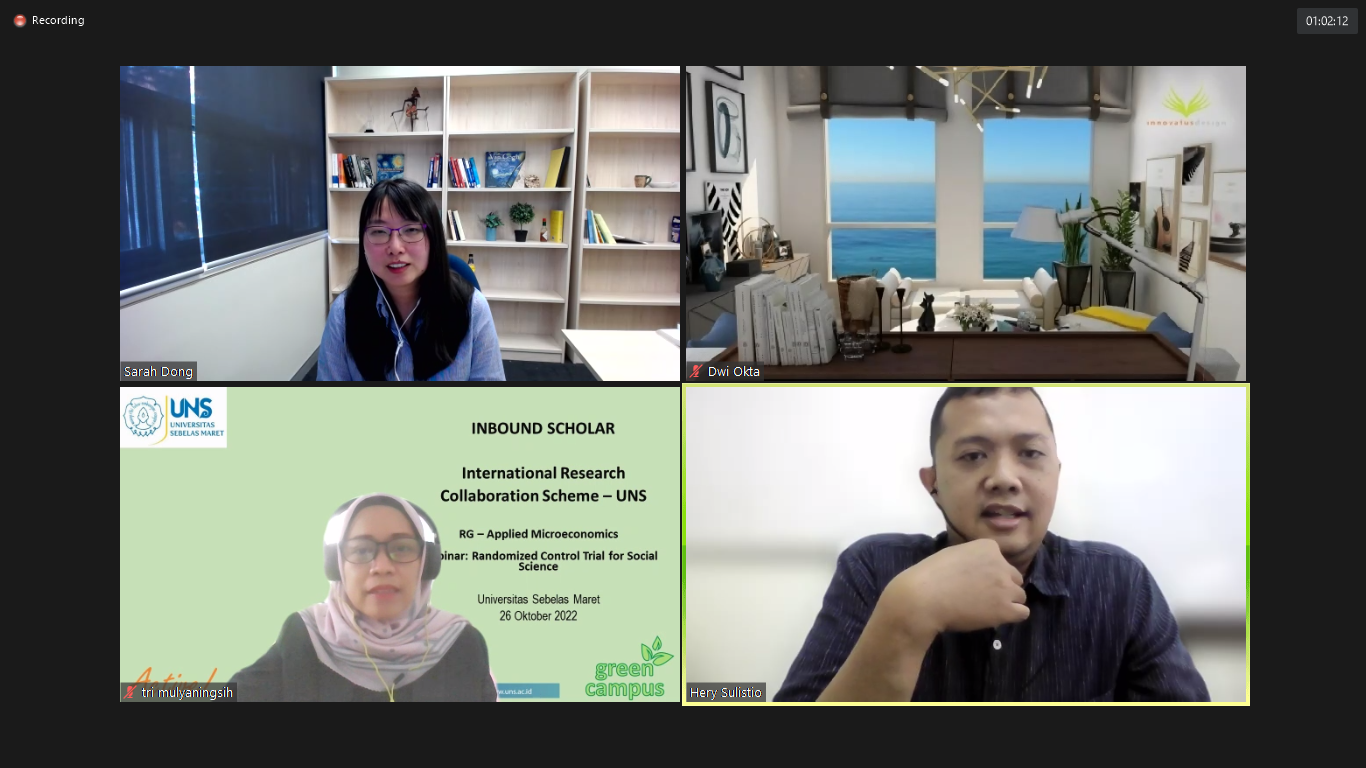
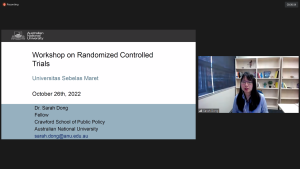
The Applied Microeconomics Research Group, Development Economics Study Program, Faculty of Economics and Business (FEB), Universitas Sebelas Maret (UNS) Surakarta, hosted an Inbound Scholar guest lecture entitled Webinar: Randomized Control Trial for Social Science, with Dr. Sarah Dong from Crawford School of Public Policy, Australian National University (ANU). The webinar, as part of the series in the UNS International Research Grant Scheme, was conducted virtually through the Zoom Cloud Meeting on Wednesday, October 26th, 2022.
Starting the material presentation, Dr. Sarah explained the implementation of the RCT technique, especially in a public policy context. Regarding this matter, she provided an example of the contra-factual effect. For instance, a research attempting to measure the effect and efficiency of a social assistance program under two different assumptions, where the effect of assistance for a specific recipient will be compared to the condition of the same subject when they do not receive assistance. “Under this context, OLS regression is not applicable to determine the causality effect of assistance provision or a policy implementation,” explains Dr. Sarah.
Further, Dr. Sarah explained the process of RCT implementation that tend to require more intensive planning. Generally, she divided the planning process into three stages. The first stage of RCT implementation is determining the design for the randomization process, this stage includes sample size determination, randomization technique, and randomization validation test. The second stage is intervention, which refers to the categorization of research subjects into control groups. The last stage is result examination using statistical analysis to calculate the effect of applied treatment. “Randomization process can be challenging, especially if the process was conducted by an independent agent where the process can deviate from research objectives,” she added.
After detailing the RCT application process, Dr. Sarah explains the example of research topics that can use the RCT technique and her previous research project using the RCT technique. Nearing the end of the agenda, Dr. Tri Mulyaningsih, as the Moderator of the discussion, delivered a brief summary of Dr. Sarah’s materials and started the interactive question-and-answer session. “Thank you for this opportunity, there are many questions from participants, you can contact me directly through the provided email address in case you have further inquiries on RCT technique,” concluded Dr. Sarah at the end of the webinar session.
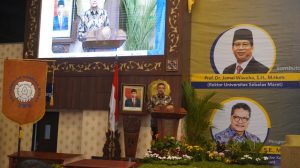
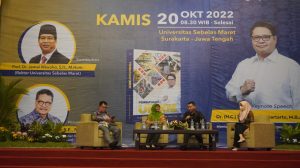
Management Study Program, Faculty of Economics and Business (FEB), Universitas Sebelas Maret (UNS) Surakarta, invited Prof. Daniel Chicksand from Birmingham Business School (UK) in a Visiting Professor Agenda. The current agenda was part of the Kompetisi Kampus Merdeka Program (PKKM) 2022, conducted virtually on Thursday, October 20th, 2022.
The event went interactively with the attendance of the lecturers of operation management study from the Management Study Program and was led by Alifah Fibayani, MSc., as the Moderator. Opening the material presentation, Prof. Chicksand invited the participants to answer a question regarding the journal ranking system in Indonesia, whether Indonesia follows the Scopus and Scimago system or adopts a specific system in the country. Following the opening question, the Professor explains the first step to be prepared by a researcher before publishing their research articles. “Right now, getting published in a reputable international journal is getting harder. Before starting the publication process, it is better if you have a specific theme for you to follow, either to develop the existing research or to establish your expertise identity as a researcher,” reveals Prof. Chicksand.
Further, Prof. Chicksand delivers another question for material discussion regarding the reason for getting published. In line with the participants’ answers, in this case, Prof. Chicksand states that one of the reasons for publication is to disseminate potential solutions to the problems in the community or business.
The discussion is followed by the stages or aspects that need to be considered by the author in choosing a publication outlet. Two aspects that need to be considered in choosing the right outlet are the journal’s impact factor and ranking. Aside from journal selection, Prof. Chicksand also shares specific reasons for a publisher to reject a manuscript. “Sometimes the problem lies in how you formulate the research problem because sometimes authors like to understate the contribution of their research.
Concluding the discussion, Prof. Chicksand delivers four top tips for a successful publication process. The first is to choose the right theory for the planned research. The second is to establish a continuous process from article preparation through collaboration. Third, the author and researcher need to establish resilience and flexibility, and lastly, a researcher needs to learn from their past mistake. “Sometimes we need to build a resilient and persistent stance, while at the same time, we need to quickly move on from a rejection,” reveals Prof. Chicksand.
The agenda, which is filled with interactive discussion and experience sharing, will be followed-up with participants’ article review by Prof. Chicksand.
Program Studi (Prodi) S1 Manajemen, Fakultas Ekonomi dan Bisnis (FEB) Universitas Sebelas Maret (UNS) Surakarta kembali menghadirkan Prof. Daniel Chicksand dari Birmingham Business School (UK) dalam agenda Visiting Profesor, Kamis 20/10/2022
Kegiatan tersebut merupakan rangkaian Program Kompetisi Kampus Merdeka (PKKM) 2022 yang dilaksanakan secara daring melalui Zoom Cloud Meeting dan dihadiri oleh dosen Konsentrasi Manajemen Operasi Prodi Manajemen.
Mengawali paparan materi Prof. Chicksand melayangkan pertanyaan terkait sistem perangkingan jurnal yang terdapat di Indonesia, apakah Indonesia menggunakan sistem perankingan Scopus, Scimago, ataukah terdapat sistem khusus yang berlaku di Indonesia.
Prof. Chicksan juga mengutarakan langkah pertama yang perlu dipersiapkan oleh periset sebelum mempublikasikan artikel risetnya.
“Saat ini publikasi di jurnal internasional yang bereputasi bertambah sulit. Sebelum memulai proses publikasi, alangkah baiknya jika Anda mempersiapkan sebuah ‘tema’ yang kemudian akan Anda ikuti, baik untuk mengembangkan riset yang telah ada maupun sebagai identitas keahlian Anda sebagai peneliti” ungkap Prof. Chicksand.
Lebih lanjut Prof. Chicksand melayangkan pertanyaan kedua terkait materi yang akan beliau sampaikan yaitu apakah alasan untuk melakukan publikasi?
Selaras dengan jawaban peserta yang hadir, dalam hal ini Ia menyampaikan bahwa salah satu alasan melakukan publikasi adalah untuk membagikan potensi solusi untuk permasalahan yang ada di lingkungan sekitar maupun bisnis.
Pembahasan kemudian berlanjut pada langkah-langkah atau aspek yang perlu dipertimbangkan penulis dalam memilih jurnal publikasi. Dua hal yang paling sering dipertimbangkan dalam hal ini adalah impact factor dan ranking jurnal.
Terlepas dari proses pemilihan jurnal, Prof. Chicksand juga menyampaikan beberapa alasan mengapa sebuah penerbit menolak manuskrip yang dikirim.
“Terkadang masalahnya adalah bagaimana Anda merumuskan masalah penelitian, dan terkadang penulis atau peneliti seringkali terlalu merendah dalam hal menyampaikan kontribusi penelitian yang dilakukannya ” katanya.
Menutup acara, Prof. Chicksand menyampaikan empat top tips dalam proses sukses publikasi. Tips pertama adalah dengan memilih teori yang tepat untuk penelitian yang akan dilaksanakan. Kedua adalah perlunya membangun proses berkesinambungan dari proses penulisan artikel melalui kolaborasi. Ketiga, peneliti dan penulis perlu membangung resiliensi dan fleksibilitas, dan keempat adalah peneliti perlu belajar dari kesalahan yang dilakukan.
“Kita perlu membangun sikap resilien dan persisten, serta harus segera move-on setelah menghadapi rejection” tegasnya menyemangati.
Sesi diskusi dalam workshop berjalan interaktif. Sharing pengalaman tersebut rencananya akan berlanjut dengan review artikel yang dikirimkan oleh peserta. (Tetri & Aulia)
Riset Grup (RG) Mikroekonomi Terapan, Program Studi (Prodi) S1 Ekonomi Pembangunan, Fakultas Ekonomi dan Bisnis (FEB) Universitas Sebelas Maret (UNS) menyelenggarakan Kuliah Tamu bertajuk Webinar: Randomized Control Trial for Social Science, Rabu 26/10/2022 melalui Zoom Cloud Meeting.
Webinar yang menghadirkan narasumber Dr. Sarah Dong dari Crawford School of Public Policy, Australian National University (ANU) merupakan rangkaian kegiatan dalam Skema Hibah Riset Internasional UNS.
Dalam paparan materinya, Dr. Sarah menjelaskan tentang penggunaan teknik RCT khususnya dalam konteks kebijakan publik. Contoh, dari efek kontrafaktual, yaitu penelitian yang berusaha mengukur efek dan efisiensi dari kebijakan (bansos) ketika subjek penelitian menerima bantuan tersebut dibandingkan jika subjek tersebut tidak menerima bantuan.
“Dalam konteks semacam ini, uji regresi OLS tidak dapat digunakan untuk menentukan efek kausal dari pemberian bantuan atau sebuah kebijakan,” terang Dr. Sarah.
Lebih lanjut, Dr. Sarah menjelaskan mengenai proses penerapan dari RCT yang cenderung membutuhkan perencanaan lebih ekstensif. Secara garis besar perencanaan tersebut terbagi menjadi tiga langkah. Langkah pertama dari penerapan RCT adalah penentuan desain dari proses pengacakan, hal ini meliputi jumlah sampel, teknik pengacakan, serta pemeriksaan keabsahan pengacakan. Langkah kedua adalah intervensi, yang merujuk pada proses penggolongan subjek penelitian kedalam kelompok kontrol. Serta langkah ketiga adalah pengujian hasil, yaitu menggunakan uji statistik untuk menghitung efek perlakuan yang diterapkan.
“Proses pengacakan bisa menjadi rumit, terlebih ketika proses tersebut dilakukan oleh pihak independen, yang prosesnya dapat melenceng dari tujuan penelitian,” jelasnya.
Setelah penjelasan rinci mengenai proses RCT, Dr. Sarah menjelaskan contoh topik penelitian yang dapat menggunakan teknik RCT, serta proyek penelitiannya yang menerapkan teknik RCT.
Di penghujung acara, Dr. Sarah mengucapkan terima kasih atas kesempatan yang diberikan, banyak sekali pertanyaan yang diajukan oleh peserta. Peserta juga dapat menghubunginya melalui email apabila terdapat pertanyaan lebih lanjut terkait RCT. (Tetri & Aulia)
20 pelaku Usaha Mikro Kecil dan Menengah (UMKM) menggelar berbagai produknya pada acara Ecofair 2022 yang diselenggarakan oleh Himpunan Mahasiswa Jurusan (HMJ) Manajemen Fakultas Ekonomi dan Bisnis (FEB) Universitas Sebelas Maret (UNS), di Halaman Gedung Suhardi, Rabu, 26/10/2022.
Acara ini diselenggarakan dan dikemas secara luring. Dua tahun sebelumnya, Ecofair diadakan secara daring karena pandemi Covid-19. Harapannya, Ecofair 2022 akan bermanfaat bagi mahasiswa, pihak kolaborator, dan terkhusus bagi para pelaku UMKM.
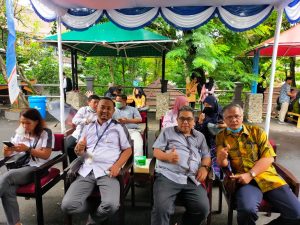
Prof. Hunik, Dosen FEB mengunjungi salah satu stan di Ecofair
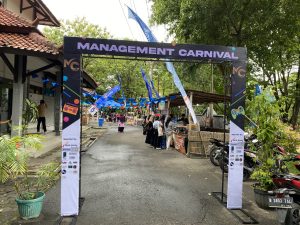
Ecofair merupakan acara pembuka dari serangkaian acara Management Carnival yang rutin diselenggarakan setiap tahun oleh HMJ Manajemen. Di tahun ini, Ecofair mengangkat tema “Upgrade Your Business by Collaborating with Us to Find New Opportunities”.
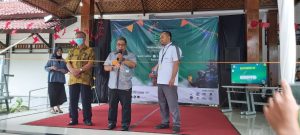
Kegiatan yang dibuka oleh Wakil Dekan Perencanaan, Kerja Sama Bisnis dan Informasi, Dr. Mugi Harsono, SE, M.Si. bertujuan agar dapat menjadi media kolaborasi, pengembangan, dan pemberdayaan UMKM. Ecofair sebagai wahana dalam mempromosikan, mengenalkan, dan meningkatkan produk atau jasa yang mereka miliki.
Pengguntingan Pita oleh Wakil Dekan Perencanaan, Kerja Sama Bisnis dan Informasi
Pelaku UMKM juga dapat berkonsultasi dengan beberapa instansi terkait seperti LOKA POM dan Dinas Perdagangan Surakarta terkait pengembangan dan program pemerintah dalam mendukung kesejahteraan UMKM di Kota Surakarta.
Dr. Atmaji, MM, Kepala Program Studi S-1 Manajemen dalam sambutannya mengapresiasi kegiatan HMJ Manajemen yang telah memberikan ruang kepada para pelaku UMKM untuk mengenalkan dan memasarkan produk-produknya.
“Mindset bisnis saat ini sudah berubah. Sebelumnya bisnis itu digaungkan dengan kompetisi. Sekarang mindsetnya berubah, bagaimana bisnis bisa berkolaborasi, bekerja sama, saling dukung dan menguntungkan untuk keberlangsungan usaha. Perubahan mindset bisnis ini yang sedang dikembangkan.” Ungkapnya.
Dr. Atmaji berharap, kegiatan yang digelar selama 3 hari itu menjadi pembelajaran bagi mahasiswa di luar kegiatan perkuliahan, melatih berwirausaha dan bergaul dalam dunia bisnis.
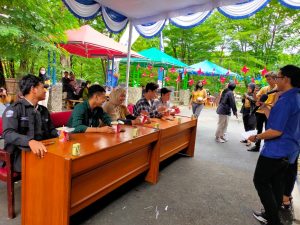
Deretan Stan UMKM di Halaman Gedung Suhardi FEB
Kegiatan yang akan digelar hingga Jumat 28 Oktober 2022 itu, dimeriahkan juga dengan berbagai kegiatan lain untuk memantik pengunjung Ecofair yakni esport Mobile Legends dan PUBG, fun games bersama para pengunjung on the spot dan penampilan band prodi maupun modern dance sebagai media penyaluran bakat dan pengembangan diri.
Fun Games bersama Para Pengunjung on the Spot
Selain pengembangan di bidang UMKM, Ecofair 2022 juga akan bersinergi dengan beberapa perusahaan BUMN dan pusat unggulan Universitas Sebelas Maret seperti PT. KAI (Persero), PT PLN (Persero), perbankan, OJK, UNS Innovation Hub, UNS Fintech Center, CDC UNS, dan lainnya. Hal ini bertujuan untuk mengenalkan inovasi bisnis serta melakukan job fair atau pameran lowongan pekerjaan yang relevan dengan Prodi S-1 manajemen agar mahasiswa dapat mengambil peluang dan kesempatan untuk karir ke depan. (Tetri)
Technology transformation has motivated the industrial sector to improve their product and service. This improvement is applicable not only to big corporations but also to MSMEs, which must adapt to the current condition to survive in the highly competitive market. One of the transformations that can’t be avoided by business is the penetration of the internet, which has become a crucial part of daily human life.
The existence of the internet has brought a substantial effect on the business sector, encouraging corporations and MSMEs to expand their business by taking advantage of the internet, especially e-commerce. The Polengan Village’s BUMDES and MSMEs have long realized this opportunity, but many of the MSMEs in the village are yet to know and understand how to adopt digital marketing.
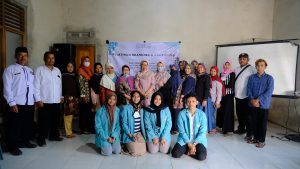
Considering this problem, the Creative Economy Research Group’s Community Service Program Team, led by Prof. Dr. Asri Laksmi Riani, MS., along with its members Prof. Dr. Hunik Sri Runing Sawitri, S.E., M.Si., Suryandari Istiqomah, SE, MSc., Dra. Anastasia Riani Suprapti, M.Si., and Dr. Intan Novela Qurrotul Aini, S.E., M.Si., provided a Digital Marketing, Branding, and Packaging Training.
In this training, the Community Service Team involves students in delivering training material to the MSMEs in Polengan Village. The training is divided into three sessions, starting with training in branding delivered by Brillian Raiszhul, who encourages MSMEs entrepreneurs to learn how to attract prospective customers through product photographs. The picture provided, indeed, must consider a favorable angle and color composition.
The following session was packaging training, considering that after understanding how to attract customers’ attention through a picture, the MSMEs’ entrepreneur can enhance their packaging to add value to their product. This session is delivered by Salsabilla Indah, who shows the stages of designing beautiful and enticing packaging for prospective customers.
The last session was concluded with digital marketing training, delivered by Afifah Hanindia, who invited the participants to register their MSMEs to several social media, such as Instagram and Facebook, as well as Shopee e-commerce that can allow them to distribute their product to more locations, thus increasing the income of Polengan Village residents.
After the material dissemination, the agenda goes on with monitoring and assistance for the participants.
The Covid-19 pandemic has affected all sectors of our daily life, starting from health, education, and the economy, which brought challenges and alterations to various business levels. The effect of the pandemic hit the MSMEs sector hard, where its business was managed by individuals or households.
To survive, the MSMEs sector must keep on innovating to deliver premium products and services to their customers. This problem brought concern to BUMDES and MSME in Polengan Village, Srumbung Sub-District, Magelang Municipality, which attempted to initiate an innovation to process material available in their surrounding environment.
The wish of BUMDES and MSME in Polengan Village later received a response from a community service team from the Creative Economy Research Group, Faculty of Economics and Business (FEB) UNS, led by Prof. Dr. Asri Laksmi Riani, MS., in the form of a Vegetable Product Innovation Training.
This training was conducted on 20 July 2022 in collaboration with Mr. Bambang Tri Admojo, who demonstrated several dishes and cuisines using local vegetables in front of the BUMDES and MSMEs in Polengan.
The demo shows how to cook three types of dishes, namely cassava leaf chips, crispy spinach, and tiwul sponge cake.
During the training, the coach provided material and invited the participants to keeping-up with the cooking process. Participants are allowed to inquire many questions during the training.
The participants’ enthusiasm and interest during the training are shown in their efforts to keep up with the cooking process.
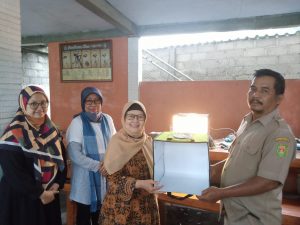
Besides production innovation, this community service program also encourages Polengan Village BUMDES and MSMEs to participate in marketing innovation through the internet. Therefore, the community service team provided supporting equipment to aid online sales to the village apparatus on 10 October 2022.
Perubahan zaman dan teknologi membuat semua perusahaan dituntut untuk berubah. Perubahan ini tidak hanya berlaku untuk perusahaan skala besar saja, namun juga untuk UMKM dituntut berubah agar dapat bertahan dalam pasar yang semakin kompetitif. Salah satu perubahan nyata yang tidak bisa ditolak adalah adanya internet yang menjadi bagian penting manusia dewasa ini.
Keberadaan internet ini memberikan dampak yang besar termasuk dalam dunia bisnis, banyak perusahaan maupun UMKM semakin melebarkan sayapnya ketika mereka menggunakan internet dalam bisnis mereka, khususnya penjualan melalui internet.
Peluang besar ini juga dilihat oleh BUMDES dan UMKM di Desa Polengan, namun banyak UMKM Desa Polengan yang masih belum mengetahui dan paham bagaimana untuk dapat melaksanakan pemasaran digital.
Oleh karena itu, Pengabdian dari Riset Grup Ekonomi Kreatif yang diketuai Prof. Dr. Asri Laksmi Riani, MS dengan anggota Prof. Dr. Hunik Sri Runing Sawitri, S.E., M.Si, Suryandari Istiqomah, SE, MSc, Dra. Anastasia Riani Suprapti, M.Si dan Dr. Intan Novela Qurrotul Aini, S.E., M.Si. memberikan pelatihan Digital Marketing, Branding dan Packaging.
Dalam pelatihan ini, tim pengabdi melibatkan mahasiswa-mahasiswa untuk memberikan pelatihan kepada UMKM.
Pelatihan terbagi menjadi 3 sesi, dimulai dari pelatihan branding dengan narasumber Brillian Raiszhul. Brillian mengajak pelaku UMKM untuk mengetahui bagaimana caranya agar calon konsumen dapat tertarik hanya dengan melihat foto produk saja, pastinya harus memilih angle yang pas dengan komposisi warna tidak terlalu mencolok dan tidak terlalu pucat.
Untuk sesi kedua adalah packing agar setelah pelaku UMKM mengetahui pengambilan gambar yang baik bisa membangun branding produk harus diimbangi dengan packing yang bisa menambah nilai produk yang dijual. Sesi ini diisi oleh Salsabilla Indah dengan mengadakan pelatihan mendesign kemasan yang baik dan memikat calon konsumen.
Sesi terakhir ditutup dengan pembekalan digital marketing dengan narasumber Afifah Hanindia yang mengajak bapak ibu pelaku UMKM untuk mendaftarkan usahanya dibeberapa sosial media, seperti Instagram dan Facebook serta e-commerce Shopee yang bisa membuat produk dijangkau banyak orang dan bisa meningkatan pendapatan warga Desa Polengan.
Setelah pelatihan dilaksanakan, kegiatan dilanjutkan dengan monitoring dan pemberian bantuan kepada peserta. (Tetri)
Pandemi Covid-19 mempengaruhi segala sektor kehidupan, mulai dari kesehatan, pendidikan, hingga perekonomian masyarakat yang menjadikan semua bentuk usaha di berbagai level usaha mengalami banyak perubahan dan hambatan. Dampak tersebut sangat dirasakan para Usaha Mikro Kecil dan Menengah (UMKM) yang dalam pengelolaan usahanya dilakukan oleh individu atau perorangan.
Untuk tetap bertahan, maka UMKM harus terus berkreativitas dan berinovasi untuk memberikan produk dan layanan prima kepada konsumennya. Hal ini juga yang menjadi perhatian BUMDES dan UMKM di Desa Polengan, Kecamatan Srumbung, Kabupaten Magelang yang ingin memiliki inovasi dari bahan-bahan yang ada disekitar daerah mereka yang selama ini belum dikelola secara baik.
Keinginan dari BUMDES dan UMKM ini kemudian direspon oleh Kelompok pengabdi dari Riset Group Ekonomi Kreatif, Fakultas Ekonomi dan Bisnis, UNS yang diketuai oleh Prof. Dr. Asri Laksmi Riani, MS dengan memberikan Pelatihan Inovasi Produk berbahan baku sayuran setempat.
Pelatihan ini dilaksanakan pada tanggal 20 Juli 2022 bersama Bapak Bambang Tri Admojo yang mendemokan beberapa masakan berbahan local di depan peserta dari BUMDES dan UMKM desa Polengan.
Dalam pelatihan ini didemokan 3 macam makanan yaitu kripik daun singkong, bayam krispi dan bolu tiwul.
Selama pelatihan, pelatih memberikan materi dan meminta bapak ibu peserta untuk langsung ikut dalam proses pembuatan makanan tersebut. Peserta juga dapat melakukan tanya jawab selama proses pelatihan berlangsung.
Peserta terlihat bersemangat dan antusias dalam mengikuti kegiatan pelatihan ini terlihat dari peran serta mereka untuk ikut serta dalam proses produksi makanan.
Selain inovasi produksi, kegiatan pengabdian ini juga mendorong BUMDES dan UMKM Desa Polengan juga melaksanakan inovasi pemasaran melalui internet. Oleh karenanya Tim Pengabdi juga memberikan peralatan yang mendukung penjualan online yang diserahkan kepada pihak desa yang diberikan pada tanggal 10 Oktober 2022 yang berlangsung di Desa Polengan. (Tetri)
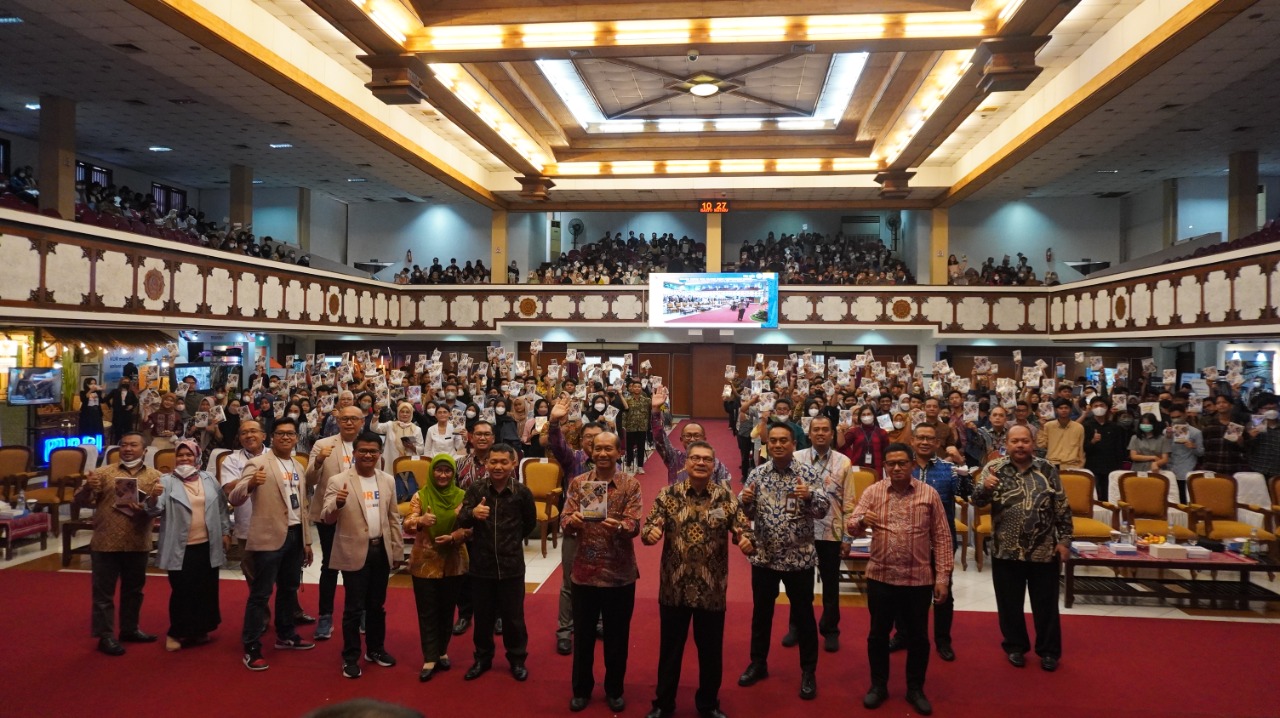
The Coordinating Minister for the Economy, Republic of Indonesia, in collaboration with the Faculty of Economics and Business (FEB), Universitas Sebelas Maret (UNS), and Rajagrafindo Persada Publisher, hosted a General Lecture and ‘MSME Financing’ Book Review at Haryo Mataram Auditorium UNS, Thursday (20/10/2022).
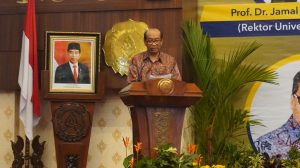
The Vice-Rector for Academic and Student Affairs UNS, Prof. Dr. Ir. Ahmad Yunus, M.S., in his remarks, conveyed his gratitude to the Coordinating Minister for Economy for establishing a partnership with UNS by organizing the General Lecture and Book Review.
The Vice-Rector for Academic and Student Affairs UNS, Prof. Dr. Ir. Ahmad Yunus, M.S.
Prof. Yunus reveals that the book written by the Coordinating Minister for Economy, Republic of Indonesia, Dr. (H.C.) Ir. Airlangga Hartarto, M.B.A., M.M.T., I.P.U., discuss five topics, including the role of MSMEs on the economy, MSME resilience to crises, MSME financing, sharia financing for MSME, and MSME financing during the COVID-19 pandemic.
He also states that UNS, as one of the State Universities as Legal Entity (PTNBH), actively took a role in MSMEs development and empowerment. This active role is not limited to an embodiment of the Higher Education Tri Dharma but also implemented as a strategic action in empowering MSMEs through collaboration, partnership, and appreciation to MSMEs entrepreneurs, as well as providing assistance for student entrepreneurship activity.
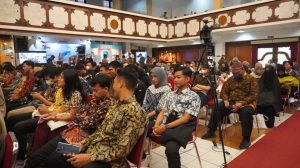
Participants Filled the General Lecture and Book Review Session at UNS Auditorium
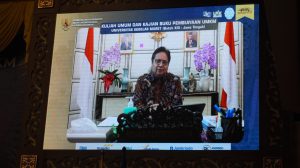
In his keynote speech, Dr. (H.C.) Ir. Airlangga Hartarto revealed that the current occasion was conducted to support MSME development and disseminate MSMEs’ funding channels to the wider community to support Indonesia’s sustainable economic development.
The book, released on 11 November 2021, contains various information and experiences in MSMEs development. MSMEs become one of the development pillars of Indonesia’s economy during the pandemic, to the point of sustaining the pandemic crisis.
“Consistent treatment on the Covid-19 cases has successfully improved community mobility, proven with the community’s confidence in resuming their economic activities. This condition also triggers MSMEs’ business activity improvement.
Further, he explained that MSMEs are a crucial key for economic activities, with a 61% contribution to GDP and 97% of the national employment rate, while at the same time stimulating investment and export rates. Investment in MSME accounted for 60% of the total national investment and contributed to 16% of non-oil and gas export.
In order to maintain the economic recovery momentum and MSMEs’ empowerment, the government initiate a development strategy along with increasing access to MSME funding.
Dr. (H.C.) Ir. Airlangga Hartarto, Coordinating Minister for Economy
The President of Indonesia has provided his instruction to increase bank lending allowance for MSMEs up to 30% by 2024 or equal to 1,800 trillion Rupiah, and Bank Indonesia has issued the Regulation of Bank Indonesia for this matter. The Kredit Usaha Rakyat (KUR-Community Business Lending) has been implemented by the government.
The Coordinating Minister for the Economy hopes this book will improve academic members’ knowledge in determining policy and for the students to monitor and evaluate the policies implemented for the MSMEs. The book is also expected to strengthen the synergy and coordination in MSMEs’ empowerment to accelerate and take advantage of the economic recovery momentum.
Dr. Iskandar Simorangkir, S.E., M.A., Deputy of Macroeconomics and Finance Coordination
Meanwhile, during the opening of the book review discussion, Dr. Iskandar Simorangkir, S.E., M.A., Deputy of Macroeconomics and Finance Coordination, states that through the Regulation of ‘Cipta Kerja’ No 11 of 2020 and Government Regulation (PP) No 77 of 2020, regulate on how the government encourages MSMEs in Indonesia to improve their quality, through business permit registration. Until September 2022, there are 1.7 million micro business units receiving Business Identification Numbers (NIB) via single online submission (OSS).
“MSMEs need support, first by encouraging them to meet the required quality, not only for national sales but also international sales, and second is by involving them in big corporation products to establish a mutual synergy. Therefore, it is expected that MSMEs can improve their quality and increase their income. If we can implement this, indeed, we will be a developed country,” he said.
Discussant of Book Review and General Lecture
Concluding his discussion, Dr. Iskandar Simorangkir invited the participants, consisting mostly of students, to create new jobs by establishing new businesses starting as MSMEs and not stopping as job seekers only.
The General Lecture and Book Review, led by Devi Setyorini, a Junior Expert Policy Analyst at the Coordinating Ministry for Economy, as moderator, invited three speakers, namely Dr. Ferry Irawan, SE, ME., Assistant Deputy for Monetary and External Sector, Gede Edy Prasetya S.E., M.M., Assistant Deputy for Capital Markets and Financial Institutions, Coordinating Ministry for Economy, and Prof. Dr. Izza Mafruhah, S.E., M.Si., the Vice-Dean for Academic, Research, and Student Affairs FEB UNS. (Humas)
The material in this event can be downloaded from the uns.id/umkmfebuns
 Starting the material presentation, Dr. Sarah explained the implementation of the RCT technique, especially in a public policy context. Regarding this matter, she provided an example of the contra-factual effect. For instance, a research attempting to measure the effect and efficiency of a social assistance program under two different assumptions, where the effect of assistance for a specific recipient will be compared to the condition of the same subject when they do not receive assistance. “Under this context, OLS regression is not applicable to determine the causality effect of assistance provision or a policy implementation,” explains Dr. Sarah.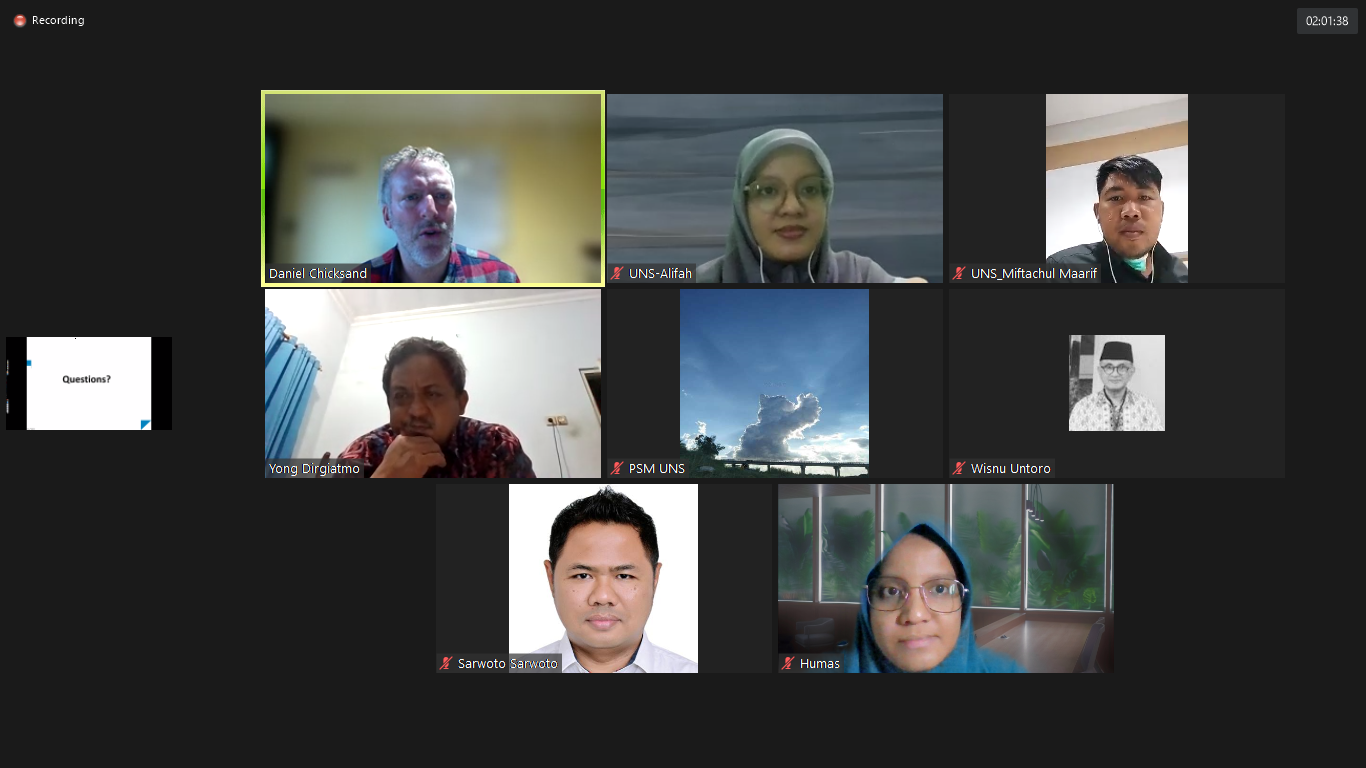
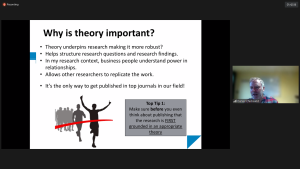 The event went interactively with the attendance of the lecturers of operation management study from the Management Study Program and was led by Alifah Fibayani, MSc., as the Moderator. Opening the material presentation, Prof. Chicksand invited the participants to answer a question regarding the journal ranking system in Indonesia, whether Indonesia follows the Scopus and Scimago system or adopts a specific system in the country. Following the opening question, the Professor explains the first step to be prepared by a researcher before publishing their research articles. “Right now, getting published in a reputable international journal is getting harder. Before starting the publication process, it is better if you have a specific theme for you to follow, either to develop the existing research or to establish your expertise identity as a researcher,” reveals Prof. Chicksand.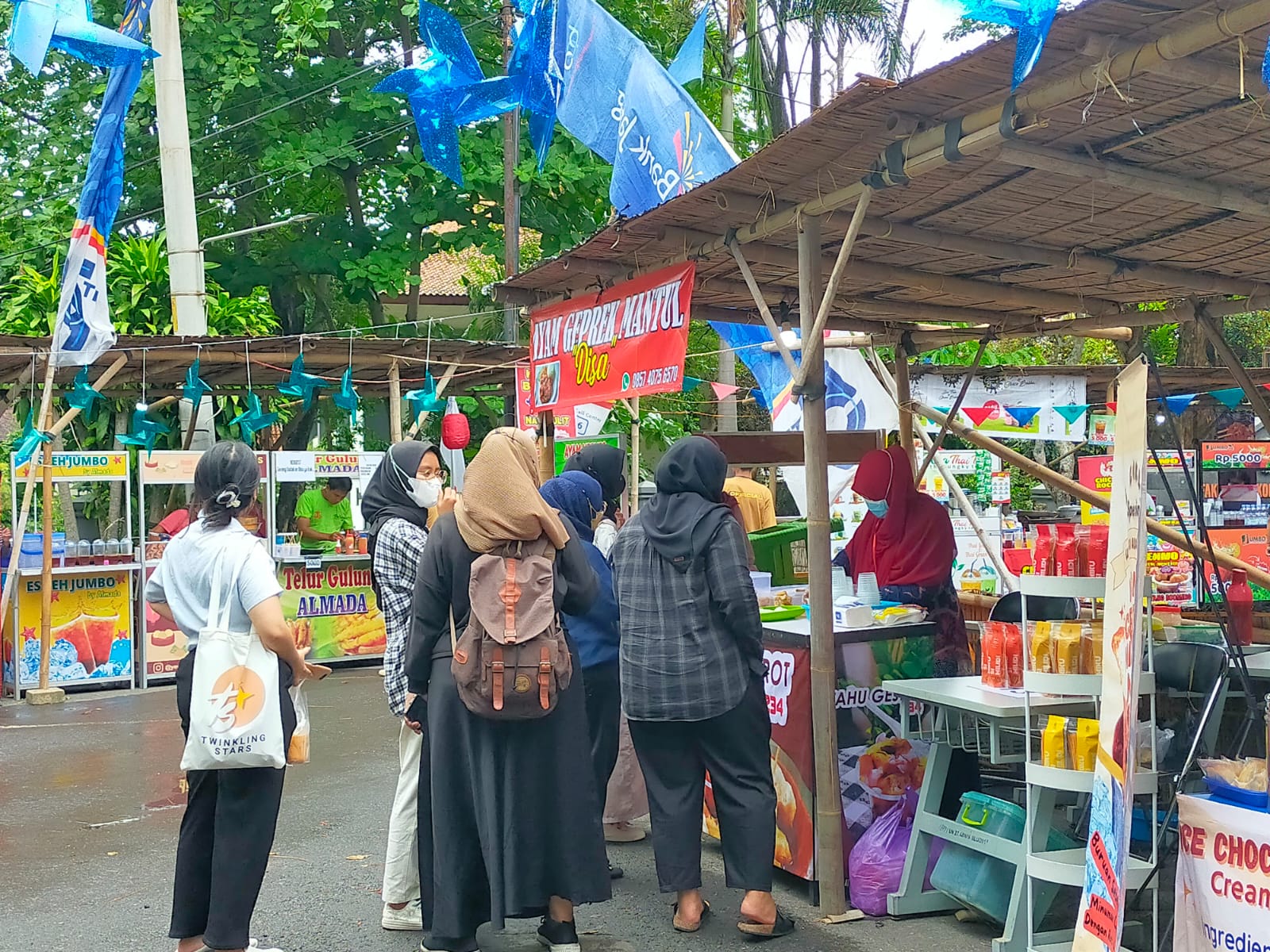

 The existence of the internet has brought a substantial effect on the business sector, encouraging corporations and MSMEs to expand their business by taking advantage of the internet, especially e-commerce. The Polengan Village’s BUMDES and MSMEs have long realized this opportunity, but many of the MSMEs in the village are yet to know and understand how to adopt digital marketing.
 The following session was packaging training, considering that after understanding how to attract customers’ attention through a picture, the MSMEs’ entrepreneur can enhance their packaging to add value to their product. This session is delivered by Salsabilla Indah, who shows the stages of designing beautiful and enticing packaging for prospective customers.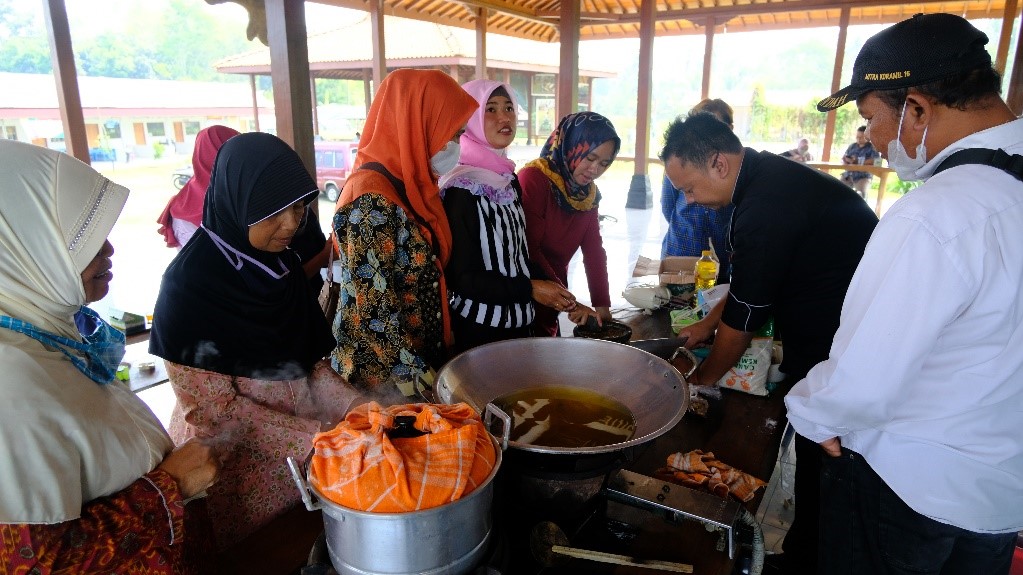
 To survive, the MSMEs sector must keep on innovating to deliver premium products and services to their customers. This problem brought concern to BUMDES and MSME in Polengan Village, Srumbung Sub-District, Magelang Municipality, which attempted to initiate an innovation to process material available in their surrounding environment.
 This training was conducted on 20 July 2022 in collaboration with Mr. Bambang Tri Admojo, who demonstrated several dishes and cuisines using local vegetables in front of the BUMDES and MSMEs in Polengan.
 The participants’ enthusiasm and interest during the training are shown in their efforts to keep up with the cooking process.