FEB

Blog

  • Book Talk: the Evolution of Solo’s Economy Features Two FEB UNS Faculty Members

    Book Talk: the Evolution of Solo’s Economy Features Two FEB UNS Faculty Members

    Two faculty members from the Faculty of Economics and Business (FEB), Universitas Sebelas Maret (UNS), Lukman Hakim, S.E., M.Si., Ph.D., and Bhimo Rizky Samudro, S.E., M.Si., Ph.D., served as invited speakers in the Book Talk entitled ‘Evolusi Ekonomi Kota Solo (The Evolution of Solo’s Economy)’ on Wednesday, 11 December 2024. The event took place at the Suhardi Hall of FEB UNS and was organized by the Regional Office of the Indonesian Economic Scholars Association (ISEI) in Surakarta. More than 100 participants attended the session, including members of GenBI (Generasi Baru Indonesia), a student organization of Bank Indonesia scholarship recipients committed to becoming role models, agents of change, and frontliners in disseminating information from Bank Indonesia to the public.

    In his presentation, Bhimo Rizky Samudro explained that ‘Evolusi Ekonomi Kota Solo’ was a collaborative publication authored by Lukman Hakim, Hery Sulistyo JNS, Mulyanto, Soejatno Kartodirjo, and others. The book explores Solo’s economic development over time, highlighting how the city’s economy has changed through the integration of traditional and modern elements.

    “This book describes the economic movement of Solo from the colonial period, the post-independence era, and into globalization and modernization. It also shows the local impacts of modernization,” stated Dr. Bhimo.

    The book also outlines Solo’s economic history during the colonial period, particularly focusing on agriculture, such as rice and sugarcane, and the significance of batik as a major commodity. It covers infrastructure development during the Dutch period, such as railway construction. Additionally, it discusses the post-independence transformation from 1945 to the 1980s, including the growth of MSMEs in batik and textile sectors, urbanization, and the rise of small-scale industries.

    Solo is also positioned as a center of creative economy, marked by cultural festivals such as the Solo Batik Carnival and the revitalization of heritage areas including Pasar Gede and the Palace complex. Bhimo also noted the current challenges and opportunities facing the city: rapid urbanization and environmental pressures on one hand, and the digital transformation of MSMEs and tourism based on tradition on the other. He concluded that Solo has successfully maintained a balance between tradition and modernity, emphasizing the need for collaboration among the government, community, and business sectors.

    Dr. Lukman Hakim further elaborated that the book provides an analysis of the city’s economic evolution from the era of the royal kingdom to the current reform era. According to him, there are two main reasons why such a study is necessary. First, Solo holds a distinctive historical position as the seat of power in Javanese civilization. As the capital of the Mataram Islamic Kingdom, Solo has remained an important cultural center and regional trade hub in Indonesia. Second, studying Solo’s economic evolution offers insights into the roots of the city’s development and its transformation into what it is today, as well as a means to envision its future trajectory.

    Lukman cited Dorodjatun Kuntjoro-Jakti (2000), who argued that history moves forward—not backward—and that society should neither romanticize the past as a “golden age” nor view it as a “dark era” that burdens the present. Instead, history should serve as a foundation for improving the capacity to anticipate the future.

    The event also marked the inauguration of the ISEI UNS Chapter, chaired by Dr. Bhimo Rizky Samudro, Dean of FEB UNS. Additionally, ISEI Surakarta established a youth division, ISEI Muda, to accommodate young economics graduates. Aprilian Tri Setyan Wijaya, S.Ak., was appointed as its first chair.

    In his address, Aprilian stated that ISEI Muda is part of the broader ISEI organization, which is a major professional institution committed to advancing Indonesia’s economic resilience and development.“As a branch of ISEI, we in ISEI Muda are focusing on developing young economics alumni in Indonesia, particularly in Solo. We believe that the younger generation holds a strategic role in national economic development—whether through theory, research, or policy implementation with direct societal impact. On behalf of my fellow members, I would like to share our vision, mission, and goals for the future,” he explained.

    ISEI Muda’s vision includes three key initiatives. First, enhancing the role of ISEI Muda as a platform to sharpen members’ capabilities and skills. In this fast-changing era, economic challenges and opportunities are constantly evolving. Therefore, the younger generation must equip themselves with relevant knowledge and adaptive skills. Through seminars, discussions, training, and collaborative research, ISEI Muda aims to create learning opportunities and drive innovation.

    Second, ISEI Muda plans to expand its network, both with local youth organizations in Solo and at the national level. Young economists should have broader access to information and become a bridge connecting academia, the workforce, and public policy.

    Third, ISEI Muda will actively engage in current socio-economic issues, from economic inequality and digital transformation to sustainability. The organization seeks to contribute with creative and forward-thinking perspectives.

    “No journey can succeed without the support and encouragement of many parties, especially from our senior members in ISEI and our beloved FEB UNS. Therefore, I invite everyone to support and contribute to ISEI. I express my gratitude to the Solo Chapter for providing us with a strong foundation. We kindly ask for your blessings and support so that ISEI Muda may continue to contribute, bring renewed enthusiasm, and create a positive impact on the community, especially in Solo,” he concluded.

  • Lebih dari 50 Startup Mahasiswa Ikuti Workshop dan FGD Peningkatan Bisnis Startup

    Lebih dari 50 Startup Mahasiswa Ikuti Workshop dan FGD Peningkatan Bisnis Startup

    Bisnis startup yang dikelola mahasiswa mempunyai peran penting bagi munculnya bisnis unggulan yang mempunyai daya inovasi tinggi. Oleh karena itu peran perguruan tinggi (PT) dalam mendukung perkembangan bisnis startup yang diinisiasi mahasiswa sangat penting bagi peningkatan pertumbuhan bisnis di Indonesia.

    Masih sedikit sekali jumlah bisnis startup mahasiswa yang mampu mengembangkan usahanya sampai menjadi perusahaan dan menghasilkan penjualan yang secara ekonomi menguntungkan.

    Pernyataan itu disampaikan Dr. Ahmad Ikhwan Setiawan S.E., M.T., ketua Riset Grup (RG) Pemasaran Keperilakuan Fakultas Ekonomi dan Bisnis (FEB) Universitas Sebelas Maret (UNS) dalam sambutannya di acara Workshop dan FGD Peningkatan Bisnis Startup UNS, Kamis, 12 Desember 2024 di Solo.

    Lebih lanjut, Dr. Ikhwan menyemangati mahasiswa untuk optimis dalam berwirausaha.

    “Banyak sekali pelaku bisnis yang sukses karena mengawali usaha sejak dari mahasiswa. Dalam perjalanannya, mahasiswa yang berwirausaha memang terkadang ada kendala. Kami akan membersamai teman-teman, akan memberikan rekomendasi kepada stakeholder terkait usaha yang telah dibangun mahasiswa. Melalui upaya ini diharapkan terjadi percepatan startup mahasiswa dalam mencapai kinerja bisnis.” ungkapnya.

    Kegiatan yang diikuti oleh lebih dari 50 startup mahasiswa itu merupakan rangkaian penelitian  tim divisi startup dari konsorsium lima perguruan tinggi yaitu Universitas Sebelas Maret (UNS) Surakarta, Universitas Islam Indonesia (UII) Yogyakarta, Universitas Pancasakti (UPANCA) Tegal, Sekolah Tinggi Pariwisata (STP) Sahid Surakarta dan Universitas Islam Negeri Raden Massaid Surakarta.

    Peluang dan Tantangan Eksplorasi Bisnis Startup di Bidang Energi menjadi topik workshop dengan menghadirkan Dr Dina Nurul Fitria.,S.E.,M.T., Anggota Pemangku Kepentingan Unsur Konsumen Dewan Energi Nasional RI

    Di kesempatan itu, hadir pula memberikan arahan, Dr. Dwi Prasetyani, S.E. M.Si, Direktur Alumni dan Kemahasiswaan UNS.

    Usai workshop, Tim RG Pemasaran keperilakuan dan seluruh peserta melakukan FGD untuk dapat mengidentifikasi permasalahan yang dihadapi oleh startup mahasiswa. Faktor-faktor penting yang belum dijalankan dengan baik yang mengganggu pencapaian keberhasilan bisnis startup. Hal itu agar dapat menentukan rekomendasi untuk perbaikan manajemen bisnis dalam upaya mengidentifikasi faktor-faktor penentu keberhasilan bisnis startup.

    Sebelumnya, workshop juga telah digelar  di UII pada 13 November 2024 lalu untuk mengadakan kerja sama bagi peningkatan startup bagi mahasiswa di UNS melalui program riset dan pengabdian dan dihadiri oleh 25 startup binaan Inkubasi Bisnis dan Inovasi Bersama (IBISMA) UII.

  • Over 50 Student Startups Join Workshop and FGD to Accelerate Startup Growth

    Over 50 Student Startups Join Workshop and FGD to Accelerate Startup Growth

    Student-run startups play a vital role in fostering high-innovation businesses that have the potential to become future industry leaders. As such, the role of higher education institutions (HEIs) in supporting the growth and development of student-initiated startups is considered crucial to boosting the overall business ecosystem in Indonesia. This urgency is further highlighted by the fact that only a small fraction of student startups are currently able to scale their ventures into fully operational, revenue-generating businesses with sustainable economic impact.

    This point was emphasized by Dr. Ahmad Ikhwan Setiawan, S.E., M.T., Head of the Behavioral Marketing Research Group, Faculty of Economics and Business (FEB), Universitas Sebelas Maret (UNS), during the Workshop and Focus Group Discussion (FGD) on Startup Business Acceleration, held on Thursday, December 12, 2024, in Solo.

    Dr. Ikhwan encouraged students to remain optimistic about entrepreneurship. “Many successful business figures started their ventures while they were still in university. Naturally, student entrepreneurs will face challenges along the way—but that’s where we come in. We are committed to mentoring and recommending actionable solutions to stakeholders who are involved in supporting these student ventures. Through this effort, we hope to accelerate the growth and performance of student startups,” he explained.

    The event, which gathered more than 50 student startups, is part of a broader research initiative carried out by the Startup Division Team, a consortium of five universities: Universitas Sebelas Maret (UNS) Surakarta, Universitas Islam Indonesia (UII) Yogyakarta, Universitas Pancasakti (UPANCA) Tegal, Sekolah Tinggi Pariwisata (STP) Sahid Surakarta, and Universitas Islam Negeri Raden Mas Said Surakarta.

    The workshop featured the theme “Opportunities and Challenges in Exploring Energy-Based Startups” and invited expert speaker Dr. Dina Nurul Fitria, S.E., M.T., Member of the Consumer Stakeholder Group of the National Energy Council of Indonesia. Also attending the event for to deliver remarks and support was Dr. Dwi Prasetyani, S.E., M.Si., Director of Alumni and Student Affairs at UNS.

    Following the workshop, the Behavioral Marketing Research Group facilitated a Focus Group Discussion (FGD) with the student participants to identify current obstacles in their business development journey. The session aimed to uncover key business management factors that have not yet been effectively implemented, which may be hindering startup success. These insights will be used to formulate targeted recommendations for improving business operations and identifying critical success factors for startup sustainability.

    Previously, a similar workshop was held at UII on November 13, 2024, to foster collaborative research and community service programs designed to strengthen student startups at UNS. That session was attended by 25 startups under the guidance of the UII Business and Innovation Incubator (IBISMA).

  • Islamic Economics and Finance Research Group of FEB UNS Delivers Material on How to Obtain Sharia Accounting Certification

    Islamic Economics and Finance Research Group of FEB UNS Delivers Material on How to Obtain Sharia Accounting Certification

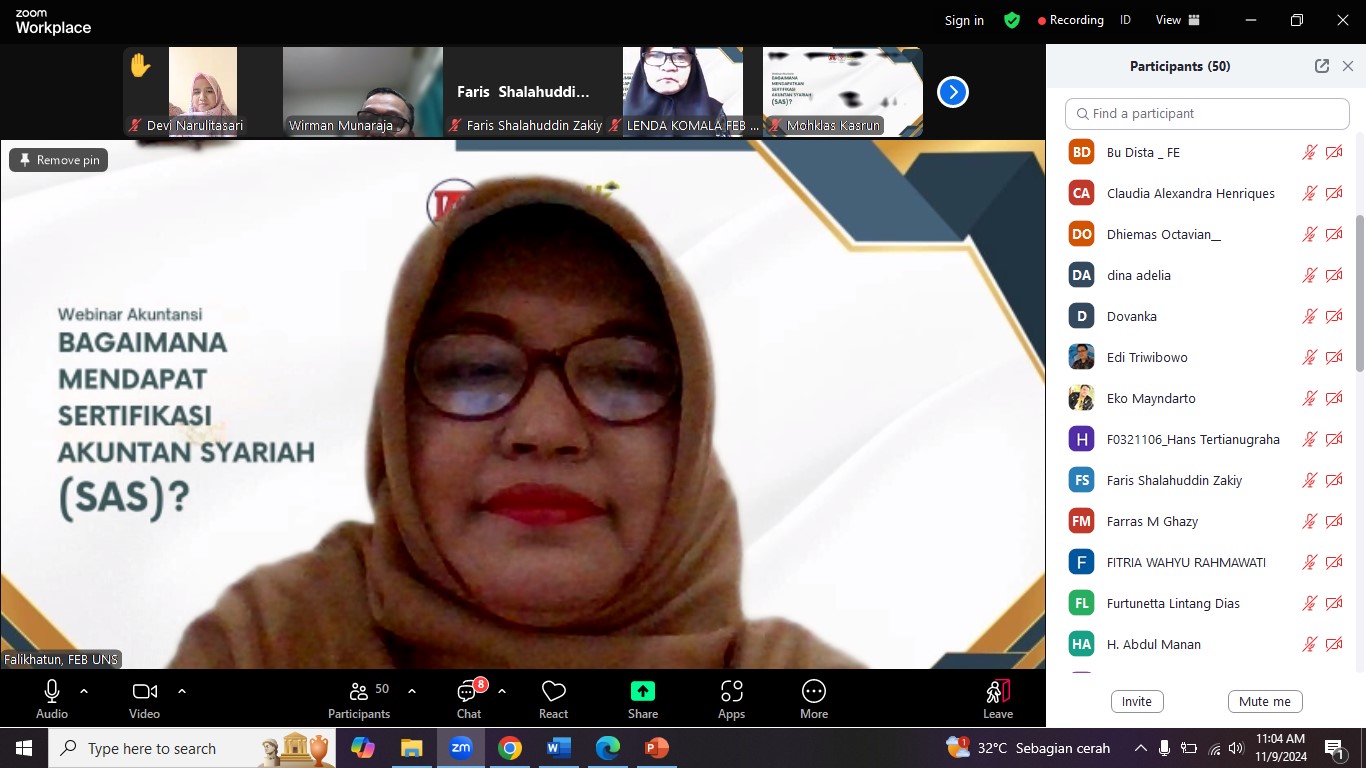
    The Islamic Economics and Finance Research Group (RG), Faculty of Economics and Business (FEB), Universitas Sebelas Maret (UNS), hosted an Accounting Webinar on Saturday, November 9, 2024, in collaboration with the Indonesian Institute of Accountants (IAI) Surakarta Branch and the Indonesian Association of Accounting Lecturers (ADAI) Central Java. The event was also supported by the Surakarta Regional Board of the Sharia Economic Society (MES), the Regional Executive Board of the Indonesian Association of Islamic Economists (IAEI) Central Java Province, and the Solo Raya Regional Board of the HMI Alumni Women’s Forum (PD Forhati).
    The webinar entitled “How to Obtain Sharia Accounting Certification (SAS)?” attracted a total of 69 attendees, consisting of lecturers and students from various universities across Indonesia. Dr. Falikhatun, M.Si., Ak., SAS., Chair of the Islamic Economics and Finance Research Group, served as the main speaker for the occasion.
    In her material presentation, Dr. Falikhatun emphasized the importance of Sharia Accounting Certification for accountants, especially for lecturers and students who intend to engage with the sharia-based industry, including both Islamic financial institutions and Islamic non-bank financial institutions (IKNB).
    “The purpose of SAS is to assess competency in sharia accounting, to serve as a quality benchmark for accountants seeking to understand sharia accounting, as a quality indicator for institutions looking to employ personnel with expertise in the field, and as a requirement for entry into certain professional roles in sharia accounting,” she explained.
    Dr. Falikhatun further noted that, since 2020, obtaining the SAS certification requires passing two examination levels: Basic and Professional. To qualify for the Basic level, candidates must hold at least an undergraduate (S1) or Diploma IV degree in any discipline, as long as they are able to complete the exam. After passing the Basic level, participants may proceed to the Professional level. Only upon successful completion of the Professional level can they obtain the SAS title.
    Accountants holding the SAS certification may pursue various career paths related to sharia accounting, such as Sharia Financial Analyst, Sharia Supervisory Board (SSB) member, Sharia Financial Planner, Sharia Auditor, and Lecturer. However, for positions on the SSB or Sharia Supervisory Board (Dewan Pengawas Syariah/DPS), an additional certification is required—specifically, DPS training and certification typically organized by the Indonesian Ulema Council (MUI) Institute.
    This initiative is intended to motivate lecturers and students, particularly those aiming to be involved in the sharia business sector. It is also expected to encourage deeper understanding and practical engagement with sharia accounting, thereby opening up promising career opportunities.
    In the long term, the program aspires to increase both competency and the number of lecturers and accountants who hold Sharia Accounting Certification, ultimately enhancing the strength and capacity of institutions served by sharia-accounting professionals.

  • Dekan: FEB Mendukung Seluruh Program Satgas PPKS UNS

    Dekan: FEB Mendukung Seluruh Program Satgas PPKS UNS

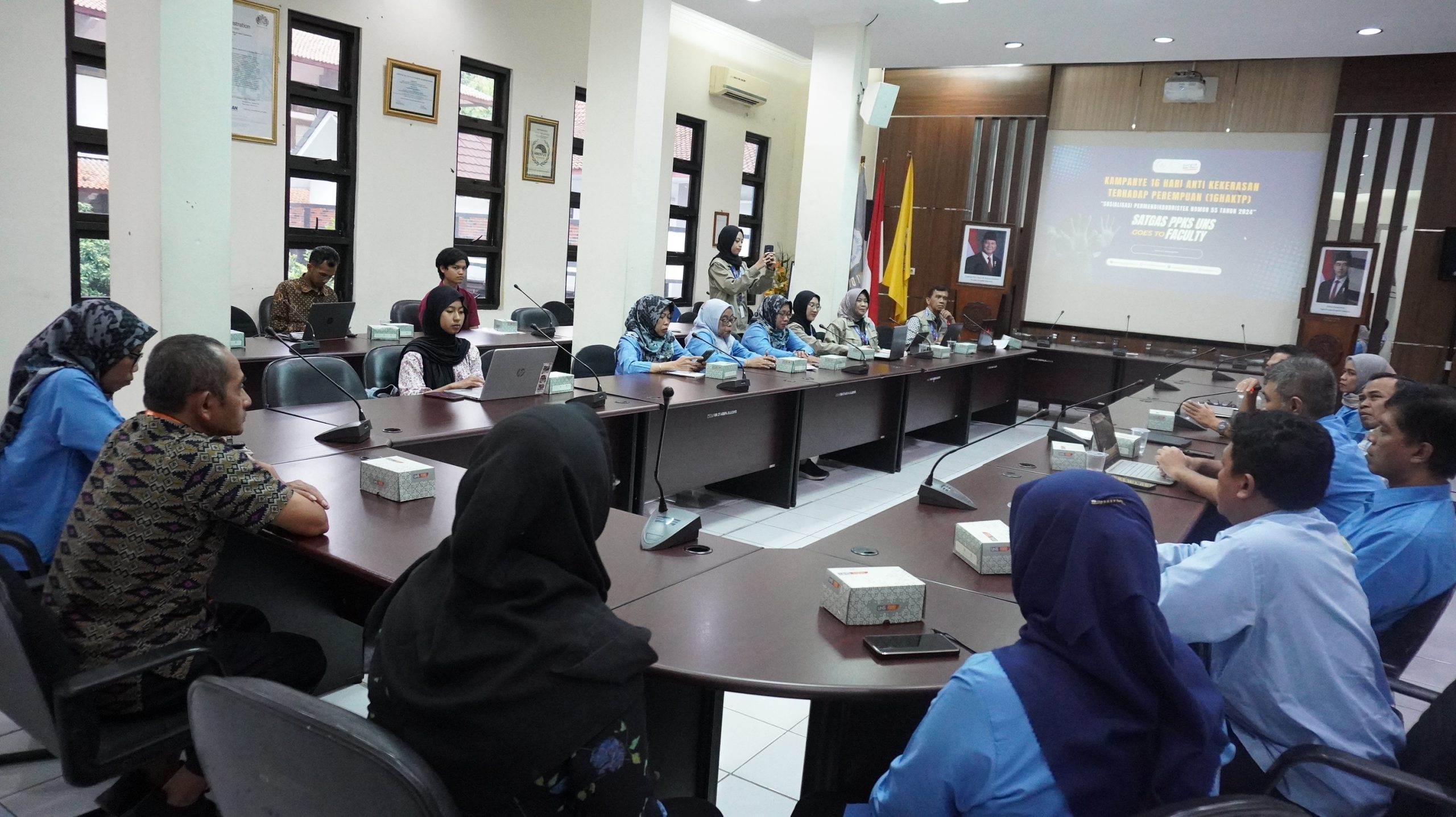
    Satgas Pencegahan Penanganan Kekerasan Seksual (PPKS) Universitas Sebelas Maret (UNS) Sosialisasikan Permendikbudristek no 55 tahun 2024 tentang Pencegahan  dan Penanganan Kekerasan di Lingkungan Perguruan Tinggi, Kamis 5 Desember 2024 di Fakultas Ekonomi dan Bisnis (FEB) UNS.

    Kehadiran Satgas PPKS yang diketuai oleh  Prof. Dr. Ismi Dwi Astuti Nurhaeni, M.Si disambut baik oleh civitas akademika FEB UNS.

    Dekan FEB UNS, Bhimo Rizky Samudro, S.E., M.Si,. Ph.D menyampaikan terima kasih atas kedatangan Satgas PPKS UNS dan sangat men-support seluruh program dari Satgas PPKS UNS.

    “Ini sangat relevan sekali dengan perkembangan dinamika kampus sekarang, kita harus cegah segala bentuk kekerasan terutama kekerasan seksual dan berbagai kekerasan lain di kampus. Khususnya di FEB sangat men-support apabila nanti akan ada progam dan peran dari  Satgas PPKS UNS yang dikoordinasikan dengan FEB UNS. Yang penting kita mulai dari awal dengan sesuatu yang baik nanti akan berakhir dengan baik pula” ungkapnya

    Terkait dengan dukungan dan komitmen sebagai Dekan dan pimpinan  FEB, Bhimo Rizky Samudro, Ph.D menegaskan bahwa pimpinan FEB memiliki kewajiban untuk men-support. Yang pertama membuka kerja sama dalam rangka preventif mencegah kekerasan seksual dari awal, memberikan edukasi kepada rekan-rekan mahasiswa, dosen dan tendik. Kegiatan yang terintegrasi yang cukup perlu, dan kami sangat membutuhkan peran dari Satgas PPKS UNS.

    Yang kedua, proses pada saat penanganan kasus kami tahu harus kemana melapor, dan  bagaimana kita menyelesaikan secara bijak, mencegah agar tidak terjadi penanganan-penanganan yang diluar batas. Karena kita ada di kampus, bagaimana menangani sesuatu dengan bijak.

    Terkait  tindakan kekerasan,  Prof. Ismi menjelaskan secara khusus kekerasan seksual. Kekerasan seksual merupakan tindakan pelecehan pemaksaan dan segala bentuk perlakuan tidak pantas yang melibatkan unsur seksual.

    Pencegahan yang dilakukan melalui pembelajaran, penguatan tata kelola, penguatan budaya komunitas mahasiswa dosen dan tendik serta penataan dan peningkatan sarana prasarana di lingkungan kampus UNS. UNS melakukan penanganan kekerasan melalui pendampingan, perlindungan, penanganan, sanksi administratif dan pemulihan korban.

    Universitas menjamin pemulihan nama baik berupa permintaan maaf dari perguruan tinggi serta pemulihan hak-hak yang hilang atau ditangguhkan akibat proses pemeriksaan kekerasan seksual.

    Satgas PPKS UNS menjadi garda terdepan dalam pencegahan dan penanganan kekerasan, termasuk kekerasan seksual di perguruan tinggi yang memihak kepentingan terbaik korban.

    Pencegahan dan penanganan kekerasan dilaksanakan dengan prinsip: kepentingan yang terbaik bagi korban, non diskriminasi, keadilan dan kesetaraan gender, kesetaraan hak dan aksesibilitas bagi penyandang disabilitas, akuntabilitas, independen, kehati-hatian, kerahasiaan, konsisten, jaminan perlindungan identitas dan jaminan ketidakberulangan.

    Mandatori satgas  PPKS sebagai lembaga bertanggung jawab untuk mendukung perwujudan kampus merdeka bebas kekerasan dan tidak mentolerir terjadinya kekerasan.

    “Jadi mari kita bersama-sama melawan kekerasan apapun termasuk kekerasan seksual, jangan ragu untuk melapor jika Anda atau teman Anda mengalami situasi yang tidak pantas, bersama kita bisa menciptakan kampus yang aman dan ramah bagi semua” pungkasnya

  • Dean: FEB Fully Supports All Programs by the UNS PPKS Task Force

    Dean: FEB Fully Supports All Programs by the UNS PPKS Task Force

    The Sexual Violence Prevention and Handling Task Force (PPKS) of Universitas Sebelas Maret (UNS) held a socialization session on the newly issued Regulation of the Minister of Education, Culture, Research, and Technology (Permendikbudristek) No. 55 of 2024 concerning the Prevention and Handling of Violence in Higher Education Institutions. The event took place on Thursday, December 5, 2024, at the Faculty of Economics and Business (FEB) UNS. The visit by the PPKS Task Force, led by Prof. Dr. Ismi Dwi Astuti Nurhaeni, M.Si., was warmly welcomed by the FEB UNS faculty member.

    Bhimo Rizky Samudro, S.E., M.Si., Ph.D., Dean of FEB UNS, expressed his appreciation for the Task Force’s presence and voiced strong support for all PPKS programs and initiatives. “This is highly relevant to the current dynamics within university campuses. We must actively prevent all forms of violence—especially sexual violence—as well as other types of misconduct in academic environments. FEB is fully committed to collaborating with the PPKS UNS Task Force on any upcoming programs or initiatives. What matters most is that we start with a clear and good intention—so that it can lead to positive and sustainable outcomes,” he remarked.

    In affirming his commitment as Dean, Dr. Bhimo emphasized that it is the responsibility of the faculty leadership to support such efforts in two main areas. First, in terms of prevention, FEB opens itself to cooperation with the Task Force to initiate educational campaigns and awareness-building for students, lecturers, and staff. “An integrated effort is crucial, and we truly need the role of the PPKS Task Force here at FEB,” he added.

    Second, during the handling of any reported cases, there needs to be a clear process—starting with knowing where to report and how to ensure the resolution is handled wisely and sensitively. “We are in an academic setting, and therefore we must respond to every case thoughtfully and responsibly,” he stated.

    Prof. Ismi further elaborated on the definition of violence, specifically sexual violence, which includes acts of harassment, coercion, and any form of inappropriate behavior involving sexual elements. According to her, prevention at UNS is carried out through learning modules, strengthening governance, fostering a healthy campus culture among students and educators, and improving campus infrastructure. When handling cases, UNS provides support through assistance, protection, case management, administrative sanctions, and the recovery of victims. The university also guarantees restorative measures, including public apologies from the institution and the reinstatement of rights that were lost or suspended during the investigative process.

    The PPKS UNS Task Force serves as the university’s frontline unit in both preventing and responding to violence—particularly sexual violence—by prioritizing the best interest of the victim. All efforts by the Task Force are guided by principles such as: prioritizing the victim’s well-being, non-discrimination, justice and gender equality, accessibility for persons with disabilities, accountability, independence, caution, confidentiality, consistency, protection of identity, and assurance of non-recurrence.

    The mandate of the PPKS Task Force is clear: to serve as a responsible body supporting the realization of a violence-free “Merdeka Belajar” (Independent Campus) environment, where any form of violence is not tolerated. “So, let us all take part in standing up against any form of violence, including sexual violence. Don’t hesitate to speak up—whether it happens to you or to someone you know. Together, we can create a safe and inclusive campus for everyone,” she concluded.

  • Undergraduate Management Program Holds Workshop on Applied Research Approach in Management

    Undergraduate Management Program Holds Workshop on Applied Research Approach in Management

    The Undergraduate Management Program at the Faculty of Economics and Business (FEB), Universitas Sebelas Maret (UNS), organized a workshop titled “Applied Research Approach in Management” on Wednesday, December 4, 2024. The session, held in Meeting Room I, Prof. Suharno TS Building, FEB UNS, was attended by academic staff from the Management Program and featured Prof. Drs. B.M. Purwanto, M.B.A., Ph.D., as the keynote speaker.
    In her opening remarks, Dr. Sinto Sunaryo, S.E., M.Si., SHRM.CP., extended her appreciation to Prof. Purwanto for his willingness to share insights on the applied research paradigm.
    “We are grateful to Prof. B.M. for taking the time to join us at FEB UNS. Today, we will engage in a discussion on applied research—an approach we are eager to explore and expand within the Management Program,” she stated.
    Dr. Sinto emphasized that historically, the predominant research output of the Management faculty has been in the realm of pure research. Therefore, exposure to alternative methodological approaches such as applied research is expected to diversify and enrich the academic research landscape.
    She further noted that the integration of applied research has significant implications not only for faculty-led research but also for student-driven projects.
    “In addition to pure research, applied research presents an alternative framework that aligns well with current academic trends. Many of our students—especially those participating in the Merdeka Belajar Kampus Merdeka (MBKM) program—have begun to express interest in adopting this approach,” she explained.
    The primary objective of the workshop was to facilitate a deeper understanding of how applied research can be initiated and systematically developed. The discussion also addressed the strategic orientation of the faculty, particularly in relation to meeting eligibility requirements for international accreditation under the AACSB framework.
    “The research approaches adopted by a faculty unit are among the key indicators assessed in the AACSB accreditation process. Prof. B.M.’s presence today will serve as a valuable resource for strengthening our institutional readiness and enhancing our research capabilities in preparation for AACSB,” she added.
    This workshop marks the first in a series of planned academic engagements. The Management Program intends to continue collaborative discussions with Prof. Purwanto to further explore the practical and theoretical dimensions of applied research. The session was moderated by Siti Khoiriyah, S.E., M.Si., who facilitated both the speaker’s presentation and the subsequent scholarly dialogue.

  • International Research Internship Forum Features Carmen Aquilar Cabello

    International Research Internship Forum Features Carmen Aquilar Cabello

    The Faculty of Economics and Business (FEB), Universitas Sebelas Maret (UNS), hosted an International Research Internship Forum featuring Carmen Aquilar Cabello, a graduate student from the Master’s Program in Sustainable Economics at Wageningen University and Research, the Netherlands, who is currently conducting her research at FEB UNS.
    In her opening remarks, Prof. Tri Mulyaningsih, S.E., M.Si., Ph.D., Vice Dean for Academic and Research Affairs, stated that events such as this forum are part of FEB’s ongoing internationalization efforts. She emphasized that FEB UNS is continuously developing engaging academic programs to enhance the learning experience of students enrolled in its International Undergraduate Program, particularly through improved access to student mobility opportunities.
    According to Prof. Tri, FEB UNS currently offers exchange opportunities with its partner universities in the ASEAN region, including Malaysia, Thailand, and the Philippines. In addition, the faculty has established collaborations with institutions in Taiwan and Russia that also offer student exchange programs.
    “We also have an academic cooperation with a university in the Netherlands, enabling our students to participate in both short-term (one-semester) and long-term (one-year) mobility programs,” Prof. Tri explained.
    She further elaborated that the faculty aims to provide broader access for international class students to study abroad through various formats, including short-term exchanges, long-term mobility, and double-degree programs.
    In addition to presenting information about student exchange programs—both inbound and outbound—the forum also highlighted a current example of an inbound student: Carmen Aquilar Cabello from Wageningen University and Research, who is currently conducting research at FEB UNS.
    “While earlier I spoke about outbound students, today we also welcome an example of an inbound student. Carmen is a graduate student conducting field research here at FEB UNS. Her presence demonstrates that international mobility comes in diverse forms, all of which aim to provide new academic and cultural experiences,” Prof. Tri stated.
    Carmen was then invited to share an overview of her research activities at FEB UNS. Her study focuses on dietary patterns among Indonesian adolescents. “Indonesia provides an ideal context for this research, as countries experiencing economic growth tend to undergo a nutritional transition. That is, dietary habits often shift from traditional foods to more processed products. This change has been linked to rising obesity rates in nations transitioning toward developed status. Understanding the root causes early on is therefore essential,” she explained.
    Carmen also shared insights into the academic and logistical processes she navigated as a Spanish student enrolled in a Dutch university while conducting fieldwork in Indonesia. Building on Carmen’s presentation, Prof. Tri further highlighted the interdisciplinary linkage between economics—particularly development economics—and public health, as exemplified in Carmen’s research.
    At its core, the study of economics often aims to formulate effective and efficient public policies. In the context of public health, particularly regarding adolescent nutrition, this research seeks to contribute toward identifying appropriate policy recommendations that address emerging challenges within transitioning economies.

  • Prodi S1 Manajemen Adakan Workshop Pendekatan Applied Research dalam Manajemen

    Prodi S1 Manajemen Adakan Workshop Pendekatan Applied Research dalam Manajemen

    Program Studi S-1 Manajemen Fakultas Ekonomi dan Bisnis (FEB) Universitas Sebelas Maret (UNS) adakan Workshop Pendekatan Applied Research dalam Manajemen, Rabu, 4 Desember 2024 di Ruang Sidang I Gedung Prof. Suharno TS FEB UNS.

    Kegiatan yang diikuti oleh Dosen Prodi Manajemen menghadirkan narasumber Prof. Drs. B.M. Purwanto, M.B.A., Ph.D.

    Dr. Sinto Sunaryo, S.E., M.Si.,SHRM.CP dalam sambutannya menyampaikan terima kasih kepada Prof. B.M. Purwanto yang telah berkenan hadir untuk sharing terkait pendekatan applied research.

    “Terima kasih kepada Prof. B.M yang telah meluangkan waktu untuk hadir di FEB UNS, kita akan bersama-sama diskusi mengenai salah satu pendekatan riset, applied research yang juga kita inginkan untuk dapat dikembangkan di Prodi Manajemen” ungkapnya.

    Lebih lanjut dikatakan, selama ini, riset yang dilakukan oleh Dosen Manajemen sebagian besar adalah adalah pure research, sehingga sharing dari pendekatan yang berbeda akan semakin memberi warna pada pendekatan riset yang dilakukan dosen.

    Applied research juga akan memberi warna, bukan hanya pada riset yang dilakukan oleh dosen tetapi juga dilakukan oleh mahasiswa.

    “Disamping pure research, kita bisa juga menggunakan applied research dan terlebih lagi mahasiswa kita sudah mulai tertarik untuk menggunakan applied research terutama mahasiswa-mahasiswa FEB yang mengambil MBKM” tuturnya.

    Harapannya, semoga diskusi ini bisa memberikan pendalaman, bagaimana kita bisa mulai dan mengembangkan pendekatan penelitian lain, salah satunya adalah applied research.

    Dari hasil perbincangan dengan Prof. B.M, hasil dari diskusi ini, bukan hanya pada konteks penelitian yang dilakukan sebagai dosen, tapi juga apa arah yang sedang dituju fakultas dalam rangka eligibility menuju akreditasi internasiona AACSB.

    “Pendekatan-pendekatan riset yang dilakukan menjadi salah sau poin yang dipertimbangkan dalam AACSB. Kehadiran Prof. B.M akan dioptimalkan untuk pengembangan wawasan dan kesiapan kita untuk menuju AACSB “ paparnya,

    Ini adalah kegiatan awal, ke depan Prodi Manajemen bersama Prof BM akan lanjut diskusi yang lebih dalam terkait pendekatan penelitian.

    Di kegiatan itu, Siti Khoiriyah, S.E., M.Si memandu jalannya sesi paparan narasumber dan juga diskusi.

  • Diskusi Magang Riset Internasional, Hadirkan Carmen Aquilar Cabello

    Diskusi Magang Riset Internasional, Hadirkan Carmen Aquilar Cabello

    Fakultas Ekonomi dan Bisnis (FEB) Universitas Sebelas Maret (UNS) menggelar Diskusi Magang Riset Internasional dengan menghadirkan Carmen Aquilar Cabello, Mahasiswa Master Program in Sustainable Economics Wageningen University and Research, the Netherland yang sedang melakukan riset di FEB UNS.

    Prof. Tri Mulyaningsih, S.E., M.Si., Ph.D., Wakil Dekan (WD) Bidang Akademik dan Penelitian FEB dalam sambutannya menyampaikan beberapa kegiatan seperti kegiatan hari ini merupakan bagian dari kegiatan internasional di FEB UNS.

    Menurutnya, saat ini FEB masih terus berusaha untuk mengembangkan program-program menarik untuk mahasiswa kelas internasional dengan tujuan untuk memberikan pengalaman dan akses yang lebih baik ke program student mobility.

    Mahasiswa bisa melakukan pertukaran pelajar ke universitas partner FEB UNS di area ASEAN, seperti Malaysia, Thailand, ataupun Filipina. FEB UNS juga memiliki kerja sama dengan universitas di Taiwan dan Rusia yang juga menawarkan program pertukaran pelajar.

    “Program lain, kita juga punya program kerja sama dengan universitas di Belanda (Netherlands). Kesempatan yang saat ini ada memungkinkan mahasiswa FEB UNS untuk melakukan pertukaran pelajar dalam program short-course (satu semester) ataupun untuk jangka waktu yang lebih panjang (satu tahun),” jelas Prof. Tri Mulyaningsih.

    Lebih lanjut Prof. Tri Mulyaningsih menyampaikan bahwa untuk mahasiswa kelas internasional, fakultas berusaha memberikan kesempatan yang lebih luas agar mahasiswa mendapatkan kesempatan untuk belajar di luar negeri baik itu short-term, long-term, ataupun double-degree program.

    Selain informasi terkait program exchange (baik inbound maupun outbound), dalam sesi diskusi tersebut juga menghadirkan contoh dari student inbound yang saat ini sedang belajar di FEB UNS, Carmen Aquilar Cabello, Mahasiswa Master Program in Sustainable Economics Wageningen University and Research, the Netherland.

    “Kalau sebelumnya saya membahas mengenai student outbound, saat ini kita juga kedatangan contoh dari student inbound. Carmen disini adalah mahasiswa magister yang sedang melakukan riset di FEB UNS. Dengan contoh ini diharapkan kalian menjadi mengetahui bahwa skema mobility tersedia dalam berbagai bentuk, model, namun dengan satu tujuan yaitu mendapatkan pengalaman baru,” ungkap Prof. Tri Mulyaningsih.

    Carmen kemudian diberi kesempatan untuk menjelaskan kegiatan riset yang sedang dilaksanakan di FEB UNS.

    Dalam risetnya, Carmen meneliti tentang pola diet remaja di Indonesia.

    “Indonesia adalah lokasi yang sangat baik untuk melakukan riset/studi karena setiap negara yang mengalami kemajuan tingkat ekonomi akan diikuti dengan transisi nutrisi. Artinya komposisi diet masyarakat cenderung berubah dari tradisional intake menjadi makanan olahan (processed food). Hal ini juga menjadi faktor pendorong peningkatan obesitas di negara yang ekonominya baru-baru saja bertransisi menjadi negara maju (developed countries), sehingga kita perlu mengetahui akar permasalahannya dari awal,” jelasnya.

    Carmen juga menjelaskan proses yang perlu dilengkapi dalam proses kuliah di luar negeri sebagai mahasiswa dari Spanyol yang kuliah di Belanda dan melakukan riset di Indonesia.

    Menyambung penjelasan dari Carmen, Tri Mulyaningsih menjelaskan keterkaitan antara ilmu ekonomi (ekonomi pembangunan) dengan kesehatan sebagaimana dilaksanakan dalam riset Carmen.

    Pada dasarnya studi ilmu ekonomi seringkali berfokus dalam usaha untuk membuat kebijakan publik yang efektif dan efisien, sehingga dalam kesehatan, khususnya terkait diet remaja, penelitian tersebut kemudian bertujuan untuk menemukan rumusan kebijakan yang tepat.