FEB

Blog

  • Kunjungan Studi Banding Senat Akademik FEB UNS ke Senat FEM IPB

    Kunjungan Studi Banding Senat Akademik FEB UNS ke Senat FEM IPB

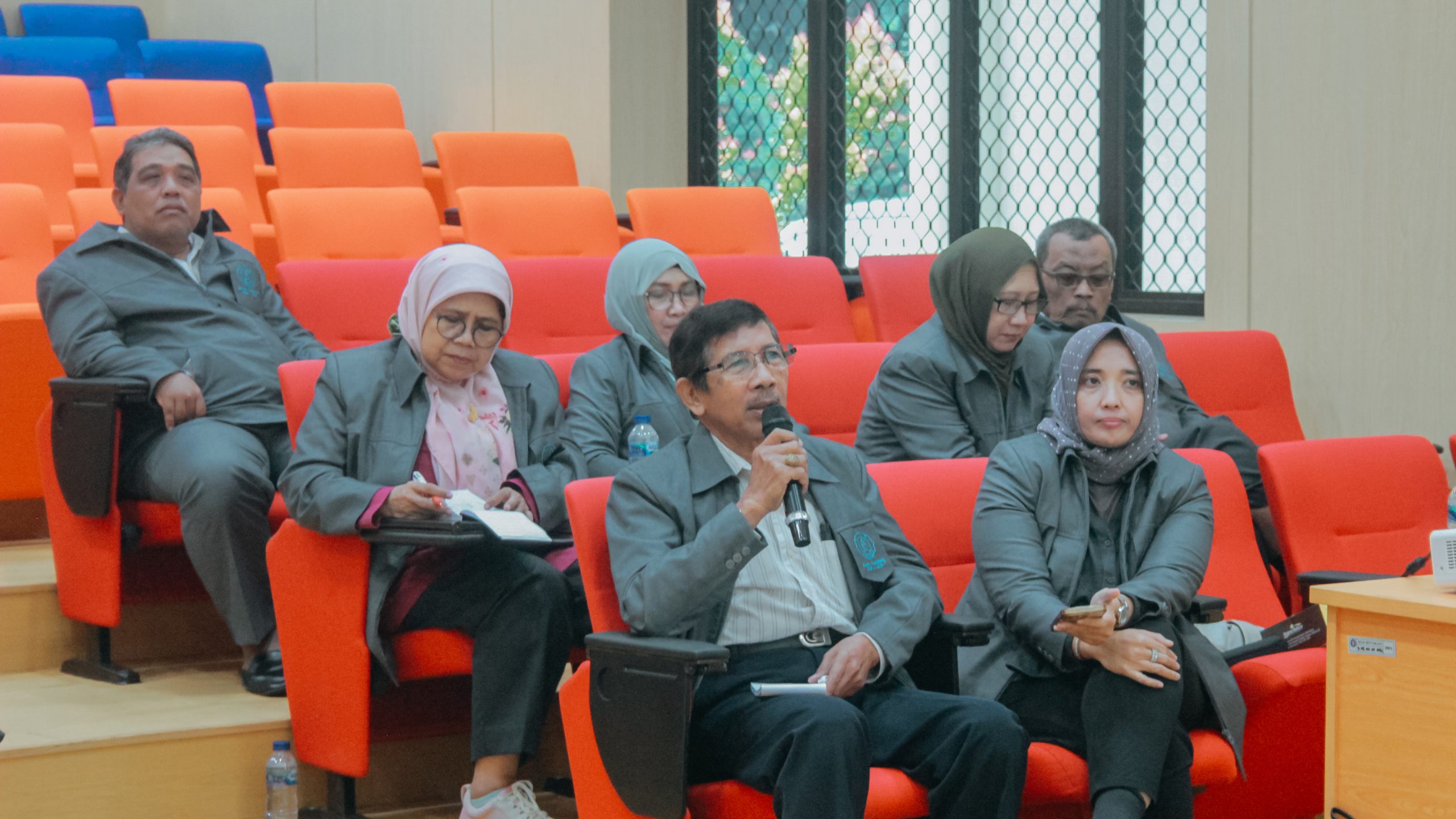
    Senat Akademik (SA) Fakultas Ekonomi dan Bisnis (FEB) Universitas Sebelas Maret (UNS) melakukan kunjungan studi banding ke Senat Fakultas Ekonomi dan Manajemen (FEM) Institut Pertanian Bogor (IPB) pada Kamis, 22 Juni 2023.

    Kepada Media FEB, Prof. Dr. Tulus Haryono, M.Ek., Ketua SA FEB menyampaikan  maksud dan tujuan kunjungan ke Senat FEM IPB adalah dalam rangka studi banding mengenai tugas pokok dan senat fakultas.

    “Dalam kunjungan itu, saya menyampaikan Struktur Organisasi SA FEB UNS dan memperkenalkan seluruh komisi  yang turut hadir di studi banding tersebut,  Komisi A, Akademik, Kemahasiswaan dan Alumni; Komisi B, Keuangan dan Logistik;  Komisi C, Inovasi dan kerjasama dan  yang ke Komisi C,  Komisi Guru Besar”  paparnya.

    Dikatakan, dari kunjungan tersebut secara tidak langsung SA FEB UNS mendapatkan masukan yang banyak terkait tugas pokok dan  fungsi senat fakultas dan juga mendapatkan motivasi yang banyak terkait raihan prestasi FEM IPB.

    Dan tidak kalah penting diusulkan adanya workshop antara Senat FEM IPB dengan FEB UNS terkait dengan membangun Mental Kebangsaan, jika di UNS ada Benteng Pancasila.

    Dr. Dwi Prasetyani, SE, M,.Si, Wakil SA yang juga Plt. Wakil Dekan Akademik, Riset dan Kemahasiswaan FEB UNS menambahkan dalam kunjungan itu SA FEB UNS disambut oleh Dekan FEM IPB,  Dr. Irfan Syauqi Beik dan Ketua Senat FEM IPB, Dr. Ir. Bayu Krisnamurthi, MS.

    Menurutnya, kunjungan ini sangat memberikan manfaat yang besar, selain studi banding, membuka lebar untuk kerjasama antara kedua belah pihak.

    “Kunjungan kemarin itu sangat besar manfaatnya, tujuan awal kita adalah untuk bersilaturahmi, benchmarking, kita juga dapat tawaran kerjasama, jadi gayung bersambut” ungkapnya.

    Banyak hal dibicarakan dalam diskusi yang berlangsung di Auditorium FEM IPB itu. Selain sharing tentang peran dan fungsi Senat di FEM IPB dan SA FEB UNS juga membahas penerapan Merdeka Belajar Kampus Merdeka (MBKM).

    Dari diskusi panjang itu, akan ada tindak lanjut aktifitas diantara keduanya. Ada joint discussion untuk evaluasi MBKM dan harapannya tidak hanya antara Senat FEM IPB dan SA FEB UNS namun juga menggandeng senat di fakultas yang lain. Selain itu akan diadakan dan workshop pengembangan usaha.

    Dibahas juga akan ada forum diskusi yang berlangsung secara hybrid antara alumni FEM IPB dan FEB UNS.

    Usai berdiskusi, SA FEB UNS berkesempatan untuk mengunjungi museum IPB, museum yang diresmikan pada 12 Juli 2023 menggambarkan IPB dari masa lalu hingga masa depan, Museum ini juga sebagai bentuk apresiasi kepada para pendahulu dan juga menjadi titik untuk merancang masa depan.
  • Accounting Study Program FEB UNS Invited Three Alumni in Success Story Sharing Session

    Accounting Study Program FEB UNS Invited Three Alumni in Success Story Sharing Session

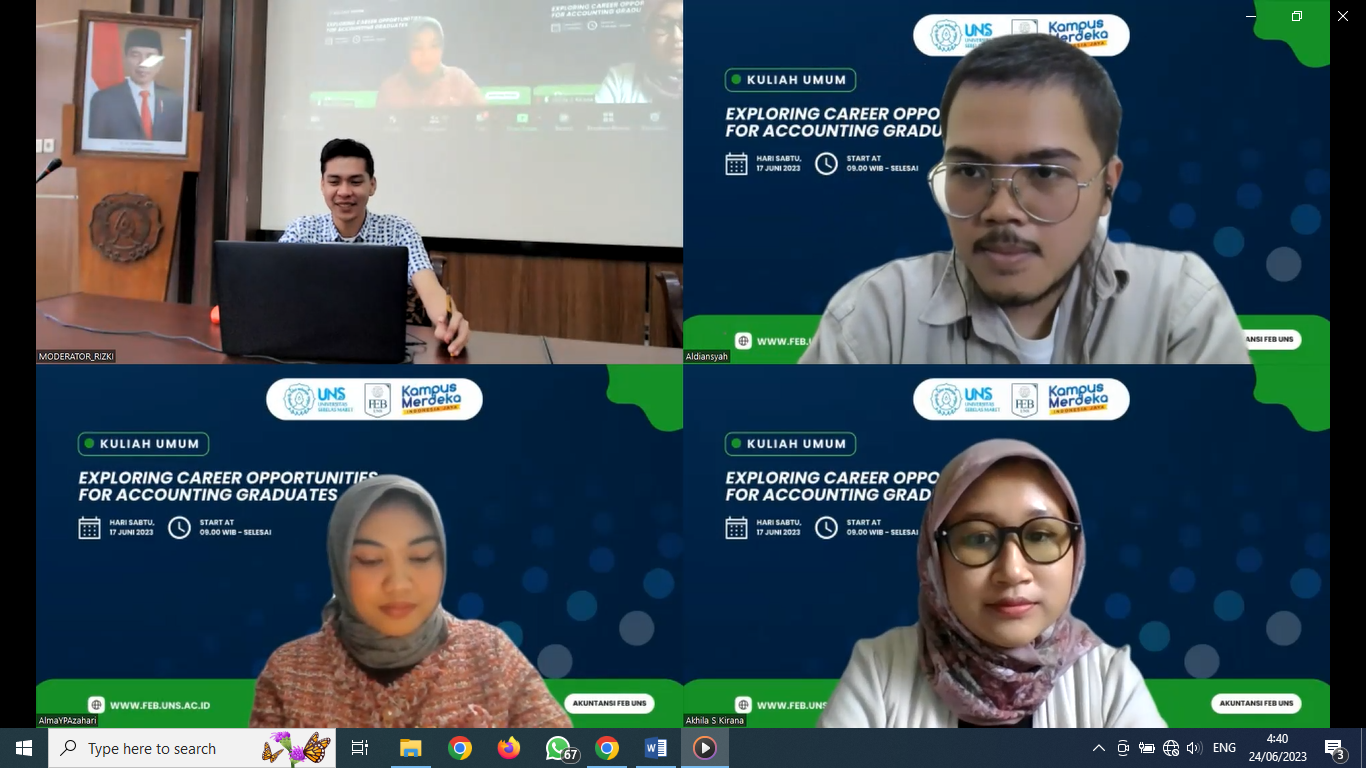
    The Bachelor in Accounting (S1) Study Program, Faculty of Economics and Business (FEB), Universitas Sebelas Maret (UNS) hosted a Public Lecture entitled ‘Exploring Career Opportunities for Accounting Graduates,’ Saturday, June 17, 2023.

    The hybrid event was conducted at Assembly Room 1 of Soeharno TS Building FEB UNS and the Zoom Meeting. The public lecture featured three alumni of the Accounting Study Program alumni, the three were Aldiansyah Syahrizal, Accounting Staff at BUMN ID Food, Akhila Santika Kirana, a Junior Supervisor at OJK, and Alma Yulia Putri Azahari, a Junior Consultant at Baldwin Bayle Group.

    The Plt. (Acting Officer) for the Head of the Accounting Study Program, Prof. Agung Nur Probohudono, S.E., M.Si., Ph.D., Ak., CA., CFrA., expressed his gratitude to all speakers and participants attending the event. “I hope on this occasion, the speakers can share their career experience after graduating from Accounting Study Program, including tips on what to do next after graduating, what soft skills are needed when entering the workforce, and how the recruitment process goes,” he said.
    Afterward, Prof. Agung states that, indeed, the professional sphere is different from the academic world.
    Do all accounting study program graduates have to become an accountant? Are there any other opportunities for the graduates, and how to prepare for these opportunities? These are some of the topics that can be discussed with the three invited alumni.

    The invited speakers mentioned that FEB UNS Accounting graduates now received a Diploma Supplement Certificate, which provides a significant advantage to fresh graduates. Further, also opened up about their study experiences, addressing the question of whether it is enough to only attend lectures each semester, or if joining a student organization is necessary. In short, they are free to share any stories and experiences with their junior. The three speakers shared their experiences starting from graduating as ASP FEB UNS students and pursuing a career as professionals.

    Furthermore, based on the World University Ranking (WUR) by Subject Ranking released in January 2023, FEB UNS Accounting Study Program entered the world’s top 300 study programs and ranked 4th in Indonesia after UNAIR, UI, and UGM. This achievement is an important asset for all fellow ASP FEB UNS students, as a boost of confidence to be FEB UNS graduates, especially from the Accounting Study Program, to be a successful personality in the future.

    Concluding the shared experiences, career preparation is a long-term process, where students must make exhaustive preparation, established a clear goal, never be afraid to learn more and change, and not hesitate to take the opportunity.

  • MESP Study Program Hosted a Spatial Econometrics Workshop

    MESP Study Program Hosted a Spatial Econometrics Workshop

    The Master in Economics and Development Studies Study Program, Faculty of Economics and Business (FEB) Universitas Sebelas Maret (UNS), hosted another workshop this week.

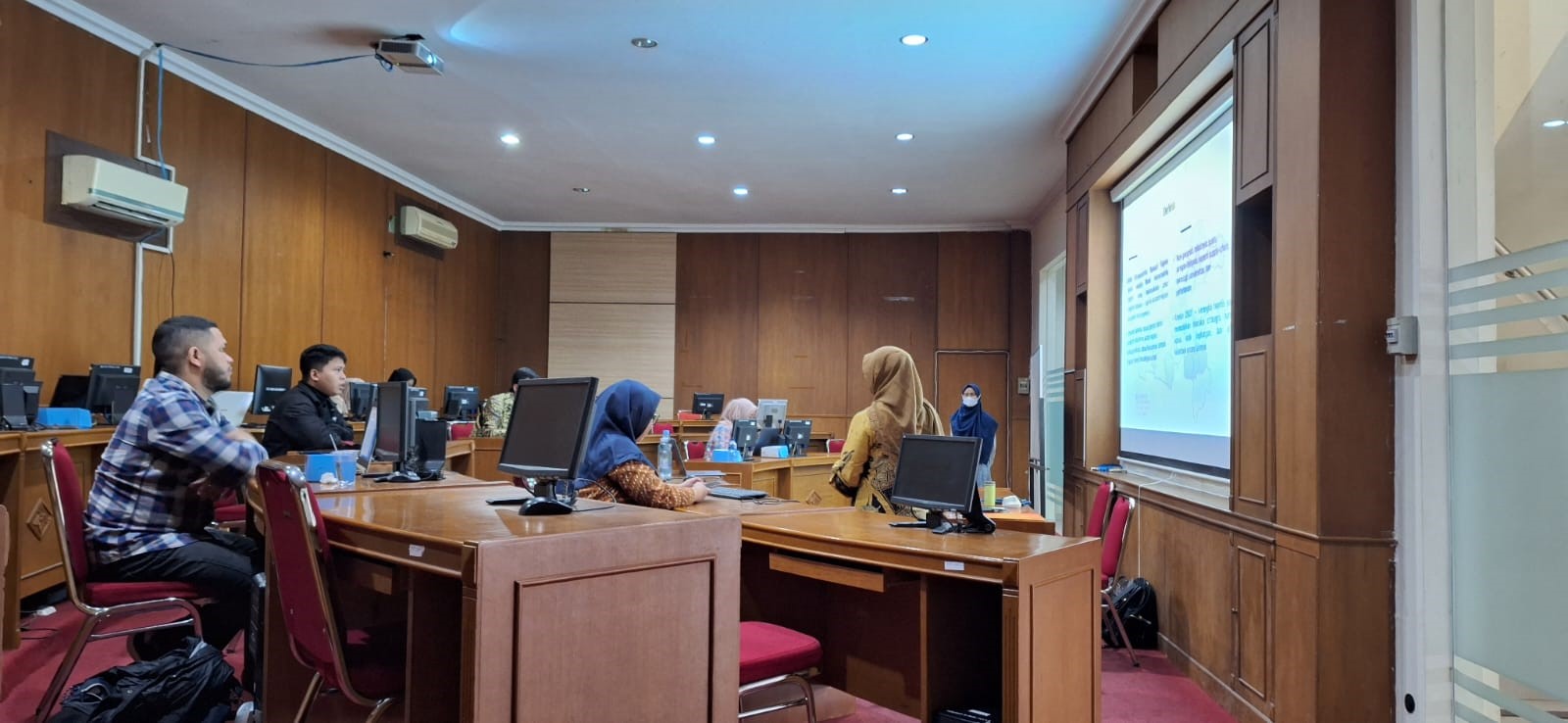
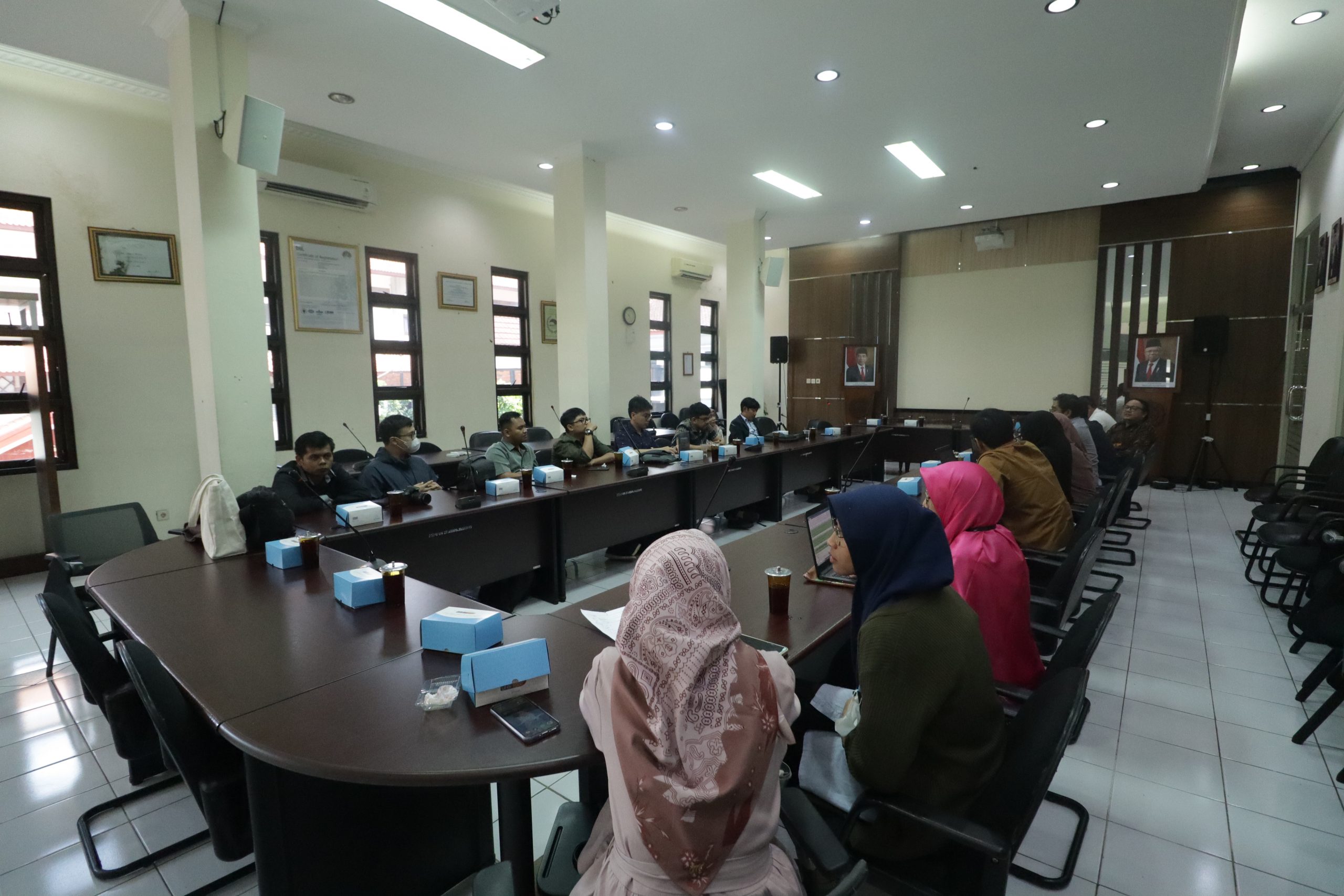
    A Workshop on Stata for Spatial Econometrics was hosted to support student learning, by inviting Dr. Dyah Maya Nihayah, SE, M.Si., the Chairman of the Quality Assurance Division of Universitas Negeri Semarang. The workshop was conducted on Saturday, June 24, 2023, in Teleconference Room Bachtiar Effendi Building FEB UNS and Zoom Meeting.
    In front of a number of MESP students, Dr. Dyah explained Spatial Econometrics in detail. Spatial econometrics is a combination of econometrics and spatial (space), which means the econometric models (regression) that include an abundance of spatial elements in the form of spatial autocorrelation and spatial heterogeneity.

    Spatial econometrics can only be used for cross-section data and panel data. Examples of these data are in the form of geography data between countries, districts/cities, villages, and housing data. These data usually can be found in the form of the PODES and SUSENAS data, while non-geography data are available such as supply chains, technology, universities, and friendships.

    According to Anselin (2001), spatial econometrics is a theoretical framework that models strategic interactions, social norms, the environment, and other equivalent group effects. The first stage of spatial econometrics analysis determines the weighting matrix used as a carrier of the spill-over effect, which is divided into a contiguity matrix and an inverse-distance matrix.

    Then a spatial dependency test is carried out (to determine whether data analysis will be carried out with spatial or non-spatial regression) and the model assumption test is selected, whether to use SLM, SLXM, and SEM. The SLM (Spatial Lag Model) is a model in which variables are dependent on dependent variables observed in neighboring units and on a set of observed local characteristics. SLXM (Spatial Lag X Model) is a model in which dependent variables in a location are related to independent variables in other neighboring or local units. SEM (Spatial Error Model) is a spatial model in which dependent variables depend on a set of observed local characteristics and error terms correlated across space.

  • Presenting Two Speakers, Master of Accounting Study Program Holds Academic Research Workshop in the Artificial Intelligence Era

    Presenting Two Speakers, Master of Accounting Study Program Holds Academic Research Workshop in the Artificial Intelligence Era

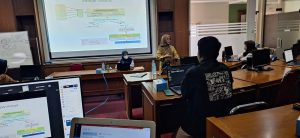
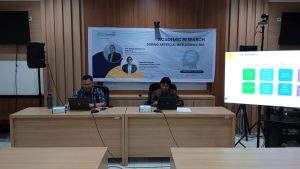
    The Master of Accounting (Maksi) Study Program, Faculty of Economics and Business (FEB), Universitas Sebelas Maret (UNS) hosted an “Academic Research Workshop During Artificial Intelligence Era,” Wednesday, June 21, 2023.

    The hybrid event was held in Teleconference Room Soedarah Soepono Building FEB UNS and Zoom Meeting presented by Rayenda Khresna Brahmana, S.E., M.Sc., Ph.D., Lecturer in the School of Economics, Finance, and Accounting, Coventry University, and Prof. Doddy Setiawan, S.E., M.Sc., Ph.D., Professor at FEB UNS.

    Plt. (Acting Officer) of. the Head of the Master of Accounting Study Program FEB UNS, Dr. Wahyu Widarjo, S.E., M.Si., CRP., CFrA., in his remarks, said that this event is part of regular activities in MAKSI FEB UNS. “We at MAKSI FEB UNS hosted regular activities like this each semester, at least once. In the future, we will try to increase the frequency to host the event twice in one semester under various topics and we strive to invite speakers from one of UNS’ international partners. We hope that this activity can enrich students’ insight and deepen their knowledge,” he explained.

    He further states that the development of technology today develops rapidly, not only in the industrial sector but also in the academic field. One of the phenomena currently developed in the academic field is the use of Artificial Intelligence (AI) in academic research. Of course, most students are familiar with ChatGPT and Google Bard.

    “If we look at the current news, mostly reported on how academics respond to the emergence of AI. We can use that technology but it should not violate academic ethics. Like a knife, if in the hands of the right person it will be used for good activities, for cooking, cutting vegetables, and producing something good. But if it falls into the hands of the wrong person, the knife can be used for bad things, robbery for example, I hope this short description helps,” he explained.

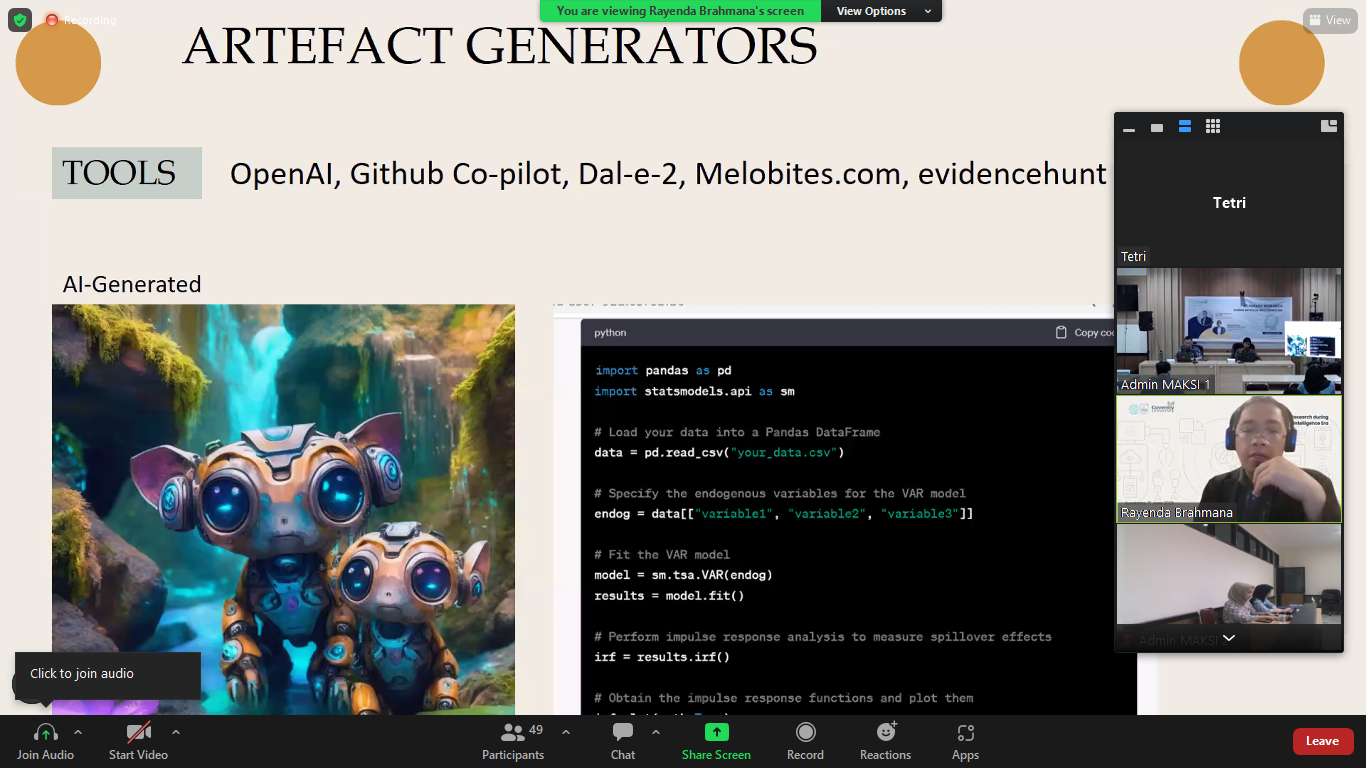
    In his material, Dr. Rayenda explained four topics related to AI, namely traditional VS Contemporary research, Tools Objectives, Practical Examples, and Ethical Issues. He explains that AI tools have been around since the 90s but at different levels. Type 1 is the most basic AI, this type refers to Translation Software, which we often use like Google Translate. Type 2 includes Spellcheckers, Predictive Text, Paraphrasers, Grammar Checks, and Speech to Text (Grammarly, Quillbot, ChatGPT, Dragon). Type 3 includes Essay Boots and Text Generators (Chat GPT, Quillbot, Preplexity.ai, Chimp Writer). While Type 4 AI is the highest level, including Programming Code, Graphics, Artworks, Maths, and Music (Github Co-Pilot, DAL-e-2, Melobites.com).
    Dr. Rayenda said students could take advantage of the technology but shall remain cautious against the use of AI. “I often say, we treat these AI tools as assistants, and assistants are not always right. Thus, we still have to review their responses. Don’t assume that technology can’t be wrong, and just simply copy all the results. Every time I use ChatGPT, I will review the result again, to determine which one is wrong,” he reminded.

    Dr. Rayenda also directly gives some examples of how AI cannot provide a highly reliable result in helping academic tasks. In line with Dr. Rayenda, Prof. Doddy emphasized that AI offers many conveniences to facilitate academic activity, but a review is a must to ensure the quality of work.

    “ChatGPT is very helpful for us, but one thing I would like to emphasize to students, you must have the ability to review the quality of work yourself. The ability to review is very important. For example, literature review-related tasks can be accelerated, but still, you must be able to understand the result independently. Do not let yourself rely too much on Chat GPT, resulting in a contrasting output between your written manuscript and presentation, where you write well but cannot deliver your ideas seamlessly,” he reminded.

  • Prodi S1 Akuntansi Hadirkan Tiga Alumni, Berbagi Pengalaman Sukses

    Prodi S1 Akuntansi Hadirkan Tiga Alumni, Berbagi Pengalaman Sukses

    Prodi S1 Akuntansi Fakultas Ekonomi dan Bisnis (FEB) Universitas Sebelas Maret (UNS) adakan Kuliah Umum bertemakan Exploring Career Opportunities for Accounting Graduates, Sabtu 17 Juni 2023.

    Acara yang digelar secara hybrid di Ruang Sidang 1 Gedung Soeharno TS dan Zoom Meeting itu menghadirkan tiga narasumber alumni Akuntansi FEB UNS, Aldiansyah Syahrizal, Accounting di BUMN ID Food, Akhila Santika Kirana, Junior Supervisor di OJK dan Alma Yulia Putri Azahari, Junior Consultant di Baldwin Bayle Group.

    Plt. Kepala Program Studi S1 Akuntansi, Prof. Agung Nur Probohudono, S.E., M.Si., Ph.D., Ak., CA., CFrA mengucapkan terima kasih kepada narasumber dan  seluruh peserta yang hadir.

    “Saya harapkan di acara kali ini teman-teman narasumber bisa mengeksplor pengalaman karirnya dan bisa dibagikan kepada mahasiswa, setelah lulus dari akuntansi itu arahnya ke mana kemudian tips-tips bagaimana, soft skill yang diperlukan apa saja ketika  nanti masuk di dunia kerja dan bagaimana proses rekrutmennya” ungkapnya.

    Selanjutnya Prof. Agung menyampaikan, setelah memasuki dunia kerja pastinya berbeda dengan dunia kampus. Sebagai seorang lulusan akuntansi apakah harus menjadi akuntan atau berbagai peluang lain dan bagaimana cara mempersiapkannya. Saat ini, lulusan Akuntansi UNS sudah dibekali sertifikat pendamping ijazah, menurut ketiga narasumber apakah itu juga sangat memiliki manfaat.

    Narasumber juga bisa berbagi pengalaman semasa kuliah dulu, apakah cukup belajar menjalani perkuliahan di setiap semesternya apakah juga sangat perlu untuk berorganisasi, silahkan kalian bisa berbagi cerita kepada adik-adik kelas.

    Lebih lanjut disampaikan, berdasarkan pemeringkatan World University Ranking (WUR) by Subject yang dirilis pada Januari 2023,  Akuntansi UNS masuk 300 besar dunia, di Indonesia peringkat 4 setelah UNAIR, UI, dan UGM.

    Adanya pencapaian ini menjadi modal penting untuk teman-teman semuanya untuk bisa percaya diri sebagai lulusan dari FEB UNS, khususnya S1 Akuntansi untuk sukses ke depannya.

    Ketiga narasumber berbagi pengalamannya mulai dari lulus sebagai mahasiswa akuntansi FEB UNS hingga meniti karirnya di dunia kerja.

    Materi ketiga narasumber dapat disimpulkan bahwa persiapan karir itu panjang maka persiapkan dengan baik, pastikan tujuan, jangan pernah takut untuk belajar dan berubah dan jangan ragu untuk mengambil opportunity.

  • Prodi MESP Adakan Workshop Ekonometrika Spasial

    Prodi MESP Adakan Workshop Ekonometrika Spasial

    Program Magister Ekonomi dan Studi Pembangunan Fakultas Ekonomi dan Bisnis (FEB) Univeristas Sebelas Maret (UNS), dalam satu pekan ini kembali menggelar Wokshop.

    Workshop Stata Ekonometrika Spasial diadakan untuk menunjang pembelajaran mahasiswa dengan narasumber Dr. Dyah Maya Nihayah, SE, M.Si. Ketua Penjamin Mutu Universitas Negeri Semarang, Sabtu 24 Juni 2023 di Ruang Telekonferen Gedung Bachtiar Effendi dan Zoom Meeting.

    Dihadapan sejumlah mahasiswa MESP, Dr. Dyah menjelaskan secara detil terkait Ekonometrika Spasial.

    Ekonometrika spasial adalah perpaduan antara ekonometrika dan spasial (keruangan) yang berarti bahwa model ekonometrika (regresi) yang memasukkan unsur limpahan spasial berupa spatial autocorrelation dan spatial heterogenity.

    Ekonometrika spasial hanya bisa digunakan untuk data cross section dan data panel berupa data geografi antar negara, kabupaten/kota, desa/kelurahan dan rumah biasanya berupa data PODES, SUSENAS dll, dan non geografi seperti supply chain, teknologi, universitas dan pertemanan.

    Menurut anselin 2001 ekonometrika spasial adalah kerangka teoritis yang memodelkan interaksi strategis, norma sosial, lingkungan dan efek kelompok setara lainnya.

    Tahapan analisis ekonometrika spasial yang pertama menentukan matriks pembobot yang digunakan sebagai penangkap spill-over effect yang dibagi menjadi contiguity matrix dan inverse-distance matrix.

    Kemudian dilakukan uji dependensi spasial (untuk menentukan apakah akan dilakukan dengan regresi spasial atau non spasial) dan uji asumsi model yang terpilih apakah SLM, SLXM dan SEM.

    SLM (Spatial Lag Model) adalah model dimana variabel dipenden tergantung pada variabel dependen yang diamati di unit tetangga dan pada serangkaian karakteristik lokal yang diamati,

    SLXM (Spatial Lag X Model) adalah model dimana variabel dependen di suatu lokasi berhubungan dengan variabel independen di unit tetangga atau lokal lainnya.

    SEM (Spatial Error Model) adalah model spasial dimana variabel dependen tergantung pada serangkaian karakteristik lokal yang diamati dan error terms berkorelasi melintasi ruang.

  • Hadirkan Dua Narasumber, Prodi MAKSI Gelar Workshop Academic Research During Artificial Intelligence Era

    Hadirkan Dua Narasumber, Prodi MAKSI Gelar Workshop Academic Research During Artificial Intelligence Era

    Program Studi (Prodi) Magister Akuntansi (MAKSI) Fakultas Ekonomi dan Bisnis (FEB) Universitas Sebelas Maret (UNS) menggelar Workshop Academic Research During Artificial Intelligence Era, Rabu 21 Juni 2023.

    Kegiatan yang diadakan secara hybrid di Ruang Telekonferen Gedung Soedarah Soepono dan Zoom Meeting itu menghadirkan Rayenda Khresna Brahmana, S.E, M.Sc., Ph.D., Dosen di School of Economics, Finance and Accounting, Coventry University dan Prof. Doddy Setiawan, S.E., M.Si., Ph.D , Guru Besar FEB UNS.

    Plt. Kepala Prodi MAKSI FEB UNS, Dr. Wahyu Widarjo, S.E.. M.Si.,CRP., CFrA, dalam sambutannya mengatakan kegiatan seperti ini merupakan kegiatan rutin Prodi MAKSI.

    “Kita adakan rutin kegiatan seperti ini setiap satu semester, minimal sekali, kita usahakan dua kali dalam satu semester dengan tema yang beragam dan kita upayakan  salah satu nara sumbernya adalah dari mitra-mitra luar negeri UNS. Harapan kami, kegiatan ini dapat   memperkaya wawasan, memperdalam pengetahuan mahasiswa,” paparnya.

    Dikatakan, perkembangan teknologi saat ini sangat cepat dan pesat sekali, tidak hanya di industri-industri tetapi di bidang akademik juga sangat pesat.

    Salah satu fenomena yang kita ketahui bersama yaitu bagaimana pemanfaatan Artificial Intelligence (AI) di bidang akademik. Tentu mahasiswa semua sudah familiar dengan ChatGPT dan Google Bard.

    “Jika kita lihat pemberitaan-pemberitaan saat ini bagaimana para akademisi menyikapi munculnya AI. Kita boleh menggunakan teknologi itu tapi jangan sampai melanggar etika akademik. Ibarat pisau, jika di tangan orang yang tepat maka akan digunakan untuk aktivitas yang baik, untuk memasak, memotong sayur, menghasilkan sesuatu yang baik tapi jika di tangan orang yang tidak tepat, pisau itu bisa digunakan untuk hal yang tidak baik, menodong misalnya, begitu kira-kira gambaran singkatnya” jelasnya.

    Dalam materinya Dr. Rayenda memaparkan empat agenda terkait AI yakni traditional VS Contempary, Tools Objectives, Practical Examples dan Ethical Issues.

    Dikatakan,  AI tools ini sebenarnya sudah ada sejak tahun 90-an, hanya saja dengan different level.  Tipe 1 adalah yang paling dasar, disebut sebagai Translation Software, yang sering kita gunakan seperti Google Translate. Tipe 2, Spellcheckers, Predictive Text, Paraphrasers, Grammar Checks dan Speech to Text (Grammarly, Quillbot, ChatGPT, Dragon) . Tipe 3, Essay Boots dan Text Generators (Chat GPT, Quillbot, Preplexity.ai, Chimp writer). Tipe 4, adalah level tertinggi, Programming Code, Graphics, Artworks, Maths, Music (Github Co-Pilot, Dal-e-2, Melobites.com).

    Dr. Rayenda mengatakan, mahasiswa bisa memanfaatkan teknologi tersebut tapi ia mengingatkan agar hati-hati dalam penggunaan AI.

    “Saya sering bilang, kita memperlakukan AI tools ini sebagai asisten, asisten itu tidak selalu benar kan. Sehingga kita harus mereviewnya. Jangan gara-gara menganggap teknologi yang tidak mungkin salah, lalu kita copy paste. Setiap saya menggunakan ChatGPT, saya akan review lagi yang mana salahnya” katanya mengingatkan.

    Dr. Rayenda juga langsung memberikan beberapa contoh bagaimana AI tidak mampu melakukan hal yang sepenuhnya tepat dalam membantu tugas-tugas seorang akademisi.

    Senada dengan Dr. Rayenda, Prof. Doddy menegaskan bahwa AI memang sangat memberikan kemudahan bagi para akademisi namun kita harus tetap melakukan review.

    “ChatGPT sangat membantu kita, tapi satu hal yang saya tekankan kepada mahasiswa,  Anda harus mempunyai kemampuan untuk mereview sendiri. Kemampuan untuk mereview itu sangat penting.  Misalnya terkait dengan telaah literatur itu bisa dipercepat, tetapi tetap saja Anda harus bisa memahami sendiri. Jangan sampai Anda terlalu tergantung pada Chat GPT sehingga pada waktu Anda menulis bagus namun nanti pada saat presentasi berlawanan“ tegasnya mengingatkan.

  • Digital Business Study Program UPI Visits Digital Business FEB UNS, Establishes Cooperation

    Digital Business Study Program UPI Visits Digital Business FEB UNS, Establishes Cooperation

    The Digital Business (BG) Study Program, Faculty of Economics and Business (FEB), Universitas Sebelas Maret (UNS), welcomed a visit from the Head of Study Program and Lecturer of Bachelor in Digital Business Study Program (S1 BisDig) Universitas Pendidikan Indonesia (UPI), Friday, June 23, 2023, in Assembly Room 1, Soeharno TS Building FEB UNS.

    The visit was led by the Head of the Digital Business Study Program, Adam Hermawan, S.Kom., M.B.A., and was welcomed by Tastaftiyan Risfandy, S.E., M.Sc., Ph.D., the Vice Dean for Planning, Business Partnership, and Information Affairs, FEB UNS Digital Business Head of Study Program and a number of FEB UNS Digital Business lecturers. In his welcoming remark, Dr. Tastaftiyan welcomes the entourage to UNS Solo and expresses his gratitude and honor to be visited by UPI’s Head of Study Programs and BisDig Lecturers. He states that there are many cooperation opportunities that can be done, such as student exchanges. There are numerous potentials in BisDig UPI Study Program and BG FEB UNS that need to get explored, which later implemented into a cooperation that will be mutually beneficial for both parties.

    Meanwhile, the Head of the BisDig Study Program UPI said that this visit aims to develop cooperation in education activities, research, community service, scientific publications, and other academic activities, including study program management benchmarking.

    “Currently we still have a lot to learn from other Digital Business Study Programs, one of which is to accelerate our objectives, thus, we have to learn a lot from the external environment,” he said.

    Furthermore, Putra Pamungkas, M.Rech., Ph.D., Plt. (Acting Officer) for the Head of FEB UNS Digital Business Study Program shared a short profile of the BG FEB UNS. “BG FEB is a new study program at UNS established in 2020, there are 5 permanent lecturers, and right now we had only our first student batch, this year is the second batch. Alhamdulilah, we received outstanding enthusiasm for the Program, since we are now in a digital era, thus, we see numerous prospective students applying to the study program,” he said.

    Also, this year, the BG Study Program FEB UNS is ranked first in UNS and fifth at the national level for all clusters. In the first batch, BG FEB UNS admitted 60 students for 2 classes, and this year there will be 3 classes available. The BG Study Program has 3 major concentrations, digital finance or financial technology, digital marketing, and digital governance.
    Further, the two study programs discussed various topics, sharing knowledge, and the occasion ended with a cooperation signatory ceremony, signifying a beginning of a collaboration signed by both parties.

  • BUMDes Need to Master Business Management

    BUMDes Need to Master Business Management

    According to Regulation of Mendes-PDTT No. 4 of 2015, a Village-Owned Business Entity is a business entity whose entire or most of its capital is owned by a Village through direct participation derived from Village wealth that is separated to manage assets, services, and other businesses for the maximum welfare of the Village community.

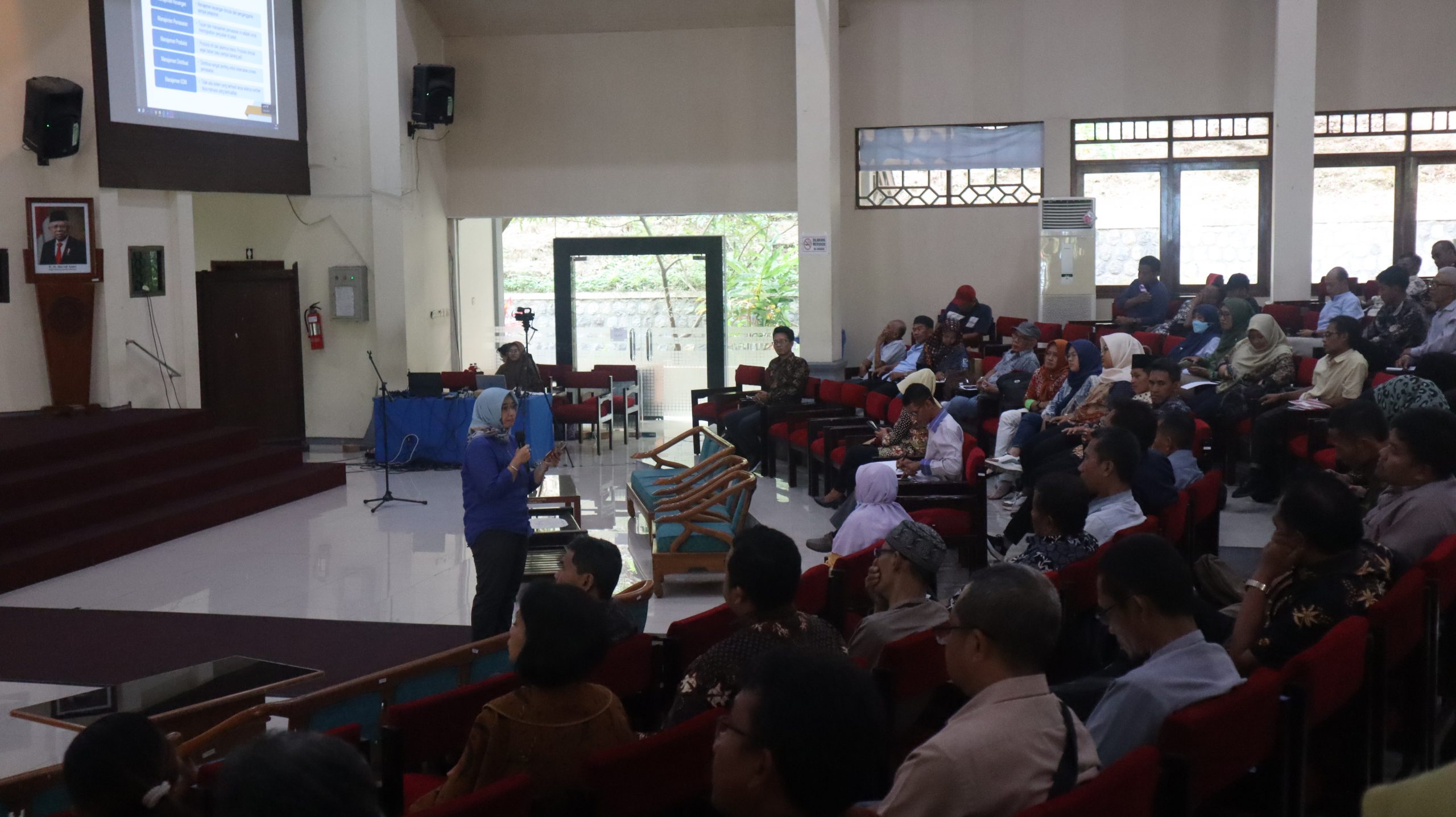
    In order for BUMDes to contribute to increasing village income, it is necessary to set up a good management system. This statement was conveyed by Dr. Dwi Prasetyani, SE, M.Si., Plt. Vice Dean for Research and Student Affairs, Faculty of Economics and Business (FEB), Universitas Sebelas Maret (UNS), as one of the speakers at the Village Empowerment and Village-Owned Enterprises (BUMDes) Workshop, Tuesday 13 June 2023, organized by Puslitdesbangda LPPM UNS.

    In front of 250 BUMDes from Klaten, Karanganyar, Boyolali, and Sukoharjo regions, Dr. Dwi explains the Management and Marketing strategy for BUMDes Products. She said that, in its management, BUMDes must have capabilities in business management including financial management, marketing management, production management, distribution management, and HR management.

    Financial management starts from budgeting to reporting activities, while Marketing Management, to increase sales in the market. As for Production Management, the core of the business process starts from raw materials to finished goods. Distribution Management is very important for the smooth marketing process, while HR Management has the most crucial role, where no system succeeds in the absence of quality human resources.

    According to Dr. Dwi, the marketing concept depends on the character of the product. “In terms of marketing, we have to know the business model of the product. For example, in rural tourism, we talk about several things, whether culinary service is available or not, what kind of crafts we can create, what kind of gifts can be bought by those who will enjoy the products, what involvement will be enjoyed by those who will be our target consumers, how is the ecosystem and so on,” she explained.

    Further, she states that, in principle, whatever business or enterprise we choose, we should have a business model and roadmap. These two will help us to plan on what to do in this year, or what to achieve in the next 2 years.

    “Not only operational, there is a destination, there is a business concept. This can show that, yes, I have achieved my objective because there are indicators of success that have been set since the beginning. Try comparative studies to advanced BUMDes, they must have a roadmap,” she said.

    Furthermore, there are 3 strategies to build a business model, initiation and positioning, branding development, and coaching and monitoring.

  • Bumdes Perlu Kuasai Manajemen Bisnis 

    Bumdes Perlu Kuasai Manajemen Bisnis 

    Menurut Permendes-PDTT nomor 4 tahun 2015, Badan Usaha Milik Desa merupakan badan usaha yang seluruh atau sebagian besar modalnya dimiliki oleh Desa melalui penyertaan secara langsung yang berasal dari kekayaan Desa yang dipisahkan guna mengelola aset, jasa pelayanan, dan usaha lainnya untuk sebesar-besarnya kesejahteraan masyarakat Desa.

    Agar BUMDes dapat berkontribusi untuk meningkatkan pendapatan Desa, maka perlu disusun sistem manajemen yang baik.

    Pernyataan itu disampaikan Dr. Dwi Prasetyani, SE, M.Si:, Plt. Wakil Dekan Riset dan Kemahasiswaan Fakultas Ekonomi dan Bisnis (FEB) Universitas Sebelas Maret (UNS) yang menjadi salah satu narasumber pada  Workshop Pemberdayaan Desa dan Badan Usaha Milik Desa, Selasa 13 Juni 2023 yang diselenggarakan oleh Puslitdesbangda LPPM UNS.

    Kepada 250 Bumdes di wilayah Klaten, Karanganyar, Boyolali dan Sukoharjo, Dr. Dwi menjelaskan perihal Manajemen dan Pemasaran Produk BUMDes.

    Dikatakan, dalam pengelolaannya, BUMDes harus memiliki kemampuan dalam manajemen bisnis meliputi manajemen keuangan, manajemen pemasaran, manajemen produksi, manajemen distribusi dan manajemen SDM.

    Manajemen keuangan dimulai dari penganggaran sampai pelaporan, Manajemen Pemasaran, untuk meningkatkan penjualan di pasar. Manajemen Produksi, inti dari jalannya bisnis yang  dimulai sejak bahan baku sampai barang jadi, Manajemen Distribusi sangat penting untuk kelancaran proses pemasaran dan Manajemen SDM , tidak ada sistem yang berhasil tanpa adanya sumber daya manusia yang berkualitas.

    Menurut Dr. Dwi, konsep pemasaran tergantung karakter produknya.

    ”Dalam hal pemasaran, kita harus mengetahui bagaimana model bisnis dari produknya. Misal desa wisata, kita bicara beberapa hal, tersedia atau tidak kulinernya, lalu kriya apa yang bisa kita create, gift apa yang bisa dibawa oleh mereka yang akan menikmati produk-produk, keterlibatan apa yang akan dinikmati oleh mereka yang akan menjadi target konsumen kita, ekosistemnya bagaimana dan lain sebagainya” paparnya.

    Dikatakan, pada prinsipnya, apapun bisnis atau usaha yang kita pilih mestinya kita harus memiliki model bisnis dan roadmapnya, apa yang harus dilakukan  di tahun ini, apa yang harus dicapai di  2 tahun mendatang.

    ”Tidak hanya mengalir begitu saja, ada yang dituju, ada konsep bisnisnya. Hal ini bisa memperlihatkan bahwa ya saya punya performance karena ada indikator-indikator keberhasilan yang memang sudah diseting sejak awal. Coba studi banding ke bumdes-bumdes yang maju, mereka pasti punya roadmap”ungkapnya.

    Lebih lanjut disampaikan, ada 3 strategi untuk membangun model bisnis, dengan inisiasi dan positioning,  development branding serta pembinaan dan monitoring.